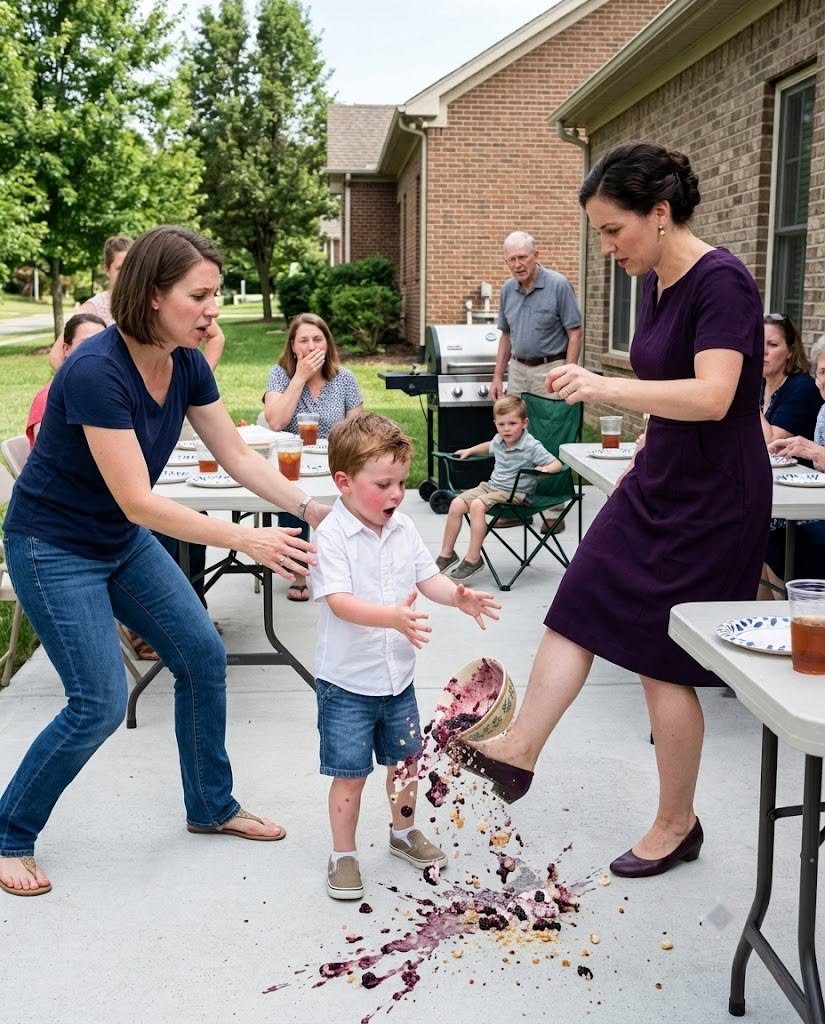
The bowl was still in Luke’s hands when Madeline decided to make a four-year-old carry the weight of an adult secret.
He had walked across the backyard patio slowly, concentrating so hard that his small shoulders rose toward his ears.
The blackberry cobbler was warm, the cream was beginning to soften, and both of his hands were wrapped around the prettiest ceramic bowl I had found in the kitchen.

“Grandma, I brought you some cake,” he said. “My mommy made it for you.”
Twenty relatives were close enough to hear him.
A few smiled.
One cousin whispered that he looked so grown-up.
For one second, Madeline looked as though she might take the bowl simply because there were witnesses.
Then her mouth tightened.
“Don’t ever call me Grandma again,” she said. “You are not this family’s grandson.”
Luke blinked at her.
Madeline lifted one foot and kicked the bowl out of his hands.
The ceramic hit the patio and broke with a hard crack.
Cream splashed across Luke’s shins, blackberry filling streaked the concrete, and a broken piece spun beneath a lawn chair.
The Bluetooth speaker on the porch rail kept playing a bright summer song while the entire backyard seemed to forget how to breathe.
Luke did not cry immediately.
His hands remained lifted in front of him, empty now, and his eyes moved from the shattered bowl to Madeline’s face.
“Mommy,” he whispered, “did I do something bad?”
I reached him before anyone else moved.
I pulled him against my chest, felt the sticky cream soak into my jeans, and held the back of his head while the first sob shook through him.
“No,” I said. “You did nothing wrong.”
I wanted to scream at Madeline.
I wanted to demand that every person on that patio explain why a child had been left standing alone in the middle of their silence.
Instead, I kept my voice steady because Luke needed one adult in that backyard to make sense.
That Thursday had started at 6:18 in the morning in the same Nashville house where Brandon had grown up.
Madeline treated the brick home, the deep porch, and the backyard as if they were proof that she had built a perfect family.
I had been in her kitchen before sunrise, rinsing blackberries and simmering brown sugar with cinnamon.
Luke stood beside me on a plastic step stool with flour on his fingers and his hair combed neatly to one side.
Blackberry cobbler was Brandon’s favorite family dessert, and Luke had begged to help.
At 9:43, I blew on a spoonful and let him taste it.
Purple filling marked the corner of his mouth when he smiled.
“It’s yummy, Mommy,” he said. “Do you think Grandma will love me now?”
I turned toward the sink and rinsed the spoon much longer than necessary.
Madeline had never treated Luke like her other grandchildren.
She did not save his drawings.
She did not ask about preschool.
She never reached for him when he ran into a room calling her Grandma.
Brandon said she was complicated because that was the word he had learned to use when he was young and still depended on her approval.
I had stopped translating cruelty into something polite.
Still, children do not understand emotional history.
They understand who kneels to tie their shoes, who saves them a seat, and who smiles when they offer a gift.
Luke kept trying because nobody had told his heart to stop.
By noon, the patio was crowded with folding chairs, paper plates, sweet tea, and relatives moving between the grill and the sliding door.
Madeline came outside last in a dark purple dress with her hair pinned high and gold earrings moving against her neck.
She greeted everyone with the polished warmth she wore in public.
Then she saw Luke beside me, and the warmth vanished.
Brandon had gone inside to help his father find an extension cord when I filled the small bowl and placed it in Luke’s hands.
“Carry it carefully,” I told him.
He nodded as if I had trusted him with something important.
I had.
I had trusted the adults around him to behave like adults.
After Madeline kicked the bowl, that trust broke as cleanly as the ceramic.
Luke buried his face against me and sobbed, “Why doesn’t Grandma want me?”
Before I could answer, Brandon came through the sliding door.
He saw the cobbler on Luke’s legs, the broken bowl near my shoe, and his mother standing over us with her arms folded.
His face changed.
“Mom,” he said, “what did you just do to my son?”
Madeline did not look embarrassed.
She looked prepared.
“Your son?” she asked. “Are you sure you can call him that?”
The question landed differently on Brandon than it did on me.
I saw it in the way he went still.
This was not the first time she had planted doubt and then stood back to watch it spread.
During my pregnancy, she had made comments about Luke’s due date.
After he was born, she compared his hair, his eyes, and even the shape of his hands to Brandon’s.
Whenever Brandon challenged her, she laughed and said she was only joking.
That afternoon, she finally said the quiet part in front of everyone.
At 12:27 p.m., Brandon stepped between his mother and our son.
“I’m asking you to leave my house,” he said. “Right now.”
A relative murmured his name.
Someone else told him not to make a scene, as if the scene had started when he set a boundary and not when a grown woman kicked food from a child’s hands.
Madeline remained calm.
She looked almost relieved.
Then Luke’s crying changed.
The sound tightened, and he pressed one small hand against his chest.
“Mommy,” he said, “it hurts.”
His face lost color so quickly that every other argument disappeared.
Brandon turned and struck his shoulder against the patio table.
I lifted Luke, felt his body curl toward mine, and heard broken ceramic crunch beneath my shoe.
“I can’t breathe good,” he whispered.
We did not wait for Madeline to leave.
Brandon grabbed the keys, and I carried Luke through the house while relatives moved out of our way too late to be useful.
The drive to the hospital felt longer than any drive I had ever taken.
I sat beside Luke in the back seat, counting his breaths and telling him to look at me.
Brandon kept both hands on the wheel, but his right cuff was still marked with dried blackberry filling from when he had picked up Luke’s shoe.
At the intake desk, a nurse checked Luke’s pulse and moved us ahead.
Adhesive leads were placed on his chest while I held his hand.
He looked very small on the hospital bed.
Brandon stood near the foot rail, trying to answer questions about family medical history.
“No known heart problems,” he said. “I had panic attacks as a kid, but that’s all.”
The nurse stopped typing.
She looked at the screen, then at Brandon.
“Were you treated in this hospital system as a child?”
He nodded slowly.
“My mother brought me here a few times.”
The nurse opened a linked record and read for several seconds.
“Mr. Carter,” she said carefully, “your childhood chart does not describe panic attacks.”
Brandon stared at her.
She turned the monitor slightly.
The record described repeated episodes of an abnormal heart rhythm, including one visit after Brandon had fainted at school.
A note warned that the pattern might run in families and should be disclosed if he ever had children.
Beneath that recommendation was a scanned page signed by Madeline.
The follow-up had been declined.
Brandon read the page three times.
“My mother told me there was nothing wrong with my heart,” he said.
The nurse did not accuse anyone.
She only explained that the doctor needed an accurate family history so Luke could be evaluated safely.
That narrow sentence did what every argument on the patio had failed to do.
It made Madeline’s secrecy practical instead of theoretical.
Her lie was no longer only about shame, control, or the cruel things she said when she thought she could get away with them.
It had followed her son into adulthood and reached her grandson’s hospital bed.
Luke was stable, but the doctor wanted to monitor him and compare the child’s results with Brandon’s older records.
While we waited, Brandon’s phone began vibrating on a plastic chair.
Madeline was calling.
He ignored the first call.
Then the second.
On the fourth, he answered and put the phone on speaker.
His mother did not ask how Luke was doing.
“Before you believe whatever they tell you,” she said, “there’s something about your childhood you were never supposed to find out.”
Brandon closed his eyes.
“What did you hide?”
Madeline began with excuses.
She said she had been young.
She said families were different then.
She said she had tried to protect him from gossip.
Brandon interrupted her.
“What did you hide?”
The room was quiet except for the monitor beside Luke’s bed.
Finally, Madeline said the man Brandon had called Dad all his life was not his biological father.
The sentence seemed to leave the air and take part of Brandon with it.
He gripped the back of the plastic chair until the tendons stood out in his hand.
I reached for him, but he kept his eyes on the phone.
“Who was?”
Madeline named a man she had known briefly before her marriage settled into the life everyone else believed was perfect.
She admitted that he had experienced fainting spells and had died young after a sudden heart event.
She had never put that history in Brandon’s records because doing so would have raised questions she refused to answer.
When doctors warned her that Brandon’s symptoms might be inherited, she declined follow-up and later told him the episodes were anxiety.
“Why would you do that?” Brandon asked.
“I was protecting the family,” she said.
I looked at Luke on the bed.
A child who had carried her a bowl with both hands was now attached to a monitor because she had decided her reputation mattered more than medical truth.
Brandon’s voice became very quiet.
“You were protecting yourself.”
Madeline shifted immediately from confession to blame.
She said I had turned him against her.
She said Luke’s episode had probably been caused by excitement.
She said the hospital was trying to scare us.
Then she returned to the accusation she had made on the patio and suggested that none of this proved Luke was Brandon’s biological son.
Brandon did not shout.
He looked at our child, then at me.
“Luke is my son,” he said. “He was my son before this call, and he will be my son after it.”
Madeline tried to speak, but he continued.
“The only person who lied about a father today was you.”
For the first time, she had no quick answer.
Brandon asked her for every fact she knew about his biological father’s medical history.
She resisted.
He told her that if she refused, he would tell his father and every relative who had been on the patio exactly why Luke’s doctors lacked information.
That choice belonged to Brandon.
No nurse made it for him.
No relative rescued him.
He stopped protecting the woman who had built her authority from everybody else’s silence.
Madeline finally gave him the information she had.
The doctor took only what was medically relevant and told us the rest could wait.
Luke remained under observation for several hours.
By evening, his color had returned, and he was asking whether the stickers on his chest would hurt when they came off.
I promised we would remove them slowly.
Brandon sat beside him and peeled one corner at a time while Luke held my fingers.
The hospital did not give us a dramatic ending.
It gave us instructions, follow-up appointments, warning signs to watch for, and a plan to make sure both Luke and Brandon received proper evaluation.
That ordinary plan felt more loving than anything Madeline had done in years.
Brandon called the man who had raised him from the hospital hallway.
He did not make the conversation theatrical.
He told him the truth as gently as he could and explained why the information had come out.
His father was silent for a long time.
Then he asked one question.
“Is Luke okay?”
Brandon leaned against the wall and covered his eyes with one hand.
“He’s stable.”
“Then stay with your boy,” his father said. “We’ll deal with the rest when you’re ready.”
That response did not erase the betrayal.
It did, however, clarify who understood what being a father required.
When we returned home, pieces of the bowl were gone from the patio, but a dark blackberry stain remained near the lawn chair.
Several relatives had sent messages.
Some apologized for freezing.
Some defended Madeline by saying she had been under stress.
One aunt wrote that the whole family needed time before anyone made permanent decisions.
Brandon read the messages once.
Then he created a group reply.
He did not share private medical details that belonged to him or Luke.
He wrote that his mother had publicly humiliated a four-year-old, questioned his place in the family, and withheld important family health information for years.
He said Luke would not be around anyone who treated him as negotiable.
He also said nobody was welcome to pressure us into a private reconciliation designed to protect Madeline’s image.
The message ended with one boundary.
Madeline would have no contact with Luke unless Brandon and I both decided otherwise, and there would be no discussion of that decision in front of our child.
Some relatives left the group chat.
Others finally admitted that Madeline had been making comments about Luke for years.
Their late honesty did not impress me.
Silence has a cost even when the person staying silent never throws the first blow.
A week later, Madeline came to our house without calling.
She stood on the porch and knocked until Brandon opened the inner door but left the storm door locked.
She looked smaller without an audience.
“I made a mistake,” she said.
Brandon shook his head.
“A mistake is forgetting a birthday. You kicked a bowl out of my son’s hands and told him he did not belong.”
She said she had been angry with me.
Brandon answered, “Then you chose a child as your weapon.”
Madeline’s eyes moved past him, searching for Luke.
Brandon shifted so she could not see into the living room.
She asked whether he was really going to cut off his own mother.
He looked at her for a long moment.
“You taught me that blood was the only thing that made a family,” he said. “Then the hospital showed me you had lied about mine.”
Madeline’s mouth tightened.
Brandon did not insult her.
He did not threaten her.
He told her to leave the porch.
This time, there were no relatives asking him not to make a scene.
There was only the locked door, the ordinary neighborhood street, and a father choosing what could enter his home.
Luke recovered from the immediate episode, but the follow-up did not end after one appointment.
He and Brandon both began receiving the evaluation Madeline had avoided years earlier.
We learned how to watch for symptoms, what information to carry, and what questions to ask.
I kept a copy of the family history in a plain folder near our car keys.
Brandon stopped calling his childhood episodes panic attacks.
Naming the truth did not make him weak.
It gave him a chance to take care of himself and his son.
The emotional part took longer.
For several weeks, Luke would not carry a bowl without asking whether someone might kick it.
He stopped saying the word Grandma.
One evening, while I was washing dishes, he asked, “Am I still in Daddy’s family?”
Brandon heard him from the hallway.
He came into the kitchen, knelt until they were eye to eye, and placed both hands gently on Luke’s shoulders.
“You are my family every day,” he said. “Not because somebody gives you permission. Because I am your dad, and I choose you in every room.”
Luke studied his face.
“Even when I spill stuff?”
“Especially then,” Brandon said.
A month after the patio gathering, Luke asked if we could make blackberry cobbler again.
I almost said no.
The smell still brought back the crack of ceramic and the sight of twenty adults looking away.
Then Luke carried the mixing bowl to the counter himself.
We baked it in our own kitchen.
He stood on the same plastic step stool, stirred the berries, and stole one warm taste from the spoon.
That evening, he carried a small bowl to the table.
His hands shook a little, so Brandon reached out and steadied the bottom without taking it away from him.
Luke set it down safely.
Brandon took the first bite.
“This is the best cake I’ve ever had,” he said.
Luke smiled.
The old bowl could not be repaired, and we did not try.
Some broken things should not be glued back together simply because they once belonged to a family.
We bought a new bowl, kept the hospital folder by the keys, and built a quieter life around the people who understood that love is not a title someone gets to demand.
It is what they do when a child walks toward them with both hands full.
