The first time my eight-year-old daughter told me her bed felt smaller in the morning, I was standing at the stove trying to keep breakfast from burning.
Ham hissed in the skillet while the kitchen fan rattled over my head with the same loose-metal sound I had been promising myself I would fix for three months.
The linoleum was cold through my work socks, my coffee was already lukewarm, and I was doing the kind of math single parents do before sunrise.

How much gas was left in the car.
Whether the school supply balance could wait until Friday.
How many minutes late I could be before my supervisor decided it was becoming a pattern.
Valerie sat at the table with one sneaker on and one sneaker off, turning her spoon around in a bowl of cereal she had barely touched.
“Mom, my bed was really cramped again.”
I kept my eyes on the skillet.
“You move around in your sleep, sweetie.”
“No,” she said. “At night there’s space. When I wake up, there isn’t.”
I remember making a little sound that was supposed to mean I was listening.
I was not.
I thought she meant the stuffed animals crowded along the wall, or the bunny blanket twisting around her legs, or one of those dreams that feels physical for a few minutes after you wake up.
Children say strange things with complete confidence.
They tell you the hallway light is whispering.
They tell you a shadow moved because it likes them.
They tell you the moon followed the car home.
Most of the time, you smile, explain what you can, and keep moving because lunches still need packing and shoes still need tying.
That was what I did.
I slid the ham onto a paper towel, checked the time, and told Valerie to finish getting dressed.
She did not bring up the bed again until the next morning.
“Mom, it got small again.”
This time I looked at her.
She had slept in her room alone for almost two years, ever since she announced that my snoring made the mattress shake.
Valerie was not fearless, but she was practical.
She checked under the bed once before going to sleep because that was the rule we had made when she was five, then she climbed under the blanket and asked me to leave the hallway light on a crack.
She did not invent elaborate monsters.
She did not cry to sleep in my room.
Even when she had the flu, she chose a bucket beside her own bed over sharing mine.
So when she said the bed was smaller, I assumed she had been rolling toward the wall.
“You’re probably moving in your sleep,” I told her.
“I’m not.”
“You wouldn’t know if you were asleep.”
She frowned at that, not angry, just dissatisfied with an answer that did not match what she felt.
The third morning, she said she had woken up almost on the edge.
The fourth morning, I knelt in the hallway to tie her school shoes while she leaned against the wall and watched my hands.
“Someone is pushing me even though I can’t see them,” she said.
My fingers stopped on the laces.
The house was quiet except for the dryer tumbling in the laundry room and a truck starting somewhere down the cul-de-sac.
“Who is pushing you?”
Valerie lifted one shoulder.
“I don’t know.”
“Did you see somebody?”
“No.”
“Did you hear the door?”
“No.”
“Then why do you think someone pushed you?”
She stared at the floor between us.
“It feels like someone else was already lying there first.”
That sentence went through me differently.
It did not sound like a child describing a nightmare.
It sounded like a child trying to explain something she did not have words for.
I stood up too fast and nearly lost my balance.
Valerie watched me, waiting for the moment when I would laugh or tell her not to be silly.
I did neither.
“Show me exactly where,” I said.
We went back into her room.
Morning light came through the cloud-print curtains and turned the lilac walls pale gray.
The room looked ordinary in the way a familiar room can look almost insulting when you are suddenly afraid of it.
Her dolls sat in a row on the shelf.
A sweatshirt hung over the desk chair.
The fan beside the bed was off.
The twin mattress was pushed against the wall, and the bunny blanket was folded crookedly near the foot.
Valerie climbed onto the bed and pointed to the open side.
“There.”
I pressed both hands into the mattress.
The springs gave evenly.
I checked the frame.
I pulled the mattress halfway off and examined every wooden slat.
I opened the closet, moved a plastic bin of winter clothes, and ran my hand along the back wall.
I got down on my knees and looked under the bed with my phone flashlight.
There were two missing crayons, a sock, dust, and nothing else.
I tested the window latch.
I checked the ceiling vent.
I even pushed on the wall as if some hidden panel might open because that was the kind of idea fear gives you when logic has already failed.
Nothing moved.
Nothing explained the pressure she felt.
The only device in the room was the security camera sitting on top of the closet.
I had installed it six months earlier after someone tried to force open the back door of the house across the street.
The police had driven through the neighborhood for a few nights, and then everything went back to normal.
But normal had changed for me.
I was a single mother in a place where neighbors noticed when your porch light stayed on and whether you brought home groceries in three bags or one.
Fear had become another utility bill.
It arrived every month whether I could afford it or not.
The camera was supposed to make me feel better.
Most nights, I forgot it was there.
I checked the app once before bed, saw Valerie sleeping, and closed it.
That morning I opened the app history and scrolled through the motion alerts.
There were clips of me putting away laundry.
A clip of Valerie hopping into bed.
A clip of the curtain moving when the fan turned.
Nothing after midnight.
Nothing that showed anyone entering.
“See?” I said, trying to sound relieved. “Nobody came in.”
Valerie looked at the mattress.
“I didn’t say they came in.”
I carried that line to work with me.
It returned while I stocked supplies.
It returned while my supervisor reminded me about clock-in times.
It returned while I sat in the car during lunch and checked the camera app twice, even though Valerie was at school and the room was empty.
By the time I got home, I had almost convinced myself I was feeding her fear by taking it seriously.
Then Julie spoke to me over the backyard fence.
I was pulling dry towels from the clothesline because the dryer had started making a burning smell again.
Julie had lived next door longer than we had.
She knew which mornings Valerie missed the bus, which weeks I worked late, and when our cat had been gone long enough to make me worry.
“Is Valerie sick?” she asked.
“No. Why?”
“She looked exhausted this morning.”
The clothespin stopped between my fingers.
Julie must have seen something change in my face because she lowered her voice.
“Nothing bad,” she said quickly. “Just tired. Dark circles.”
I looked toward the kitchen window.
Valerie was inside at the table, bent over her homework.
From that distance she looked small and normal.
Then she raised her head and glanced toward the hallway.
Not toward me.
Toward her room.
She held that look for two seconds, then bent back over the page.
I started replaying the last week.
She had been quieter at breakfast.
She had stopped asking for music in the car.
Twice I had found her asleep on the couch before dinner.
Every morning, before she sat up, she looked at the empty side of the bed as if she needed to confirm something had left.
I had noticed each thing separately.
Together, they formed a shape I could no longer ignore.
That evening I made chicken noodle soup because it was easy, warm, and one of the few meals Valerie would eat without negotiation.
She did her homework at the kitchen table while I checked the locks again.
I asked whether anything had happened at school.
She said no.
I asked whether someone had scared her.
She said no.
I asked whether she wanted to sleep in my room.
She gave me the same offended look she always gave me when I suggested it.
“You snore.”
For a second, I almost laughed.
The sound came out thin.
After dinner, I washed her hair and brushed it while she sat cross-legged on the bathroom counter.
I checked her scalp for bumps.
I checked her arms for bruises.
I asked whether she had been sleepwalking.
She said she did not know how she would know that.
It was a fair point.
At bedtime I tucked the bunny blanket around her waist and adjusted the fan so it would not blow directly on her face.
The room smelled faintly of shampoo and dust warmed by the small lamp.
When I leaned over to kiss her forehead, she caught my wrist.
Her hand was cold.
“Are you going to watch the camera tonight?”
“Why?”
She did not look at me.
Her eyes stayed on the wall.
“Because last night I heard someone breathing.”
The fan turned toward us with a soft click.
From the kitchen came the low mechanical hum of the refrigerator starting.
The ordinary sounds made her words worse.
“Where did you hear it?”
Valerie swallowed.
“On my pillow… but on the other side.”
I looked at the second pillow.
It was not really a second pillow.
It was the one she used when she read in bed, usually shoved beside the wall or dropped on the floor.
That night it lay flat on the open half of the mattress.
I picked it up and squeezed it.
Nothing inside.
No smell.
No dampness.
No strange mark.
I put it back because removing it felt like admitting something.
“Did the breathing say anything?”
“No.”
“Did you turn around?”
“No.”
“Why not?”
Her fingers tightened around my wrist.
“Because I thought if it knew I was awake, it would move closer.”
That was when I stopped trying to explain it.
I kissed her forehead and told her I would watch.
I left the hallway light on and pulled her door almost closed, exactly the way she liked it.
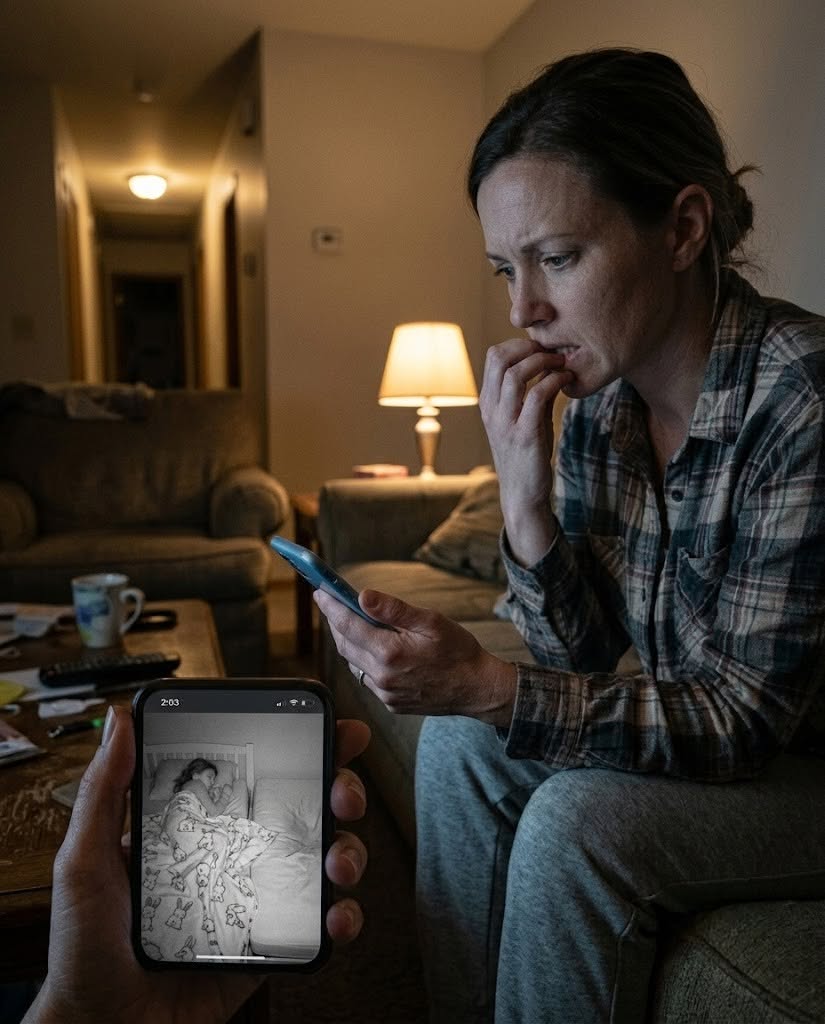
Then I went downstairs and opened the camera app.
At 10:00 p.m., Valerie was still awake.
At 10:17, she rolled onto her side.
At 10:31, her breathing became slow and even.
I watched for another twenty minutes, then carried the phone with me while I cleaned the kitchen.
Every small sound sharpened.
The pipes clicked.
The ice maker dropped a tray.
A car door slammed two houses down.
At 11:40, I checked the back lock.
At midnight, I checked the windows.
At 12:18, I walked halfway up the stairs and listened.
Nothing.
I returned to the couch.
The camera feed showed Valerie curled toward the wall with the bunny blanket at her waist.
A thin blade of light glowed beneath the bedroom door.
The image was black and white, the way night-vision video always is, and the familiar objects looked flatter and less trustworthy.
The dolls on the shelf became pale faces.
The curtain looked like a hanging figure whenever the fan moved it.
I knew those were tricks of light.
I told myself that repeatedly.
At 1:00 a.m., I made coffee.
At 1:30, I checked the back door again.
At 1:47, I almost woke Valerie and brought her downstairs.
I did not because I was afraid of teaching her that fear itself was proof.
At 2:00, the coffee had gone cold.
Both hands were still wrapped around the mug.
My shoulders hurt from holding them too high.
Nothing had happened.
That should have relieved me.
Instead, I began to feel foolish.
I imagined telling Julie that I had stayed awake watching a mattress.
I imagined calling in late because my daughter thought an invisible person was taking up space in her bed.
I imagined the expression on my supervisor’s face.
Then the clock on my phone changed to 2:03.
The picture shifted.
At first I thought the camera had moved.
The view seemed to dip slightly at one side, and a thin line of shadow changed along the bottom of the bed.
I leaned closer.
The camera had not moved.
The closet shelf had not moved.
The room had not moved.
The bed had.
Valerie remained curled toward the wall.
Her body was completely still.
The open side of the mattress began to lower.
Not suddenly.
Not with the bounce of a child turning over.
It sank slowly and evenly, as though weight were being placed on it a little at a time.
My fingers tightened around the mug.
The depression deepened.
The fitted sheet pulled taut across the empty space.
There was no person.
There was no animal.
There was nothing I could see pressing down.
I brought one hand to my mouth.
On the screen, Valerie moved without waking.
Her shoulders drew inward.
Her knees came closer to her chest.
She slid another inch toward the wall as if her sleeping body understood the danger before her mind did.
The empty pillow beside her changed shape.
Its center pressed downward.
The edges lifted slightly.
It looked exactly like a head had settled into it.
I bit the side of my hand to keep from screaming.
The pain was sharp and real.
The image was neither.
I wanted the camera to glitch.
I wanted the feed to freeze.
I wanted the mattress to spring back and prove that exhaustion had turned pixels into a story.
Instead, the audio meter jumped.
A breath came through my phone.
Slow.
Close.
The sound was not loud.
That made it worse.
It was the quiet, measured breath of someone already comfortable.
Another breath followed.
Valerie pressed harder against the wall.
The space between her back and the sinking pillow disappeared.
My body finally moved.
I put the mug down too hard, spilling coffee across the table.
Before I could stand, the bunny blanket lifted from the empty side of the mattress.
It rose six inches and held there.
The fabric folded inward as if invisible fingers had gathered it.
Then it began to draw across the bed toward my daughter.
I dropped the mug.
It struck the rug and rolled, sending coffee in a dark line beneath the table.
I ran.
The hallway seemed longer than it had ever been.
I hit the stairs with one hand on the railing and the phone clenched in the other.
On the screen, the mattress was still depressed.
The blanket was still moving.
“Valerie!”
Her bedroom door was closed.
I knew I had left it open a crack.
I reached the landing and grabbed the knob.
A faint vibration traveled through the metal into my palm.
It felt like pressure from the other side.
Then it stopped.
I shoved the door open.
The fan turned toward me and clicked.
Valerie was awake, pressed flat against the wall with one hand over her mouth.
The bunny blanket lay across the bed again.
The pillow beside her was still dented.
I crossed the room and lifted her into my arms.
The instant her feet left the mattress, the empty side of the bed rose with a long, slow creak.
Valerie buried her face against my shoulder.
“Did you see it?” she whispered.
“Yes.”
Her fingers tightened in my shirt.
“No, Mom. Did you see where it went?”
I looked at the bed.
The pillow had gone flat.
The sheet was smooth.
The closet door stood open by less than an inch.
I knew I had shut it before she went to sleep.
Valerie lifted her head.
She was not looking at the closet.
She was staring past me toward the hallway.
Her face changed before she spoke.
“Mom,” she breathed, “it isn’t in the bed anymore.”
