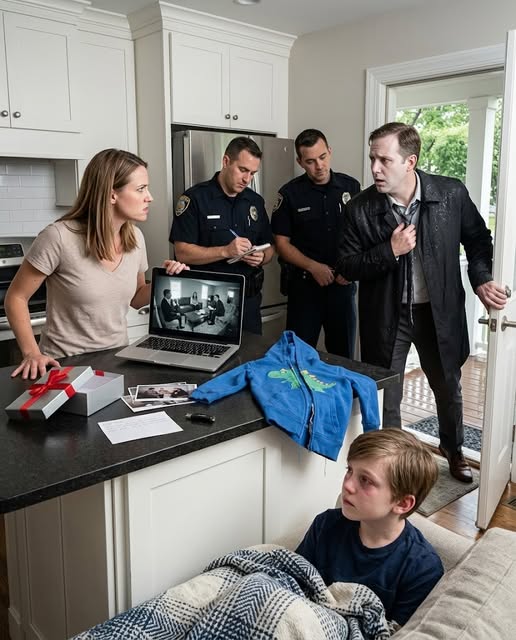
My mother did not knock.
She left my seven-year-old son on my front porch in the middle of a hard rain, placed a silver gift box in his arms, and drove away before I reached the door.
Noah was crying so hard that his breath kept catching in his throat.

Wet hair clung to his forehead, his sneakers squeaked against the porch boards, and the red ribbon around the box had gone dark where the rain touched it.
The package looked expensive in the porch light.
That made it worse.
My mother had always believed presentation could excuse almost anything.
She could deliver an insult with a casserole, a threat inside a birthday card, or a lie in the soft voice she used around strangers.
This time, she had wrapped whatever she wanted me to see in silver paper and sent it through my son.
Noah held the box out to me without stepping forward.
“Grandma said you had to take it,” he whispered.
I bent down and opened my arms.
He flinched.
It was not a large movement.
His shoulders jumped, his chin tucked, and his hands tightened around the package as if he expected me to grab him instead of comfort him.
That small recoil frightened me more than the tears.
Noah had always been affectionate with me.
He still climbed into my bed during thunderstorms, still reached for my hand in crowded parking lots, and still leaned against my side when we watched movies on Friday nights.
He had never looked at me like I might become dangerous without warning.
“Baby, what happened?” I asked.
His lower lip trembled.
“Grandma said, ‘Tell my mom not to make a scene.’”
The sentence sounded wrong in his voice.
Those were adult words, chosen carefully and handed to a child who did not understand why they mattered.
“What else did she say?”
Noah looked past me toward the driveway.
“She said if I cried, it would make everything worse.”
I pulled him inside, shut the door, and turned the deadbolt.
The rain rattled the front windows while I stood with one hand on the lock and the other resting lightly between Noah’s shoulder blades.
He did not relax.
My mother had been calling me dramatic since I was old enough to object to her version of events.
If I remembered something differently, I was dramatic.
If I asked why she had said something cruel, I was dramatic.
If I refused to apologize for a fight she started, I was making a scene.
She did not use the word to describe emotion.
She used it to disqualify me.
Over the years, I had learned to lower my voice when she raised hers, save text messages she later denied sending, and repeat important plans in writing so she could not quietly change them.
Daniel used to understand that.
When we first married, he would squeeze my hand under the table when my mother interrupted me or corrected a story that had happened to me.
Later, he began asking me to let things go.
Then he began saying she was difficult but harmless.
By the time Noah started elementary school, Daniel’s favorite sentence was, “Can we not turn this into a whole thing?”
Standing beside the deadbolt with my frightened son, I heard my mother inside that sentence too.
I carried the silver box to the kitchen island.
It was heavier than it looked.
Something shifted inside when I set it down, not with the loose rattle of a toy but with the flat slide of paper against cardboard.
Daniel was supposed to be at a client dinner downtown.
He had left the house in a navy jacket, kissed Noah on the top of the head, and told me not to wait up.
The kitchen should have felt ordinary.
There should have been a grocery list under the fruit bowl, two clean lunch containers drying by the sink, and the quiet hum of the refrigerator.
Instead, every familiar object looked like part of a room I had misunderstood.
Noah stayed near the doorway.
“Do you know what’s inside?” I asked.
He shook his head.
“Did Grandma tell you not to open it?”
Another shake.
“Did she bring you here herself?”
He nodded.
“Did she pick you up from school?”
His eyes filled again.
“I thought Dad knew.”
The answer landed with a weight I could not place yet.
I slid one finger beneath the tape.
The silver paper tore in a single clean strip, revealing a white cardboard box beneath it.
Inside was Noah’s blue dinosaur hoodie.
He loved that hoodie even though one sleeve was beginning to fray at the cuff.
He wore it on spelling-test days, dentist days, and any morning when the cafeteria menu included something he did not recognize.
He called it his brave hoodie.
Now it had been cut straight down the back.
The line began at the collar and ended at the waistband.
It was too straight to be an accident.
The fabric edges were clean except for a few curling blue threads, and the dinosaur graphic on the front was untouched.
Someone had not damaged the hoodie in anger.
Someone had opened it deliberately.
Noah covered his mouth with both hands.
“Was it on you when that happened?” I asked.
He shook his head quickly.
“Grandma made me take it off.”
I wanted to ask why.
I also wanted to stop asking questions until another adult was present, because my son looked like every answer cost him something.
I folded the hoodie once and placed it beside the box.
Under it were photographs.
The first showed Noah outside his elementary school, one foot on the curb, backpack hanging from one shoulder while he waited for pickup.
The second showed him in our backyard, kneeling beside the little rectangle of soil where he had planted sunflower seeds.
The third showed him asleep in his bed.
That photograph had been taken through the half-open bedroom door.
I could see the edge of the hallway wall in the frame.
The angle was low enough that whoever took it had stood a few feet from his room and leaned inward.
My hands went cold.
The school photo could have been taken from a parked car.
The backyard photo could have come from behind the fence.
The bedroom photo came from inside our home.
I spread every picture across the island.
Different shirts.
Different weather.
Different days.
In one, the maple near the school had green leaves.
In another, the same curb was scattered with brown ones.
This was not a single afternoon.
Someone had been watching my son over time.
Noah stared at the photographs but did not touch them.
“Have you seen these before?”
“No.”
“Did Grandma take them?”
“I don’t know.”
At the bottom of the box, a black USB drive was taped to a white index card.
Four words were written across it in my mother’s slanted handwriting.
Ask Daniel what he agreed to.
For a moment, I heard nothing except the rain and the blood beating in my ears.
My mother’s message did not ask me to call her.
It did not say she was sorry.
It did not explain why she had frightened Noah, cut his hoodie, or collected photographs of him.
It pointed at my husband.
That was the part my mind resisted.
Daniel packed Noah’s lunch when I worked early.
He knew which stuffed animal had to stay on the left side of the pillow.
He could identify, from two rooms away, whether Noah’s crying meant pain, frustration, or exhaustion.
He was not a distant man in the abstract.
He was the person whose work shoes sat beside mine by the garage door.
He was the person whose coffee mug was still in the dishwasher.
He was the person my mother wanted me to question.
I looked at Noah.
“Did Dad give Grandma the box?”
“I don’t know.”
“Did Dad tell you she was picking you up?”
He rubbed his sleeve across his face.
“He said Grandma might help with something.”
That answer was not proof.
It was enough to make me open the laptop.
I plugged in the USB drive with fingers that had begun to shake.
One folder appeared.
Inside it was one video file.
There were no labels, no explanation, and no second chance to decide I did not want to know.
I clicked play.
My mother’s living room appeared on the screen.
The image was grainy and slightly tilted, as though a phone or small camera had been hidden between books on a shelf.
Her lamp glowed in the corner.
The curtains were closed.
Daniel sat on the couch in the same navy jacket he had worn when he left our house that morning.
Across from him sat a bald man in a gray coat.
My mother occupied the armchair beside the lamp, hands folded in her lap, posture straight and composed.
Nobody looked surprised to be there.
Nobody spoke like the meeting had happened by accident.
Daniel leaned forward.
“She’ll fight me for custody,” he said. “She won’t just hand him over.”
The words passed through the laptop speakers in my husband’s voice.
Not a distorted voice.
Not a voice that could be explained away as a misunderstanding.
His voice.
The bald man barely moved.
“Then we make her unstable.”
My fingers locked around the edge of the island.
My mother nodded as if he had suggested changing an appointment.
“Megan has always been dramatic,” she said. “A little panic, a little police involvement, a few reports from school. Daniel gets emergency custody. Clean and legal.”
I paused the video.
The kitchen went silent except for Noah’s breathing.
Several details arranged themselves in my mind at once.
The sudden concern Daniel had expressed about my sleep after I stayed up with Noah during a stomach bug.
The way my mother had begun asking whether I ever lost my temper.
The school email Daniel said he would answer because I was busy.
The afternoon he told me the counselor had misunderstood something Noah said and that there was no reason to follow up.
Individually, each moment had seemed ordinary enough to dismiss.
Together, they formed a shape.
I pressed play again.
Daniel’s shoulders were tight.
He did not look comfortable, but he did not stand up.
He did not say the plan was wrong.
He did not leave.
“She’ll know something’s happening,” he said.
The bald man answered, “Not until the record is already there.”
My mother adjusted one cuff.
“She reacts when she feels cornered,” she said. “That’s the useful part.”
Useful.
They were talking about my fear as material.
They were talking about school reports, police involvement, and custody as pieces of a structure they intended to build around me.
Then Daniel lowered his voice.
“Noah can’t know.”
A small sound came from behind me.
The chair scraped hard against the floor when I turned.
Noah stood in the kitchen doorway.
Tears covered his face.
He was staring at the laptop as if the screen had opened a hole beneath him.
Children do not understand custody strategy.
They understand being wanted, being left, and hearing a parent discuss where they will live without speaking to them.
I crossed the room.
“Noah.”
He did not move until I reached him.
Then his knees bent, and I caught him under the arms before he slid to the floor.
“Dad wants to take me?” he asked.
I held him against my chest.
“I’m right here.”
“That’s not what I asked.”
The precision of that sentence broke something in me.
I could not promise him I had misunderstood.
I could not tell him the video was harmless.
I could only say the truest thing I had.
“No one is taking you anywhere tonight.”
His fingers twisted into the back of my shirt.
For one second, anger rose so fast that I could taste metal.
I pictured calling Daniel and demanding he come home.
I pictured calling my mother and saying every sentence I had swallowed since childhood.
I pictured driving to her house with the cut hoodie in my hands.
Then I looked down at Noah.
He did not need a dramatic confrontation.
He needed an adult who would not make him carry the next decision.
I called 911.
I told the dispatcher my child had been left at my house frightened, carrying photographs that appeared to show him being watched.
I said there was a video discussing a plan to portray me as unstable in order to seek custody.
I did not guess at crimes.
I did not exaggerate.
I described the box, the cut garment, the photographs, the USB drive, and the people visible on the recording.
The dispatcher asked whether Daniel or my mother was currently at the house.
I said no.
She asked whether Noah was injured.
I said I did not see an injury, but he was terrified.
She told me officers were on the way.
After the call, I left the laptop open but stopped the video.
I photographed the arrangement on the island without moving anything else.
The cut hoodie lay on top of the silver paper.
The photographs remained in the order I had found them.
The index card stayed beside the USB drive.
My mother had taught me, through years of denying what she said, to preserve things.
I never imagined that habit would become the one steady motion my hands knew how to perform while my marriage came apart in my kitchen.
The officers arrived twenty minutes later.
One spoke with me near the island while the other crouched at Noah’s level several feet away.
Neither promised an outcome.
Neither told me what the video meant legally.
They asked what had happened, who had handled the package, and whether I had copied or edited the file.
I answered as carefully as I could.
One officer photographed the box, ribbon, wrapping paper, hoodie, index card, USB drive, and each picture.
The other watched the video from the beginning.
When my mother said, “A little panic,” his expression changed.
It was not a dramatic reaction.
His mouth tightened, and he wrote something in his notebook.
Noah sat on the couch wrapped in a blanket.
The blanket was one Daniel’s sister had given us when Noah was born.
I nearly laughed when I noticed that, because ordinary objects were still carrying old meanings while the people attached to them became strangers.
Noah kept his knees pulled to his chest.
Every few seconds, he glanced toward the front door.
“Are you expecting someone?” the officer asked him.
Noah looked at me before answering.
“Dad.”
Daniel’s client dinner had been scheduled to end around eight.
It was already past that.
I checked my phone and saw two missed calls from him, followed by a text asking why the porch light was on.
He could see the porch light from the street before he entered the driveway.
That meant he was close.
I handed the phone to the officer without replying.
A minute later, headlights crossed the front window.
Noah’s body tightened under the blanket.
The lock turned.
Daniel stepped inside with his tie loosened and rain shining on the shoulders of his coat.
He was still holding his car keys.
His first glance landed on the two uniforms.
His second found me.
His third found the silver box.
He stopped moving.
“Police?” he said.
The word came out thin.
Then he looked at Noah.
“What happened?”
There are moments when a person’s face tells the truth before their mouth can assemble a lie.
Daniel did not look confused when he saw the box.
He looked exposed.
The color left his face, beginning around his mouth and spreading upward.
His hand tightened around the keys until the metal pressed white marks into his fingers.
I stood beside the kitchen island.
I did not shout.
I did not ask him how he could do this.
I did not give him the argument he and my mother had predicted I would create.
I turned the laptop toward him.
His own recorded voice filled the room.
“She’ll fight me for custody.”
Daniel’s mouth opened.
Nothing came out.
The officer nearest him shifted slightly, not touching him, but placing himself between Daniel and the path to the couch.
On the screen, the bald man said, “Then we make her unstable.”
Daniel stared at the video.
He looked at the photographs.
He saw the cut blue hoodie.
Finally, he looked at Noah.
Our son had gone very still.
He was not crying anymore.
That was worse.
For one stunned second, I watched Daniel understand the full shape of what had happened.
The child he believed could be kept outside the plan had carried the evidence to my front door.
The wife he expected to panic had preserved the box, called for help, and said almost nothing.
The private meeting he thought belonged to him was playing in front of witnesses.
One officer stepped closer.
“Who is the man in the gray coat?”
Daniel looked toward the screen.
Then he looked at Noah before he answered.
Noah’s blanket slipped from one shoulder.
His voice was barely above a whisper.
“He came to my school.”
Both officers turned toward him.
Daniel closed his eyes.
And outside, through the rain-streaked front window, another pair of headlights slowed at the curb.
