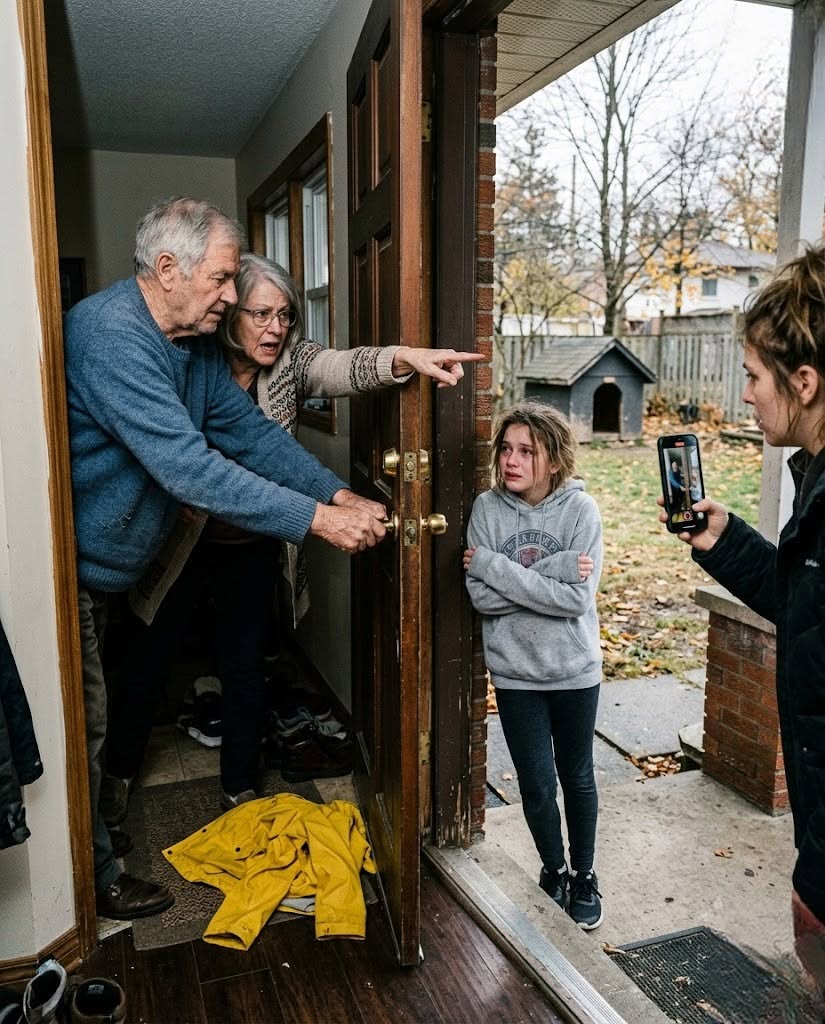
“—and when she realizes how difficult you are, she’ll leave you here for good.”
The sentence came out in my mother’s own voice.
My daughter stopped shivering for one second, not because she was warm, but because she recognized the lie exactly as it had been delivered to her.

The recording continued. My father turned the deadbolt while my mother picked up the yellow raincoat, looked at it, and deliberately dropped it back onto the hallway floor. Neither of them could call that an accident now.
My mother lunged for an explanation.
“She twists everything,” she said. “Children say things when they’re angry.”
The captain asked her to step back. Then he asked me one question: did I want the incident described as a misunderstanding, or did I want every action and every recorded word included?
I looked at my daughter, wrapped in my coat, and understood that she was listening for more than an answer. She was learning whether adults could rename cruelty until it sounded acceptable.
“Write exactly what happened,” I said.
My father’s jaw tightened.
“You’ll destroy this family over one bad night.”
“No,” I said. “I’m ending the part where Emma has to be hurt to keep it together.”
I told them they would never be alone with her again. I asked for my house key back, and when my father refused to move, I held out my hand until he finally pulled it from his ring.
Emma watched the key fall into my palm.
Then she whispered something that changed the captain’s next question.
“Mom,” she said, “this wasn’t the first time they locked me out.”
The captain’s expression changed, but he did not look at my parents.
He looked at Emma.
“Can you tell me what you mean?” he asked.
Emma curled both hands into the sleeves of my coat and stared at the porch boards.
“Last month,” she said, “Grandma put me on the back porch because I didn’t finish dinner. Grandpa locked it so I couldn’t come in until I stopped crying.”
My mother gave a small, irritated laugh.
“That was three minutes, and we could see her through the window.”
The words landed harder than a denial.
My father turned toward her, but it was too late. She had just confirmed the second lockout while trying to make it sound reasonable.
The captain asked the neighbor whether her current recording began before or after the front door closed.
“Before,” she said. “I heard the grandmother yelling first. I came to my window, saw the child outside, and started filming when the man reached for the lock.”
She handed him the phone only after he explained that she could keep possession while sending the original file through the ordinary evidence process.
He checked the visible timestamp, the continuous audio, and the clock through the front window.
He did not make a speech.
He simply asked my parents to stop talking over each other.
My mother ignored him.
She looked at me and said, “You’re going to regret this the next time you need someone to pick her up.”
There it was. Not concern for Emma. Not shame. Leverage.
For two years, my parents had handled two school pickups most weeks while I worked late and chaired evening board meetings. They called it helping, but every favor arrived with a receipt I could not see until they wanted obedience.
They criticized what Emma wore, what she ate, how quickly I answered messages, and whether I sounded grateful enough.
I had pushed back on the small things.
I had never imagined the price of their help was my daughter learning that asking for me could get her locked outside.
A favor stops being help the moment it becomes a leash.
I stood with Emma in my arms and made the first decision that belonged entirely to us.
“I’ll figure out pickup,” I said. “You will not use access to her as a threat again.”
My father finally stepped away from the door.
“You’re emotional,” he said. “Take her home. Sleep on it. We can talk tomorrow without an audience.”
The neighbor lowered her phone, but she did not leave.
The captain waited.
My mother held her chin high, already trying to turn the scene into a misunderstanding that could be managed once the witnesses disappeared.
I knew that pattern.
Private conversations were where my parents edited the past.
They would soften the quote, shorten the time, blame Emma’s behavior, and ask why I had embarrassed them.
By morning, I would be defending my tone instead of their locked door.
“No private rewrite,” I said. “Not tomorrow. Not ever.”
I asked the captain what he needed from me before I left.
He said only that he needed Emma warm, safe, and available for a follow-up conversation with an appropriate adult present, and that the recording and statements would be handled through the normal process.
I nodded.
Then I carried my daughter to my SUV.
My mother called after me.
“You’ll come back when the real world gets inconvenient.”
I opened the rear door, buckled Emma in, and tucked my coat around her legs.
The yellow raincoat stayed on their hallway floor.
At home, I ran a warm bath while Emma sat on the closed toilet lid and watched the steam gather on the mirror.
Her lips had stopped trembling, but she kept rubbing her palms over her knees.
I set out pajamas, made toast, and heated soup even though it was late.
Ordinary things mattered that night: a clean towel, a glass of water, and the hallway light left on.
When I tucked her into bed, she did not ask whether Grandma and Grandpa were angry.
She asked whether I was.
“Are you mad I told the captain about before?” she whispered.
“No.”
“Even though Grandma said families don’t tell strangers family business?”
I sat on the edge of the mattress.
“The captain wasn’t there to decide whether you were good or bad,” I said. “He was there because a door was locked and you were outside. You can always tell the truth about something that scares you.”
Emma studied my face with the careful attention children use when they have heard adults promise one thing and do another.
“Will you believe me the first time?”
“Yes.”
That was the first promise I made after the porch, and it became the rule that guided everything afterward.
The next morning, practical consequences arrived before breakfast was over.
I removed my parents from every pickup and emergency-contact list I controlled.
I changed the keypad code on my house, even though my father had returned the key.
I moved two evening meetings online, canceled another, and called the after-school care program to ask about an opening without giving them more of Emma’s story than they needed.
The cost made my stomach tighten.
So did the calendar.
My parents had been right about one thing: the real world was inconvenient.
I would need to leave work earlier twice a week, pay for care I had not budgeted for, and ask for help from people I had not spent years trying to please.
None of that was worse than teaching Emma that safety was a privilege she could lose for speaking.
By noon, my phone held fourteen missed calls from relatives.
My mother had moved quickly.
Her version was that Emma had refused a reasonable consequence, I had used my connection to the captain to stage a public humiliation, and a neighbor had filmed private property because she was nosy.
The deadbolt became “a misunderstanding.”
The doghouse became “a joke.”
The dry raincoat disappeared from the story entirely.
I answered one family message.
“Emma was locked outside while her coat was kept inside. A neighbor recorded it. The matter is being handled, and I will not debate her safety.”
Then I stopped replying.
I did not send the video.
Emma’s worst night was not family entertainment, and I would not use her fear to win an argument.
That afternoon, the captain called from his office.
His tone was formal now, which I appreciated.
He told me the neighbor had preserved the original recording and that my mother’s statement about the earlier back-porch incident had been noted.
He did not predict an outcome.
He did not promise that a title, donation, or handshake would change the process.
I told him I would step away from any board discussion touching his unit until the matter was resolved.
“Thank you,” he said. “That protects everyone.”
It also protected me from the easiest accusation my parents wanted to make.
I had not funded obedience.
I had funded tools that were supposed to help children be heard, including mine.
Three days later, my father left a voicemail.
He did not apologize.
He said my mother had been under stress and that Emma had always been “sensitive.”
He said I had forced them into a defensive position by bringing police to the house.
I listened once.
Then I saved it with the other messages and went back to packing Emma’s lunch.
A week passed before my mother came to my porch.
She arrived just before dinner carrying a paper grocery bag with a casserole dish inside, the same kind of offering she had used after every argument since I was a teenager.
Food first.
Accountability later, if ever.
Emma was at the kitchen table doing homework.
I stepped outside and closed the door behind me.
My mother looked at the new keypad beside the frame.
“You changed the code,” she said.
“Yes.” She held out the grocery bag, and I asked, “What does peace mean?”
Her mouth tightened. “I came to make peace.”
“It means we stop letting one emotional night destroy this family,” she said.
I did not take the bag.
“Can you say what you did without calling Emma emotional?”
“I disciplined her.”
“Can you say you locked her outside?” I asked.
“For a few minutes,” she said, refusing to meet my eyes.
“Can you say you kept her coat inside?”
“She needed to understand consequences.”
The casserole dish shifted inside the bag as her grip tightened.
She had come prepared to forgive me for reacting.
She had not come prepared to name what she had done.
Behind the door, a floorboard creaked. Emma was listening, and my mother heard it too.
Her face changed, and for the first time she tried to soften her voice.
“Sweetheart,” she called, “Grandma loves you.” Emma did not answer.
My mother reached for the doorknob, and I put my hand over it first.
“You don’t get to ask her for comfort while you’re still defending the thing that scared her.”
“She is my granddaughter.”
“She is my daughter.”
The same fact that had triggered the punishment now stood between us like a boundary my mother could not move.
She lowered the grocery bag.
“You’re choosing strangers over your own parents.”
“No. I’m choosing the child you locked outside.”
My mother stared at me, waiting for the guilt to do what it had always done.
It did not.
I asked her to leave.
She set the grocery bag on the porch and walked back to her car without looking at the house.
I carried the bag to the trash bin without opening it.
When I went inside, Emma was still at the table, pencil resting across her worksheet.
“Was Grandma mad?” she asked.
“Yes, but we are not in trouble,” I said.
She looked toward the hallway where her yellow raincoat now hung from a low hook beside her backpack.
I had retrieved it the day after the incident when an officer accompanied me to collect her things, and I had washed it twice even though it had never gotten wet.
Emma had not touched it since.
“Did you tell her I’m not bad?” she asked.
“I told her you’re my daughter.”
Emma nodded as if that answer reached somewhere deeper.
The review of the incident moved slowly and mostly outside our view.
There were follow-up questions.
There were statements.
There was the original recording, still continuous from the first shout to the 911 call.
I refused to turn each update into a family announcement.
My parents were not allowed unsupervised access to Emma, and I did not negotiate around that boundary.
My father sent one more message saying he had only turned the lock because my mother told him to.
That was the closest he came to admitting his own choice.
I replied with a single sentence: “You placed your hand on the deadbolt.”
He never answered.
The hardest part was not the paperwork or the phone calls.
It was rebuilding Emma’s trust in ordinary separations.
The first time I left her with a new caregiver, she asked three times whether the front door could lock from the inside.
We checked it together.
I showed her the phone on the counter, the list of numbers beside it, and the coat she could reach without asking anyone.
I told the caregiver, in front of Emma, that she could call me for any reason.
Then I left for forty minutes instead of four hours.
When I returned, Emma ran to the driveway before I had fully closed the car door.
“You came back,” she said.
“I said I would.” The next visit lasted longer, then stretched into an afternoon.
Slowly, predictability did what speeches could not.
It gave her body evidence that a goodbye did not mean abandonment and a mistake did not mean exile.
My schedule changed.
I took fewer evening meetings in person.
I learned which parents could trade pickups without making the favor feel like a debt.
I paid for after-school care and cut other expenses until the numbers worked.
Some weeks were messy. Dinner came from the freezer, and laundry sat unfolded.
I answered emails from the bleachers while Emma finished an activity.
But she no longer watched the door when adults lowered their voices.
That was worth every inconvenience.
Two months after the porch, a plain envelope arrived from my mother.
There was no casserole, no family messenger, and no demand for an immediate response.
Inside was one page.
She wrote that she had locked Emma outside.
She wrote that keeping the raincoat inside had been deliberate.
She wrote that calling it discipline had allowed her to avoid saying it was cruel.
Then she asked whether there might someday be a way to repair what she had done.
I read the letter twice.
It was the first time she had used the correct verbs.
I did not hand it to Emma.
Accountability did not create an obligation for a child to reopen a door.
I placed the letter in a drawer and told my mother through a brief message that any future contact would depend on Emma’s comfort, professional guidance, and consistent behavior over time.
My father did not sign the letter, and that mattered too.
There was no dramatic reunion or porch embrace.
No instant forgiveness arranged for the convenience of adults.
There was only distance, a clear boundary, and the possibility that honest language might someday support honest change.
Emma stopped asking whether she had caused the family fight.
She started asking normal questions again: could she have cereal for dinner, wear mismatched socks, or bring a frog-shaped eraser to school even though it was “technically distracting”?
The first rainy morning of spring, she stood in the hallway beneath the yellow raincoat.
Water ticked against the front window.
She looked at the coat for a long moment, then looked at me.
“Can I get a different one?” I asked.
Emma shook her head.
“No. This one is mine.”
She pulled it from the hook and held out one arm.
I helped her find the sleeve, smoothed the collar, and zipped it to her chin.
At the door, she paused and said, “Mom?”
“I’m right here.” She opened the door herself.
This time, the yellow raincoat went outside with her.
