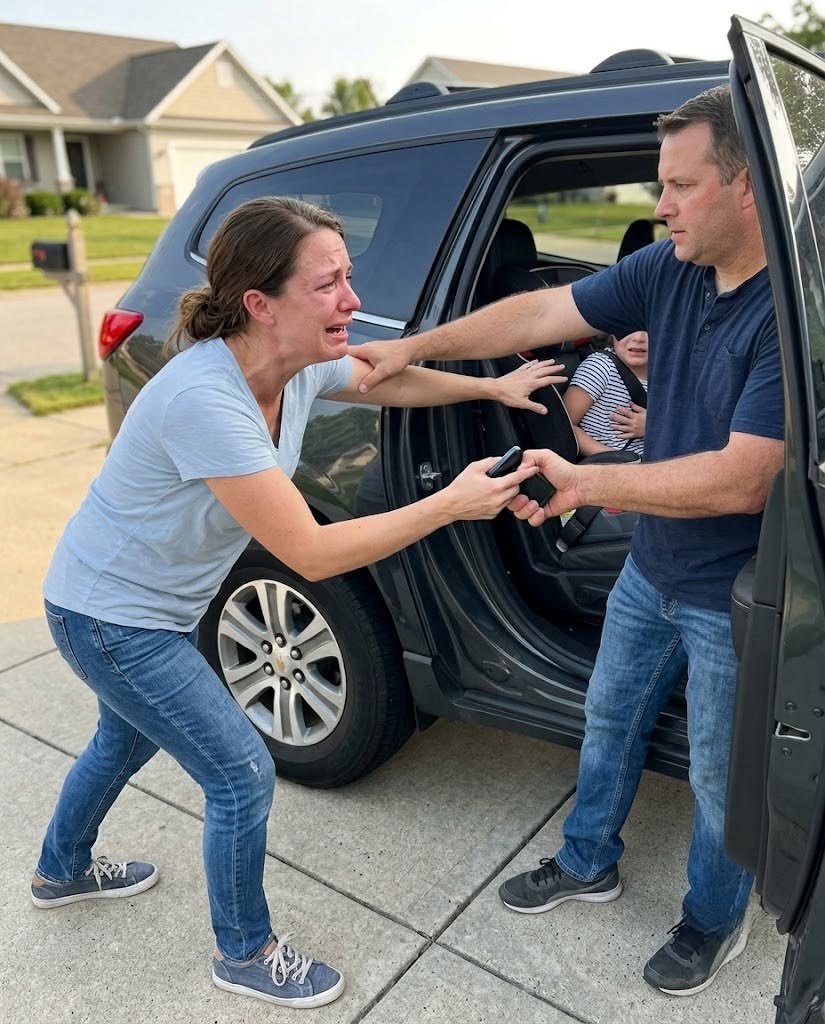
My husband blocked the car door and ripped the phone from my hand while our six-year-old daughter struggled to breathe in the back seat.
“You’re not calling anyone,” he hissed.
But the 911 operator had already heard her whisper, “Daddy gave me the other bottle”—and the medicine he kicked beneath the seat carried another child’s name.

The SUV’s warning chime kept sounding through the open driver’s door, steady and stupid, as if the car believed the only emergency was a key left in the ignition.
The afternoon heat had turned the seats tacky, and the inside of the vehicle smelled like apple juice, old coffee, and the alcohol wipes I kept in the console for scraped knees.
Behind Michael, Emily was pulling for air in short, frightened breaths.
Her small shoulders rose too fast.
One sneaker had slipped off and lay sideways on the floor mat.
I had come home early because of a text that did not sound right.
“She’s fine,” Michael had written.
Then, thirty seconds later, “Don’t make this bigger than it is.”
Those two sentences told me more than he intended.
People who are caring for a sick child usually tell you what happened, what they did, and what they need.
People who are protecting themselves tell you how to react.
Michael and I had been married eight years.
He was good at looking dependable from across a room.
He remembered birthdays, kept the gas tank above half, and knew which grocery store carried the crackers Emily liked.
He also hated being corrected.
Small mistakes became debates, debates became accusations, and by the time he finished talking, the person who noticed the problem was somehow responsible for creating it.
I had learned to pick my battles.
I had not realized our daughter’s breathing would become one of them.
Emily had been prescribed rescue medicine after a series of breathing episodes that began in preschool.
We kept a written plan on the refrigerator, a copy in her school backpack, and the current bottle in a zippered pouch with her name printed across the label.
I handled the pediatric appointments.
Michael usually handled pharmacy pickup because it was on his route home.
That division had never felt dangerous before.
Twelve days earlier, the pharmacy had said the refill could not be completed until the prescriber approved it.
I was at work when the call came, so Michael said he would take care of it.
At 3:41 p.m. on the day everything broke open, I texted him one question.
“Did you get Emily’s medicine?”
He replied, “Handled.”
I read that word twice.
There was no photo of the bag on the counter, no complaint about the line, no joke about the pharmacy’s hold music.
Just handled.
By 4:10, he stopped answering.
By 4:18, I turned into our driveway and saw the family SUV sitting crooked with the driver’s door open.
Michael stood beside it.
Emily was in the rear seat.
The moment I saw her posture, I knew she was not fine.
She was folded forward with one hand pressed against her ribs and the other gripping the edge of the booster seat.
Michael held a small bottle near his thigh.
It was the wrong shape.
“Whose is that?” I asked.
He turned the label away.
“It’s the same kind.”
“Same kind for who?”
He looked toward the street instead of at our daughter.
That was when I pulled out my phone.
The 911 operator answered before Michael understood I had already pressed call.
I said our address.
I said my daughter was six.
I said she was struggling to breathe and that I did not know what medicine she had been given.
Michael stepped between me and the open rear door.
“Hang up.”
I tried to move around him.
He blocked me with his arm.
The operator said, “Ma’am, stay on the line.”
Then Michael tore the phone from my hand.
“You’re not calling anyone,” he hissed.
The phone stayed connected.
I could hear the operator through the speaker, asking whether the child was conscious and whether anyone could open the door.
Michael pressed the phone against his hip as if that could hide the voice.
Then Emily whispered from the back seat.
“Daddy gave me the other bottle.”
Michael froze for half a second.
It was not the stillness of a frightened parent.
It was the pause of someone recalculating.
He kicked the bottle beneath the passenger seat.
The movement was quick, but the operator heard the scrape.
So did I.
“When they get here, you’re going to say she grabbed it herself,” he said.
His voice was low now, almost conversational.
“You are not turning one mistake into a custody circus.”
There are moments when a marriage does not end with a slammed door or a signed form.
It ends when someone asks you to help rewrite what happened to your own child.
“I’m not lying for you,” I said.
His hand tightened around my phone.
“Then you can explain why you left me to handle everything.”
The sirens reached our street before he finished.
The first paramedic came around the passenger side and opened the rear door.
Another responder moved between Michael and me.
I climbed halfway into the back seat and held Emily’s hand while the team began the treatment she had actually been prescribed.
I did not understand every piece of equipment or every number they called out.
I understood her fingers around mine.
I understood that she was still trying.
Michael kept talking.
“She gets dramatic when she’s scared.”
The paramedic did not look up.
“Who gave her the medicine?”
Michael pointed toward me.
Emily shook her head.
It was a tiny movement.
It destroyed the version he had been building.
A responder reached beneath the passenger seat and recovered the bottle.
The white label had a dirty scrape across it from Michael’s shoe.
The first name was still visible.
Ethan.
Ethan was Michael’s nephew.
He had spent the previous weekend with us and had left a small zippered medication bag in the SUV.
I remembered Michael saying he would return it.
He never had.
“It’s practically identical,” Michael said.
“I made a judgment call.”
The responder held the bottle at eye level.
“A prescription with another child’s name is not your judgment to make.”
Michael reached for it.
“Give me that. It’s none of your business.”
The officer who had arrived with the emergency crew caught his wrist before he touched the bottle.
“Step away from the vehicle.”
For once, Michael obeyed without arguing.
His face had lost its certainty.
That was when I saw the folded paper beside the cup holder.
It had been pushed down between two receipts and a paper coffee cup.
The page was creased into quarters and stained at one edge.
I knew the format before the responder unfolded it.
The title read PRESCRIPTION REFILL STATUS NOTICE.
The notice was dated twelve days earlier.
In the center was one clear clause: “Refill cannot be dispensed until prescriber authorization is received.”
That sentence changed the story.
Michael had not been surprised by an empty bottle.
He had not discovered the problem that afternoon.
He had known for nearly two weeks that Emily’s medicine was unavailable.
He had told me it was handled.
Then, when she began to struggle, he used another child’s prescription and tried to make her carry the blame.
The paramedic read the date again.
“You had this for twelve days?”
Michael’s fingers slipped from the door frame.
The officer’s radio crackled.
A dispatcher said the operator had captured another statement from Emily before the phone moved.
The recording played through the speaker.
Michael’s hand scraped against the phone.
My own voice sounded distant.
Then Emily said, “Daddy said not to tell Mommy he forgot the real one.”
Michael began talking immediately.
“She was confused.”
No one answered.
“She misunderstood what I said.”
The paramedic folded the notice along its original crease and placed it in a clear sleeve with the bottle.
The officer wrote down the 4:18 p.m. call time.
Another responder photographed the location beneath the passenger seat where the bottle had been found.
Michael tried again.
“Sarah, tell them I was handling it.”
I looked at the notice.
I looked at the bottle with Ethan’s name.
I looked at our daughter beneath the oxygen mask.
“You weren’t handling it,” I said.
“You were hiding it.”
Emily was taken to the community hospital for monitoring.
I rode beside her.
Michael was not allowed in the ambulance.
At the hospital, the emergency team continued the treatment listed in Emily’s plan and watched her closely until her breathing eased.
No one gave me a dramatic speech.
A nurse adjusted a blanket.
A respiratory therapist explained each step in plain language.
A doctor asked me to repeat exactly what had happened, and then asked me to repeat it again while another staff member documented the timeline.
The ordinary professionalism of those people nearly broke me.
They did not ask me to soften anything.
They did not tell me I was overreacting.
They believed the evidence in front of them.
At 6:07 p.m., a nurse handed me a clear bag containing Emily’s school jacket and one small sock.
The other sock was still in the SUV.
That detail made me cry harder than the forms.
Emily opened her eyes and asked, “Am I in trouble?”
I sat beside the bed and held her hand.
“No.”
“But I told.”
“You told the truth.”
“Daddy said you’d be mad.”
“I’m not mad at you.”
She watched my face carefully.
Children learn the weather in a home by studying the adults.
She was six years old and already checking whether honesty was safe.
I leaned closer.
“Adults are responsible for what adults do,” I said.
“You are never responsible for protecting a grown-up from the truth.”
She nodded once and closed her eyes.
Later that evening, an officer took my statement in a quiet hospital room.
The 911 call log showed the call began at 4:18 p.m. and remained connected after Michael removed the phone from my hand.
The incident report listed the phone, the medicine bottle, the refill notice, and the recovery location beneath the passenger seat.
The hospital intake record documented the name printed on the bottle and the time Emily arrived.
Three artifacts.
One timeline.
No room for Michael to turn it into a disagreement between spouses.
The next morning, I retrieved my phone.
There was a message thread between Michael and me that I had almost forgotten.
Twelve days earlier, I had asked whether the pharmacy problem was resolved.
He had replied, “Yes. Stop worrying.”
The refill notice proved the opposite.
That was the reversal he had not expected.
He had built his defense around my supposed anxiety.
The paperwork showed that my anxiety had been the only adult response grounded in reality.
A child-safety caseworker met with me before Emily was discharged.
She did not make promises.
She explained the immediate safety plan, asked who could stay with us, and confirmed that Michael would not return to the house that night.
My sister, Megan, came with a grocery bag, a clean hoodie, and the charger I had forgotten.
She did not ask why I had stayed with Michael so long.
She put coffee in my hand and said, “You don’t have to explain today.”
That was love in a form I could use.
The temporary family-court hearing happened the following week.
The hallway smelled like floor wax and paper.
Michael wore the blue shirt he used for job interviews and funerals.
He sat with his attorney and kept his eyes on the table.
When the 911 recording played, his face changed at the exact moment Emily’s whisper filled the room.
“Daddy said not to tell Mommy he forgot the real one.”
The judge did not raise her voice.
She asked about the refill notice.
She asked about the bottle with Ethan’s name.
She asked why Michael had taken the phone.
Michael said he panicked.
The judge said panic did not explain ordering a child to lie before help arrived.
The temporary order gave me sole decision-making over Emily’s medical care and limited Michael to supervised contact while the investigation continued.
It was not a triumphant moment.
There was no applause.
I signed the papers with a hand that would not stop shaking.
Relief can feel a lot like grief when the thing keeping you safe is also proof that your family had become unsafe.
Michael sent one apology through the approved communication channel.
“I was scared of losing everything,” he wrote.
He still made himself the center of the sentence.
I did not answer that night.
Weeks later, during a supervised meeting, he apologized to Emily.
The supervisor sat nearby.
Michael said, “I made a bad choice.”
Emily looked at him and asked, “Why did you tell me Mommy would be mad?”
He had no prepared answer.
That silence mattered more than anything he had written to me.
For once, he could not hide behind speed, volume, or blame.
He eventually said, “Because I didn’t want her to know I forgot.”
Emily looked down at her shoes.
“You made me scared to tell.”
“Yes,” he said.
The word was quiet.
It was the first honest thing I had heard from him about that day.
Honesty did not restore the marriage.
It did not erase the call or the bottle or the way he blocked the door while our daughter struggled behind him.
Consequences are not revenge.
They are the structure that keeps an apology from becoming another performance.
Over the next several months, Michael completed the safety requirements ordered in the parenting plan and continued supervised contact.
I did not promise reconciliation.
I focused on making Emily’s world predictable again.
We created a new medication binder with the current plan, refill dates, pediatric office numbers, and a checklist for every adult responsible for her care.
The school nurse received an updated copy.
The pharmacy contact was moved to my phone.
A sealed backup stayed where the medical team advised, clearly labeled and checked each month.
At first, Emily asked to see the label every time.
“Does it say my name?”
“Yes,” I would tell her.
She would trace the letters with one finger and breathe out.
That ritual lasted almost three months.
Then one morning, she checked without asking me.
A few weeks after that, she stopped checking at all.
Trust returned in inches.
Not because I told her everything was fine.
Because I showed her the bottle, answered the question, and never punished her for asking.
The SUV remained in the driveway for a while after the incident.
I could not open the rear door without hearing the warning chime in my head.
Eventually, Megan helped me clean it.
We found the missing sock beneath the seat.
We found a crushed cracker, two crayons, and the paper coffee cup that had hidden the refill notice.
I threw the cup away.
I kept the sock.
It sits in the top drawer of Emily’s dresser, not as evidence, but as a reminder of how small she was when adults asked her to carry something that never belonged to her.
Michael’s biggest lie was not that the medicine was “practically identical.”
It was that one mistake had caused everything.
The truth was twelve days long.
It had a timestamp, a notice, a text message, a child’s name, and a phone call he could not disconnect fast enough.
He had time to tell me.
He had time to call the pediatric office.
He had time to ask for help.
Instead, he used another child’s bottle and told our daughter to protect him.
The day in the driveway did not teach Emily that her father was a monster.
I refused to make her carry that story, too.
It taught her something more useful.
A grown-up can love you and still make a dangerous choice.
A grown-up can apologize and still face limits.
And when your body tells you something is wrong, you are allowed to call for help even if someone you love tells you not to.
Months later, Emily stood beside me at the kitchen counter while I checked the refill date.
She watched me place the new bottle in its pouch.
“Mommy?”
“Yes?”
“You would call every time, right?”
“Every time.”
“Even if Daddy got mad?”
I closed the pouch and looked at her.
“Especially then.”
She nodded and went back to coloring.
The refrigerator hummed.
A school bus rolled past the corner.
The ordinary sounds of the house returned.
For years, I had thought keeping a family together meant absorbing the sharp edges before they reached the child.
That day taught me the opposite.
Sometimes protecting a family means refusing to help someone hide what they did to it.
The bottle under the seat carried another child’s name.
The truth carried Emily’s voice.
And this time, everyone listened.
