I used to think fear announced itself loudly.
I thought it would arrive with broken glass, slammed doors, or a scream from somewhere down the hall. In our house, fear learned to wear clean shirts. It learned to pack lunches and smile at teachers.
Mark was good at being believed. He remembered birthdays, shook hands firmly, and sent thank-you emails before anyone else did. People called him steady. I called him my husband because I was still trying to believe that word meant safety.

Our daughter Ella was six when the first strange night happened. She woke after midnight with her cheeks flushed and her breathing too fast. Mark was already beside her bed when I got there.
“I gave her what the doctor said,” he told me.
His voice was calm. The bathroom cup was on her nightstand, rinsed clean. The medicine cabinet door was closed.
I asked which bottle.
“The usual one,” he said.
That should have settled me. Instead, it stayed in my mind like a coin under a shoe. Something small kept pressing every time I stepped forward.
Ella improved by morning. Mark made pancakes shaped like hearts. He joked that I could turn a sneeze into a federal case.
I laughed because Ella laughed. I also moved her medicine to the top shelf of my closet that afternoon. I told myself it was just organization.
Two weeks later, Mark started offering to handle bedtime. He said I looked tired. He said a good father knew when to step in. Every sentence sounded generous from the outside.
Inside my body, each one landed differently.
Ella began asking a new question at bedtime.
“Do I have to take Daddy’s bottle?”
The first time, I corrected her gently. We had only one bottle for her, and it had her name on it.
She frowned at her socks.
“It tastes sleepy,” she said.
I checked her bottle that night. The label was right. The cap was white, not blue. The liquid line looked normal.
Mark stood in the doorway while I looked.
“You trust plastic more than me now?” he asked.
I said no because I wanted the argument to end. I said no because Ella was brushing her teeth behind me. I said no because I did not yet understand that peace can be a trap.
The night in the parking lot began with a pharmacy run. Ella had coughed through dinner, and I wanted a refill before the storm got worse. Mark insisted on driving.
“You’re too keyed up,” he said.
I sat in the passenger seat with Ella’s small backpack on my lap. Her stuffed rabbit poked from the zipper. She had named it Moon because its ears glowed under her nightlight.
At the pharmacy, Mark went in alone. He came back with one paper bag and a face I could not read. When I asked for the receipt, he said it had blown away.
“It’s raining,” I said.
“Exactly,” he answered.
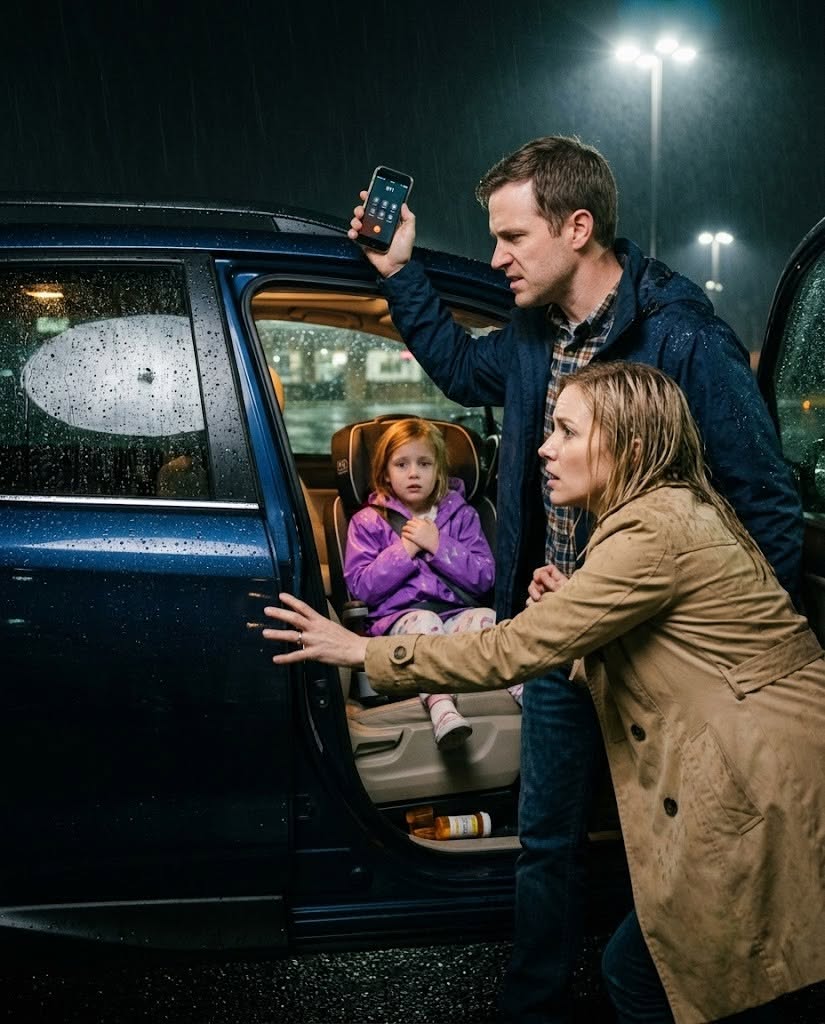
We were halfway across the lot when Ella made a sound I had never heard from her. It was not a cough. It was a tiny effort, like her chest had become a door too heavy to open.
I turned around so fast the seat belt cut my shoulder. Her mouth was open. Her eyes were wet and confused.
“Pull over,” I said.
Mark did, but only because we had not left the lot. I was already dialing before the car stopped. That was when his hand shot across my body.
He blocked the door. He ripped the phone away. He told me I was not calling anyone.
Then Ella whispered about the other bottle.
I watched Mark hear it. I watched the color leave his mouth. That was the moment I stopped being confused.
The 911 operator stayed on the line. Her calm voice became the only solid thing in that car. She told me to keep Ella upright if I could hear her.
I could hear her because Mark had not ended the call. He had only stolen the phone. That mistake saved us.
Ella pointed at the floor behind his seat. I reached under with two fingers and touched plastic. The bottle rolled against the metal rail.
The label said Noah Bennett.
I did not know that name.
Mark did.
He grabbed my wrist before I could bring the bottle up. His fingers locked around me. The pressure was familiar enough to shame me.
“Give it to me,” he said.
I did not fight the way he expected. I let my wrist slacken. I kept the bottle pinned sideways with my thumb, label facing the phone in his hand.
He thought I had gone weak. He always mistook quiet for surrender.
Outside, headlights cut across the rain. A paramedic stepped out first, then another responder behind her. Mark saw them and lifted the bottle toward the open window.
The flashlight reached him before he could throw it.
“Sir, set it on the hood,” the paramedic said.
Mark smiled the polite smile people trusted.
“My wife overreacts,” he said.
The phone in his pocket answered for me.
“Yes, she did place the call,” the operator said.
The paramedic looked at his pocket, then at my wrist. Her face did not change. That was how I knew she had seen men like Mark before.
I unbuckled Ella while Mark kept talking. He said she had episodes. He said I forgot doses. He said I panicked when I should listen.
Each sentence was a small shovel. He was trying to bury me before anyone checked the ground.
Ella folded into me. Her breath scratched against my neck. I carried her to the ambulance bench and climbed in beside her.
“Did Daddy give you something?” the paramedic asked softly.
Ella looked at Mark through the open doors.
“He said Mommy would get in trouble,” she whispered.
Mark stopped talking.
That silence was the first honest thing he gave us.
The responders took the bottle. They would not let him touch it again. One of them sealed it in a clear bag and wrote the time on a strip of tape.
The name Noah Bennett sat behind the plastic. The rest of the label was smeared, but the name remained sharp. It felt like the story had chosen what to keep.
At the hospital, Ella was treated quickly. I will not dress that night in heroic colors. I was shaking too hard to sign my name cleanly.
A nurse put a blanket around my shoulders. I kept saying I should have noticed sooner. She told me to breathe with my daughter.
Mark tried to come into the treatment room. The paramedic blocked him with one arm. She did not raise her voice.
“Parents only,” Mark said.
The paramedic looked at his wedding ring.
“Safe parents,” she said.
Those two words stayed with me.
A deputy arrived before dawn. He asked careful questions and did not rush me. The operator’s recording had already been saved.
He played only the part he needed me to confirm. My voice was thin. Mark’s voice was low and clear. Ella’s whisper was smaller than both.
“Daddy gave me the other bottle.”
I pressed my hand over my mouth. I had heard it once already. Hearing it from a speaker made it colder.
The deputy asked if I knew Noah Bennett. I said no. He asked if Mark had family with that name. I said no again.
Then he showed me a photo from Mark’s wallet. It had been found when hospital security collected his belongings. A little boy stood beside Mark at a lake.
On the back, in blue ink, someone had written Noah, age five.
My body understood before my mind did.
Mark had another child.
Not a rumor. Not an old mistake from before me. A child close enough in age to Ella that the lie had lived beside our life for years.
The deputy did not make a speech. He placed the photo on the table and waited. Kind people know silence can hold a person better than hands.
By sunrise, a woman named Dana Bennett was sitting across from me in a family room. Her face looked like mine felt. She held a paper cup of coffee she never drank.
“I thought he was only lying to me,” she said.
Dana told me Mark had visited Noah twice a month under a different story. He told her he was separated. He told me he was working late.
Noah had the same blue-capped medicine after a winter breathing scare. Dana kept it in a locked kitchen box. The bottle had disappeared during Mark’s last visit.
“I blamed myself,” she said.
I knew that sentence. I had been living inside it.
The hospital social worker brought us tissues, but neither of us reached for them. Dana and I were too busy comparing dates. Every date became a little explosion.
The night Ella first woke gasping matched the weekend Mark had taken Noah to the aquarium. The bottle vanished from Dana’s house the next day.
The pharmacy bag from our car carried no receipt because it had not held Ella’s refill. It had held a second box of adhesive labels and a cheap measuring cup.
Mark had not made one mistake. He had built a method.
I wanted to hate Dana for existing. That would have been easy and useless. She had been lied to from the other side of the same wall.
So I gave her the only thing I had.
“The call recorded him,” I said.
Her shoulders dropped like she had been carrying furniture through a burning house. She covered her eyes, but she did not cry loudly.
A court order came later that day. It was temporary, but it gave me enough air to stand. Mark could not contact me, Ella, Dana, or Noah.
He called anyway from a blocked number.
I did not answer. The deputy had told me not to answer. Still, my hand trembled while the phone shook across the table.
The voicemail arrived thirty seconds later.
Claire, this looks bad, but you know me.
I almost laughed. That was the problem. I did know him.
I knew the public version who carried groceries for neighbors. I knew the private version who watched my fear and called it drama. I knew the version who hid a child in plain sight.
I saved the voicemail. Then I sent it to the deputy.
Ella came home the next afternoon. She wore hospital socks with yellow dots on the bottom. She asked if Moon could ride in the front seat with me.
I said Moon could ride anywhere she wanted.
For the first week, Ella slept with every light on. She asked if Daddy was mad. I told her grown-up trouble belonged to grown-ups.
“You told the truth,” I said.
She touched the edge of her blanket.
“Will Noah get in trouble?”
That was how I learned children can worry about strangers while adults are still sorting blame.
“No,” I said. “Noah did nothing wrong.”
Neither did Dana. Neither did Ella. Neither did I, though it took longer for me to believe my own name on that list.
The hearings were not dramatic like people imagine. No one slammed a table. No one confessed because a perfect question trapped him.
Real accountability moved slowly. It came in recordings, pharmacy logs, custody paperwork, and the sealed bag with the bottle inside. It came because ordinary people did their jobs.
The operator wrote a statement. The paramedic wrote one too. Dana brought proof that Noah’s bottle had vanished from her home after Mark’s visit.
Mark’s lawyer argued misunderstanding. He said families share medicine by accident during stressful nights. He said my panic made everything seem cruel.
Then the recording played.
The room heard Mark tell me I was not calling anyone. The room heard Ella whisper the sentence that broke him. The room heard the operator telling me help was coming.
Mark stared at the table.
For years, he had survived by making women sound unstable in rooms where he sounded calm. The recording stole that trick from him.
My only aphorism from that year is simple. When a liar steals your voice, let the evidence speak first.
The judge gave me full temporary custody while the criminal case moved forward. Dana received protection for Noah. Both children were ordered into care with therapists who specialized in fear.
That sentence sounded clinical. To me, it sounded like mercy.
The final twist came from the bottle itself. A lab report showed it had been rinsed and refilled. The label was Noah’s, but the contents were not his medicine anymore.
Mark had used Noah’s name as a disguise.
He thought a stranger’s label would make the trail messy. He thought I would look careless. He thought Dana would look careless too.
He had chosen a bottle with another child’s name because he wanted two mothers blamed at once.
That was the part I could not stop seeing. His secret was not only another child. His secret was that he had practiced making women carry his guilt.
Months later, Dana and I sat together at a school concert. Ella sang from the second row. Noah stood three children away, waving both hands at his mother.
They did not know the whole story. They knew enough. They knew the grown-ups who stayed were the grown-ups who told the truth.
After the song, Ella ran to me and handed me a paper star. Noah ran to Dana with glue on his sleeve.
For one second, our eyes met over their heads. Nothing needed saying.
Mark had tried to turn a bottle into a weapon and a name into a hiding place. Instead, that name became a bridge. It led me to Dana, led Dana to the truth, and led both children away from him.
I keep the court copy in a locked drawer now. Not because I need to stare at it. Because some proof deserves a safe home.
Ella is older now. Her breathing is steady. She still keeps Moon on her bed, though she pretends it is only for decoration.
Sometimes she asks why I stayed calm that night. I tell her the truth in the gentlest way I can.
“I was not calm,” I say. “I was listening.”
That is what saved us. Not bravery the way movies sell it. Just one open line, one honest whisper, and one small BOTTLE he failed to throw away.
