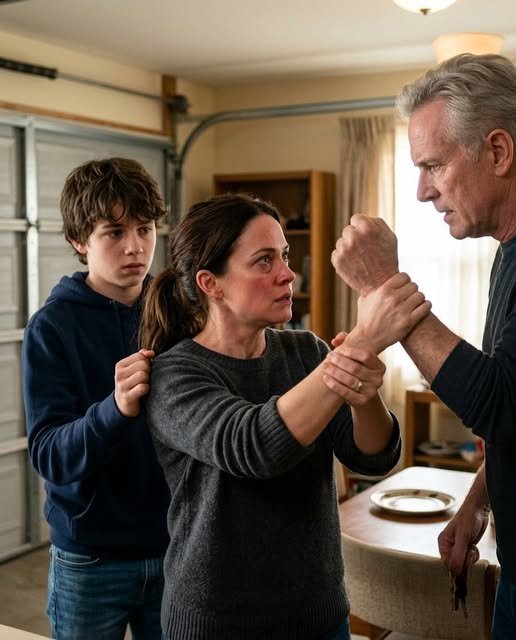
The roast was already dry when my father decided the family could begin eating.
That was how he ran a room. He did not ask. He waited until everyone understood the waiting was part of the punishment.
I had cooked most of that dinner myself. Dad called it a peace dinner, but he had not lifted a pan. He wanted my labor on the table, then my apology beside it.

My son Noah sat to my left. He was sixteen, tall, and usually careful with adults. That night, his knee bounced under the table hard enough to shake my water glass.
“Stop that,” Dad said.
Noah went still.
My sister Melissa looked at her plate. Aunt Carol folded her napkin again. They had all learned the same rule.
Let Daniel Morgan finish.
I had learned it too. I had learned it after Mom died. I had learned it when Dad started calling my concern disrespect. I had learned it when he told relatives that Noah was dramatic, unstable, and impossible to discipline.
Noah was none of those things.
He was quiet. He was observant. He noticed when people lied because he listened longer than they expected.
That was why Dad feared him.
I did not know that yet.
I only knew Noah had come in from the side yard with dust on his jeans. He kept pressing his right hand against the empty pocket where his phone should have been. His cheek was already flushed before dinner turned violent.
“Where is your phone?” I whispered.
Noah looked at Dad.
Dad smiled and set the carving knife down.
“Your boy has been snooping.”
“Dad,” I said.
He ignored me.
“Family opens its doors,” he said. “Family does not dig through a man’s private things.”
Noah’s voice shook, but it did not break.
“Tell Mom what you made me hide.”
The whole table stopped moving.
Dad rose so fast his chair hit the wall. His palm cracked across Noah’s face. The sound was flat and horrible, and it seemed to hang above the plates.
For one second, no one breathed.
Noah staggered back. He did not cry. His hand lifted toward his cheek, then dropped like he refused to give Dad that much.
I shoved my chair away.
“Do not touch him.”
Dad grabbed Noah by the sleeve. He was still strong enough to make a teenage boy stumble. He dragged him through the side hallway toward the garage door.
Melissa half-stood.
Carol caught her wrist.
“Daniel,” Carol said, but it came out soft.
The garage door opened. Noah twisted back toward me.
“Mom, listen to me.”
Dad shoved him through and slammed the door. The lock turned.
That sound changed the room.
It made every fork and glass look obscene.
Dad returned to the table and straightened his collar. His breathing was heavy. His face was red, but his voice came out steady.
“Keep eating unless you want to join him.”
Nobody ate.
Nobody moved either.
I hate that memory because it includes me. My hands were on the table. My body was frozen. My son was behind a locked door, and I needed one second too long.
Then Noah kicked the garage door.
“Mom.”
I stood.
Dad pointed at me.
“Sit down, Sarah.”
“Give me the key.”
“He needs to learn respect.”
“He is sixteen.”
“Then he is old enough to stop lying.”
That word snapped something awake in me.
“What lie?”
Dad did not answer.
My phone buzzed against the table. The screen lit with Mrs. Delgado’s name.
She lived next door. She was the kind of neighbor who brought soup when someone died, but never asked questions in public. She also had a porch camera pointed toward our side yard.
Her text had four words.
Look at my porch.
I turned.
Through the side window, I saw her under her porch light. One hand held her phone. The other covered her mouth. Her porch camera sat above the mailbox, angled straight toward Dad’s garage wall.
Then I heard her voice through the open kitchen window.
“He hit the boy. He locked him in the garage. He is trying to keep the boy from saying why.”
She was not talking to me.
She was talking to 911.
Dad saw my face change.
“Give me your phone.”
“No.”
It was the smallest word I had ever said to him. It felt like pushing a door open after years in a room with no air.
Some doors open only after someone stops pretending the lock is love.
Dad moved around the table. Melissa stood fully this time.
“Dad, stop.”
He turned on her.
“Stay out of it.”
From the garage, Noah shouted again.
“Mom, the blue folder.”
Dad went still.
Not angry. Not loud. Still.
That frightened me more.
“What folder?” I asked.
He smiled again, but it did not reach his eyes.
“There is no folder.”
Noah slammed his shoulder against the door.
“Behind the water heater.”
Dad’s fork fell from his hand. It hit the plate with a small, bright sound.
Carol whispered, “Daniel?”
He bent and grabbed the key ring from the sideboard.
For one terrible moment, I thought he meant to open the garage. Then he turned toward the hallway that led to the basement stairs.
He was not going to Noah.
He was going to the folder.
I stepped into his path.
“Open the door first.”
“Move.”
“No.”
He lifted his hand.
This time Melissa crossed the room and stood beside me. Her face was white. Her hands shook. She still stood there.
Through the window, Mrs. Delgado’s voice rose.
“Ma’am, officers are on their way.”
Dad heard it.
The hand he had raised dropped slowly.
The next few minutes came in pieces. Noah kept calling my name. Mrs. Delgado stayed on the line.
Aunt Carol cried into her napkin and said she had not known. Melissa kept whispering that she was sorry.
I did not have room for sorry yet.
I wanted my son.
Dad unlocked the garage only when the first cruiser lights washed across the side wall. Noah came out blinking, one cheek red, one sleeve torn at the cuff.
I pulled him into my arms.
He shook once, then held himself stiff.
“I’m okay,” he said.
“You do not have to be.”
An officer stepped into the side hallway. He asked who had been hit. Noah raised his hand without looking at Dad.
Dad started talking at once.
“This is a family discipline issue.”
The officer looked at the locked garage door, then at Noah’s cheek.
“It stopped being that when a child was locked in a garage.”
Dad’s mouth tightened.
“He is not a child. He is almost grown.”
Noah looked at him then.
“You were fine calling me a kid when you wanted everyone to ignore me.”
The officer asked about the folder.
Dad laughed.
“There is no folder. He is making up stories.”
Mrs. Delgado came through the side gate with her phone in her hand. She had not changed out of her house slippers. She looked small beside Dad, but she did not look scared.
“I heard the boy through the vent,” she said.
Dad pointed at her.
“You stay off my property.”
“I am on the walkway.”
The officer stepped between them.
“Ma’am, what did you hear?”
Mrs. Delgado looked at Noah first.
“I heard him say his grandfather hid a folder behind the water heater. I heard Daniel say, ‘One more word and your mother loses everything.’ Then I called.”
Dad’s hand closed around the key ring.
That was his mistake.
The officer saw it. I saw it. Noah saw it too.
“What key is that?” the officer asked.
“My house,” Dad said.
“Then you will not mind opening the basement door.”
Dad looked at me like I had betrayed him by standing still.
“Sarah, tell him this is nonsense.”
I thought of every dinner where I had smoothed his anger. I thought of every phone call where I had apologized for his tone. I thought of Noah behind that door.
“Open it,” I said.
The basement smelled like dust and laundry soap. The water heater sat in the corner, humming like nothing important had happened. Behind it was a dented blue folder wrapped in a plastic grocery bag.
Noah did not touch it.
He pointed.
“There.”
The officer pulled it free.
Dad made a sound like air leaving a tire.
Inside were papers I had never seen. There were bank letters addressed to my mother before she died. There was a property tax notice for the house Dad always called his. There were copies of checks from Mom’s account, each one signed after the date she entered hospice.
At the back was a notarized statement.
My name was on it.
The signature was not mine.
I knew that before anyone asked. My S never looked like that. My hand never leaned hard to the right. The date was a day when I had been at the hospital with Mom.
The officer did not read it aloud at first. He took photos. He called for another unit. He asked me whether I had signed any document giving Dad control over Mom’s estate.
“No.”
Dad scoffed.
“She forgets things when she is upset.”
Noah stepped forward.
“She did not forget. I found it today. He told me to put it back and keep my mouth shut.”
Dad spun on him.
“You little thief.”
The officer’s voice hardened.
“Do not speak to him.”
That was when the dispatch log came through on the officer’s radio tablet. I saw the officer read it. His eyes moved once to Dad, then back to the screen.
“This call notes a locked minor, a physical strike, and a witness statement about concealed financial papers.”
Dad’s hand froze over his plate.
He had followed us back to the table because control was his habit. He stood beside the roast like dinner could still protect him. The key ring hung from his fingers.
The transcript did not just prove he had hurt Noah. It proved he had been afraid of a boy telling the truth.
Melissa put both hands over her mouth.
Carol sat down hard.
Dad tried one last time.
“Sarah, he is turning you against me.”
Noah was still shaking, but his voice came out steady.
“No. I told her where you hid what you stole.”
The room went silent.
Dad looked at the officer. Then he looked at me. For the first time, he had no sentence ready.
The next hour stripped him of every performance. Officers photographed the garage lock. Mrs. Delgado sent her porch footage.
The blue folder went into an evidence bag. Noah gave his statement with my hand around his.
Dad was not dragged away screaming. He was too proud for that. He was told to step outside, and he did. He kept smoothing his shirt like cameras were waiting.
No one applauded.
Real consequences rarely arrive like thunder. Sometimes they arrive as a calm voice asking for your keys.
That night, Noah and I left with Melissa. She drove because my hands would not stop shaking. Noah sat in the back seat and stared out the window until the house disappeared.
“Mom,” he said.
“I’m here.”
“I thought you would not believe me.”
I turned in the passenger seat so fast the belt locked against my shoulder.
“I will spend the rest of my life making sure you never think that again.”
He nodded once. Then he finally cried.
I did too.
Two weeks later, a lawyer confirmed what the folder had already told us. Mom had left her half of the house and a small account to me. Dad had hidden the papers after her funeral. The forged statement was his attempt to sell the house before probate questions reached me.
He had not hit Noah because Noah was disrespectful.
He had hit him because Noah found the paper trail.
Melissa came with me to the lawyer’s office. She brought a grocery bag full of envelopes she had taken from Dad’s desk after officers left. Most were ordinary bills, but two had Mom’s maiden name on them.
The lawyer opened them slowly. One showed a rejected transfer from Mom’s account. The other showed a warning letter from the county recorder.
“He knew the title was not clean,” the lawyer said.
Melissa cried then.
“I kept defending him.”
I wanted to tell her that fear teaches people to survive sideways. I only took her hand. There would be time later to decide what forgiveness could hold.
The final twist came from Mrs. Delgado. She brought me a thumb drive and a casserole, in that order. On the drive was porch audio from the week before dinner.
Dad’s voice was clear.
“Sarah signs nothing if Noah keeps sniffing around. Scare the boy first.”
I listened once. Then I closed the laptop.
Noah did not need to hear it. He already knew enough.
Dad had called the dinner peace. He had set the table like a judge. He thought shame would keep us seated, and fear would keep a locked door quiet.
But the neighbor heard.
The dispatcher wrote it down.
My son told the truth.
And for once, everyone kept listening.
