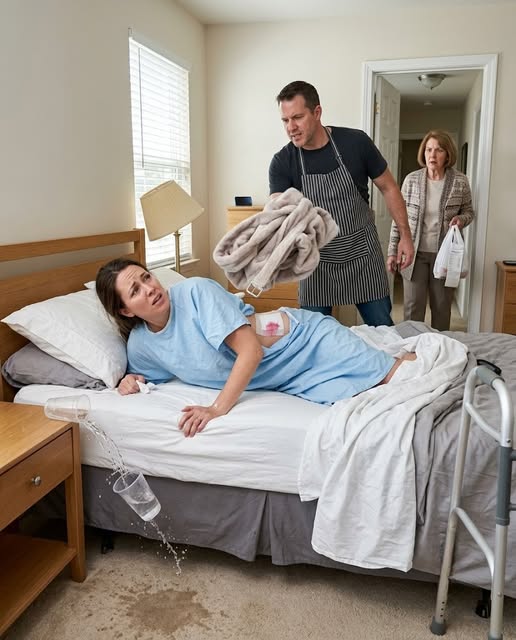
My mother said, “Call 911, because her incision is bleeding, her prescribed medication has been withheld, and nobody moves her until paramedics arrive.”
No one moved.
I watched my husband’s face lose the patient expression he had been wearing for his family.

He reached for the pharmacy bag, but my mother placed her shoe on one handle and told him to keep his hands where she could see them.
I pulled the robe away from my chest and asked her to get my phone.
My left leg burned from my hip to my ankle, and I had not eaten since a few crackers sometime the previous evening.
My husband stepped between her and the dresser.
“She’s medicated,” he said. “She’s confused, and your panic is making her worse.”
I looked at his sister, Dana, standing behind him with one hand still holding a paper plate.
She said I had come home close to five and probably needed more time before anyone called an ambulance.
My mother ignored her, picked up the cordless charger from the floor, and used its end to drag my phone within reach without leaning across my back.
The room had gone cold after my husband pulled away the blanket, while garlic and burned butter still drifted upstairs from the kitchen.
I unlocked the phone with my thumb.
My husband lowered his voice again.
“You’ll frighten everyone over a little spotting.”
I called 911.
When the dispatcher answered, I gave my name, my address, the time of my surgery, and every restriction my husband had repeated to the discharge nurse.
He tried to speak over me, telling the dispatcher that I had refused to walk and was becoming dependent on pain medication.
I held the phone against my ear and said, “My caregiver took my medication downstairs, kept my phone beyond my reach, and tried to force me out of bed twenty-six hours after spinal surgery.”
The dispatcher asked whether I felt safe with him in the room.
I said no.
Then I asked her to send police with the paramedics while his entire family listened from the hallway.
My husband backed away from the bed.
For the first time that morning, he stopped telling me what I needed.
While we waited, my mother checked the edge of the dressing without touching it and asked when I had last received each prescription.
I answered as precisely as I could, then admitted I did not know where the bottles were.
My husband said he had followed the schedule.
I asked him to bring the medication upstairs.
He did not move.
A child downstairs began winding a toy that played six uneven notes, and somebody turned it off before it finished.
My mother picked up the empty water cup, set it upright, and left the wet carpet alone.
When sirens reached our street, my husband told Dana to take the children into the backyard so they would not see me being dramatic.
I told Dana to leave the bedroom door open.
She did.
Two paramedics came upstairs with a folding stretcher, followed by a police officer whose radio kept clicking against the doorframe.
I gave the paramedics permission to examine the dressing and answered their questions without letting my husband finish a single sentence for me.
One paramedic cut the hospital gown farther up the back rather than rolling me, while the other asked my husband for the medication bottles and discharge papers.
He said the papers had been misplaced and the bottles were somewhere downstairs.
My mother said, “The caregiver page is in the glove compartment unless he moved it after hiding it there yesterday.”
I watched Dana look at her brother.
He told her not to get involved.
She put down the paper plate and went outside with his keys.
The first paramedic photographed the dressing for the receiving hospital, then covered me with a warmed blanket that smelled faintly of plastic.
I asked him to document the robe on my legs, the phone on the dresser, and the spilled water beside the bed.
He did.
My husband laughed once and said everybody was turning ordinary recovery into a crime scene.
I asked the officer to record that statement too.
Dana returned carrying the folded discharge packet.
She had opened it to the page where my restrictions appeared in bold type above my husband’s signature as designated caregiver.
Her mouth stayed open for a second.
“I thought he meant the doctor wanted you moving around the house,” she said.
I asked her to hand the packet directly to the officer.
She did not give it to her brother.
Downstairs, the second paramedic found both prescription bottles inside a kitchen cabinet beside the cereal boxes, although my husband had claimed he was keeping them near him to track my doses.
The labels were warm from the kitchen, and one bottle had a smear of flour across its cap.
I read the printed schedule aloud while the paramedic counted the remaining tablets.
The count matched two administered doses, not the four listed on the schedule for the hours since discharge.
My husband said I had refused the missing doses.
I told the officer I had called his name until my throat hurt and had asked again that morning.
My mother opened the pharmacy bag she had carried upstairs.
Inside were the additional nausea tablets the surgeon’s office had sent after I became sick in the hospital, still stapled to a receipt with a packet of mint gum listed beneath them.
My husband had not known she was collecting those.
When the paramedics prepared to roll me onto the transfer sheet, I asked everyone except my mother to step into the hallway.
My husband objected because he was still my caregiver.
I said, “Not anymore.”
The officer escorted him downstairs.
I gripped the sheet while the paramedics moved me three inches at a time, and my mother kept one hand where I could see it without touching me.
The pain sharpened.
I kept talking.
In the ambulance, I gave the paramedic my phone and asked him to place it beside my right hand rather than in the belongings bag.
He tucked the robe into that bag, along with the torn gown and discharge packet, while a loose blue sticker on the monitor lifted every time the heater came on.
At the hospital, the spine service examined the incision before anyone offered an opinion about what had caused the bleeding.
I asked them to explain every movement before they touched me.
The surgeon found that a superficial section at the edge of the incision had separated and the dressing had shifted, but the deeper closure remained intact.
There was no damage to the hardware.
I breathed again.
The surgeon cleaned the area, reinforced the closure, and ordered monitoring because the pain down my leg had increased after I strained against the mattress.
When he asked why my medication schedule had been interrupted, I told him exactly where the bottles had been and who controlled them.
A nurse entered the missed doses, the delayed evening dose, and my husband’s explanation into the chart.
I asked her not to replace any of my words with “family disagreement.”
She typed while I watched.
Sometime that afternoon, my husband arrived at the emergency department with the signed caregiver page and told the front desk that my mother had interfered with my recovery plan.
Because his name was still listed as my primary support person, a staff member allowed him into the treatment area before the new restriction reached every desk.
He came through the curtain carrying my walker and wearing the same concerned smile he had used with the discharge nurse.
“I brought what you need,” he said. “Your mother has everyone worked up.”
I pressed the call button.
Before the nurse arrived, he placed the walker beside the bed and told me we could go home as soon as I admitted I had misunderstood him.
I asked why he had told my mother I wanted privacy.
He said she was too intense and that he had protected me from stress.
I asked why my phone had been placed beyond my reach.
He said screen time interfered with sleep.
I asked why the medication was stored beside cereal instead of near the written schedule.
He said the kitchen was convenient.
The nurse entered while he was explaining that every choice had been for my comfort.
I told her to remove him from the room and from every medical contact field connected to my care.
He held up the caregiver page.
For several minutes, the page worked.
A security officer asked my mother to wait outside while the charge nurse confirmed who had authority to change the visitor list, and my husband remained beside my bed with his hand resting on the walker.
I had regained my voice downstairs and lost my witness upstairs.
My hands shook from pain and hunger, but I asked the nurse to bring the hospital’s patient-rights form and a phone for the nursing supervisor.
My husband said paperwork could wait until I was thinking clearly.
I signed the visitor restriction in front of him.
The charge nurse removed his badge sticker, security walked him out, and my mother was allowed back without anyone asking his permission.
I tried to flatten the curled edge of my hospital wristband against my arm, but it sprang up again.
My mother sat where I could see her and waited for me to speak first.
I asked what my husband had told her on the phone before we left the hospital.
“He said you wanted two quiet nights with him,” she answered. “He said you were afraid I would hover.”
I unlocked my phone and showed her that I had sent no message and made no call asking her to stay away.
She opened her call history and showed me his number at 2:26 the previous afternoon, eleven minutes after the discharge nurse had begun reviewing my restrictions.
I photographed the screen.
When Dana came to the hospital later that afternoon, she carried the medication bottles in a clear property bag and kept both hands around them as though her brother might appear and take them back.
I asked whether he had told the family I promised to cook.
She looked at the floor.
“He sent the invitation,” she said. “He told us you wanted everyone there because being useful would keep your mind off the pain.”
I asked to see the family message thread.
Dana hesitated long enough for the air vent above us to stop and start again.
Then she handed me her phone.
My husband had sent the first message before sunrise, listing the chicken dish, the side dishes, and the time everyone should arrive.
He had written that I was “moving slowly but perfectly capable” and that nobody should offer to help unless I asked.
At 8:07, Dana had asked whether bringing seven people the day after surgery was a good idea.
He replied, “She needs normal expectations, not another audience for her complaints.”
I forwarded the thread to myself and to my mother.
My husband called Dana while the files were sending.
She looked at his name, silenced the phone, and placed it face down.
That changed two things at once: he no longer controlled the only copy of the family story, and his sister was no longer repeating it for him.
I asked Dana to email the screenshots to the hospital social worker and the officer who had responded to the house.
She did it before leaving.
By evening, the immediate medical danger had narrowed, but the problem moved sideways into every place where my husband still spoke for me.
I changed the password on my patient portal, removed him from appointment notifications, replaced him as my emergency contact, and added a verbal security code to telephone calls about my care.
The nurse brought broth, crackers, and a cup of applesauce that had already warmed to room temperature.
I ate half the crackers.
My mother peeled the lid from the applesauce and folded it into a tiny square for no reason, then unfolded it when she noticed what she was doing.
After the room became quiet, I opened the rest of Dana’s screenshots.
At 7:06 that morning, my husband had written, “Get everybody here before noon, because if she refuses to get up in front of you, you’ll finally see what I’ve been dealing with.”
At 8:14, he added, “Keep saying she promised the chicken, and don’t let her turn this into a medical emergency.”
One relative had replied with a laughing face.
Another asked whether I would remember making the promise after taking pain medication.
My husband answered, “Probably not clearly.”
I saved each image separately and sent them to a secure folder rather than trusting the message thread to remain available.
The social worker read them beside my bed without commenting on his intentions.
She asked what I wanted to happen next.
I said I would discharge to my mother’s house, that my husband was not to receive my location from the hospital, and that I wanted information about documenting coercive control and medical neglect.
She arranged for the responding officer to take a fuller statement at the hospital the next morning.
Near midnight, my husband sent an apology through Dana.
He said he had been overwhelmed, had misunderstood the walking instructions, and would stay at her house until I felt calmer.
He offered to bring my clothes, charger, and walker to my mother’s porch without coming inside.
For a few hours, that looked like an ending I could survive without making anything larger.
I told the social worker I might only need the hospital restriction, a new caregiver plan, and time away from him.
She wrote down my decision without pushing me.
The following morning, my pain had settled enough for me to stand beside the bed with two staff members and the walker.
I took four steps.
Afterward, I watched the blood-pressure cuff deflate while a breakfast cart squeaked past the doorway and someone in the hall asked for grape jelly.
The surgeon opened my chart to review the overnight notes.
Then he stopped scrolling.
I asked what he had found.
At 8:41 the previous morning, thirty-seven minutes before my husband’s family entered our house, someone using my husband’s verified caregiver information had called the surgical triage line.
The telephone note said the patient was refusing prescribed medication, refusing assisted walking, exaggerating pain, and becoming hostile when encouraged.
It also recorded that the triage nurse had asked to speak with me directly.
My husband had said I was asleep and should not be disturbed.
Before ending the call, he asked the nurse to place my “noncompliance” in the medical record in case my recovery failed.
I read the note twice.
He had not merely reacted badly when his family arrived; he had started creating a medical version of the morning before anyone else could see me.
I asked the surgeon to preserve the call note, the caller-verification record, and the exact time in my chart.
Then I called the officer back and changed my statement from an informational report to a formal complaint.
I included the medication count, the hidden discharge page, the call to my mother, the family messages, the visitor incident, and the triage note.
The hospital social worker helped me request an emergency protective order rather than sending me home with only a private agreement he could reinterpret later.
My husband left six voicemails before the order was served, each one softer than the last and each one describing his actions as care.
I did not answer them.
A judge signed a temporary no-contact order that afternoon and scheduled a hearing for eleven days later.
When I left the hospital, my mother drove me to her house, placed my phone on the bedside table within reach, and set every medication bottle beside a written schedule I could read without lifting my head.
She asked before adjusting my pillow.
I said yes.
At the hearing, the discharge nurse’s documentation established that my husband had repeated the restrictions, and the triage record showed what he reported before trying to force me downstairs.
Dana submitted the family messages and answered questions without looking toward her brother.
The court extended the order while the separation proceeded, but nobody announced an arrest, a ruined career, or any punishment larger than the evidence supported.
He was barred from contacting me, managing my appointments, entering my mother’s property, or collecting my belongings without an arranged third-party exchange.
My incision healed without another procedure.
The nerve pain took longer, and for several weeks I slept in pieces, walked in measured laps, and stopped whenever my leg began to tighten.
During the property exchange, I asked for my documents, clothes, medication lockbox, and the phone charger that had been left near the bedroom floor.
I did not ask for the dining set, the apron, or any explanation from him.
My mother found the robe inside the hospital belongings bag after the police released the photographed items.
She asked whether I wanted it washed or thrown away.
I asked for scissors.
The robe became four cleaning rags in my mother’s laundry room.
