His Mother’s Final Letter Exposed the Cruel Plan He Thought Was Perfect

His Mother’s Final Letter Exposed the Cruel Plan He Thought Was Perfect
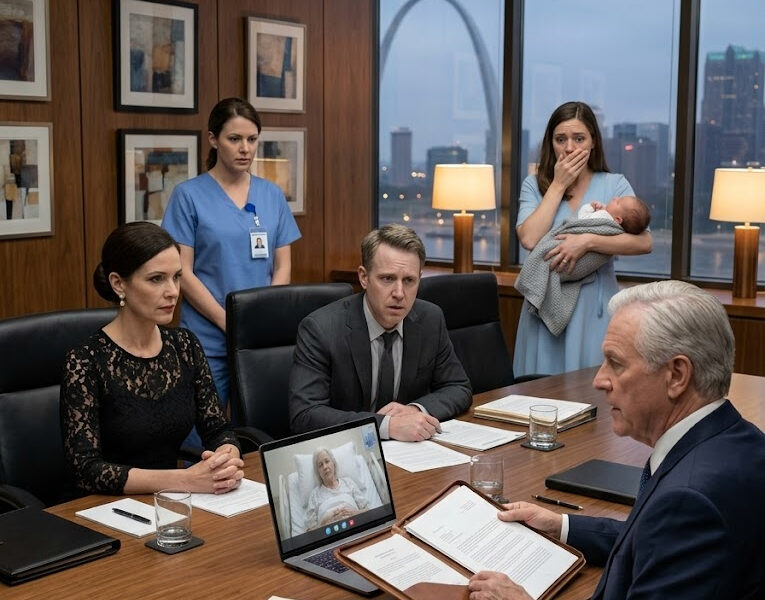
The hospital video filled the laptop screen with a pale blue light.
Margaret Caldwell lay propped against two pillows, thinner than I remembered and connected to an oxygen line.
Ethan stood beside her bed with a pen in one hand and a deed in the other.
In the conference room, no one moved.
Lauren held the newborn tightly against her chest.
Ethan stared at the screen with his mouth slightly open, as though he had forgotten the recording existed.
On the video, he placed the document over Margaret’s blanket.
“Sign it, Mom,” he said.
“Claire is already planning to take everything.”
Margaret looked down at the paper but did not touch the pen.
“Claire has asked me for nothing,” she said.
“You have asked me for my house six times.”
The nurse standing behind us folded her arms.
Her name was Denise Mercer.
I remembered her from Margaret’s final week—the soft-spoken night nurse who always seemed to enter the room just before Ethan ended one of his private conversations.
On the recording, Ethan glanced toward the hospital door.
“Lauren is having my child,” he whispered.
“I need to make sure they’re protected.”
“You already have a wife.”
“Claire and I are finished.
She just doesn’t know it yet.”
The words did not hurt the way they might have a month earlier.
Hearing them in Margaret’s room changed something.
This was no longer only an affair.
It was a plan built around my ignorance and a dying woman’s money.
Ethan pushed the pen into his mother’s hand.
“Sign it, or I’ll tell the doctors you’re confused and have them restrict your visitors.”
Lauren’s face changed.
“You said she wanted us to have the house,” she murmured.
Ethan did not look at her.
On-screen, Margaret raised her eyes toward a small camera mounted near the television.
“You’re too late,” she said.
“I signed the real papers this morning.”
Mr.
Harlan paused the video.
The silence that followed felt heavier than shouting.
Ethan stood abruptly.
“That recording was illegal.”
“It was made in Margaret’s private hospital room with her written consent,” Mr.
Harlan said.
“The hospital’s legal department has the authorization.
So do I.”
He removed a certified document from the leather folder and placed it on the table.
“This deed was executed on March third and recorded the following morning.
Margaret transferred her riverfront residence, including its contents, to Claire Caldwell.”
For several seconds, I did not understand what he had said.
The house was not simply valuable.
It was the center of the Caldwell family’s identity—a limestone mansion overlooking the Mississippi, filled with portraits, antique furniture, and decades of carefully protected history.
Ethan had been speaking about it as his future home since the week we married.
Now the deed carried my name.
Lauren turned on him.
“You told me we would move in after the funeral.”
“Be quiet,” he snapped.
The baby startled and began to cry.
Lauren rose from her chair, rocking him against her shoulder.
Her earlier confidence was gone.
She looked less like a victorious mistress and more like someone realizing she had bought a ticket on a sinking ship.
Ethan pointed at me.
“She manipulated my mother.
Claire was alone with her every day.”
Mr.
Harlan opened another section of the folder.
“Margaret anticipated that accusation.”He produced a statement from Dr.
Miriam Feld, a geriatric psychiatrist who had examined Margaret on March third.
The evaluation found her fully oriented, aware of her assets, and able to explain the consequences of each change she requested.
Two witnesses had watched her sign: Nurse Mercer and a hospital social worker with no connection to our family.
A separate attorney from another firm had reviewed the documents before Margaret executed them.
“Your mother took extraordinary precautions,” Mr.
Harlan said.
“She wanted no credible claim that Claire influenced her.
Claire was not present when the documents were discussed or signed.”
That was true.
On March third, Margaret had insisted that I go home and sleep.
She said she wanted a quiet morning with her lawyer.
I had kissed her forehead and left without asking why.
Ethan looked from the medical statement to the deed.
“A house isn’t the whole estate.”
He said it too quickly.
The arrogance had not disappeared.
It had merely retreated behind calculation.
Margaret’s home was worth nearly four million dollars, but Ethan knew there were investment accounts, commercial properties, and a trust created after his father’s death.
Mr.
Harlan unfolded the revised will.
“No,” he said.
“It is not the whole estate.”
Lauren sat again, the baby quieting against her chest.
Ethan lowered himself into his chair.
Mr.
Harlan read the distributions slowly.
Margaret left ten percent of her remaining liquid estate to the hospice foundation that had supported her during treatment.
She created a protected trust for Ethan’s newborn son, subject to legal confirmation of paternity.
The trust would cover education, healthcare, and basic support, but Ethan and Lauren would have no authority to withdraw money from it.
An independent bank would serve as trustee.
Lauren interrupted.
“How much is in the child’s trust?”
Ethan looked at her with open disgust.
Mr.
Harlan answered calmly.
“Approximately one million dollars, depending on final valuation.
It belongs to the child, not either parent.”
Lauren’s shoulders loosened slightly, but only until he continued.
The largest portion of Margaret’s financial estate—investment accounts, two rental properties, and her controlling interest in a family partnership—was left to me.
I stared at him.
“That can’t be right.”
“It is,” he said.
Ethan laughed, but the sound was brittle.
“And what did she leave me?”
Mr.
Harlan looked down at the page.
“One dollar, your father’s watch, and the opportunity to retrieve personal photographs under supervision.”
Lauren closed her eyes.
Ethan remained still for one long moment.
Then he struck the table with both hands.
Coffee jumped in the untouched cups.
The baby cried again.
“My mother would never do this.”
Mr.
Harlan did not flinch.
“Your mother explained exactly why she did it.”
He returned to the letter.
Margaret wrote that wealth had protected Ethan from consequences for most of his life.
Every debt had been paid, every failure explained away, every cruel decision softened by someone who loved him.
She admitted she had participated in that pattern.
When Ethan lied, she defended him.
When he wasted money, she replaced it.
When he married me, she quietly hoped responsibility would transform him without asking what the transformation might cost me.
Then she became ill.
During her final year, she watched me arrive with clean clothes, soup I knew she would barely eat,and lists of questions for doctors.
She watched Ethan arrive with documents.
One afternoon, while I was downstairs speaking to a pharmacist, Margaret heard Ethan on the phone with Lauren.
He promised that once Margaret died, he would file for divorce, leave me responsible for our joint debts, and use his inheritance to buy Lauren a home.
He said I would be too humiliated by the baby to fight him publicly.
Lauren stared at the table while the letter was read.
“You said the divorce papers had already been filed,” she said.
“I was handling it.”
“You said Claire refused to sign.”
“This is not the time.”
“You told me she knew about us.”
Ethan’s expression hardened.
“Lauren, stop talking.”
She looked at him as if she had never heard that tone before.
I had heard it many times.
It was the voice he used whenever facts began escaping his control.
Mr.
Harlan continued reading.
Margaret had also discovered that Ethan contacted a private lender using the false deed shown in the video.
He intended to borrow against her house before probate, apparently believing her death would prevent anyone from challenging the signature quickly enough.
The lender had requested additional verification.
That request reached Margaret’s financial adviser, who contacted Mr.
Harlan.
The attempted transaction had been stopped.
The forged deed, the hospital recording, Ethan’s messages to the lender, and Margaret’s sworn statement had been submitted to the county prosecutor’s elder financial exploitation unit before her death.
Ethan slowly turned toward the closed conference-room door.
Mr.
Harlan noticed.
“An investigator is waiting outside,” he said.
“You are not under arrest, but he has requested an interview.”
“You set me up.”
“Your mother documented your actions.”
“She was dying.”
“She was still your mother.”
The words landed harder than anything else said that morning.
Ethan looked at me, searching for the version of his wife who would rescue him from embarrassment, explain away his behavior, or ask everyone to calm down.
That woman had spent years trying to preserve a marriage he had already emptied.
I did not recognize her anymore.
“Claire,” he said, lowering his voice, “we need to speak privately.”
“No.”
“You don’t understand what she’s done.
These properties require management.
The taxes alone—”
“Mr.
Harlan will explain them to me.”
“You’ll lose everything without me.”
It was almost impressive.
Even after the video, the forged document, the affair, and the will, he still believed fear was the key that opened every door.
“Then I’ll lose it myself,” I said.
Lauren gave a small, humorless laugh.
Ethan turned on her.
“What is funny?”
“You told me she was helpless.”
“She is.”
“She’s sitting there with your house, your mother’s money, and the only lawyer in the room who isn’t calling her a criminal.”
His face darkened.
“Everything I did was for you and the baby.”
Lauren’s expression went cold.
“No.
Everything you did was for you.”
She began gathering the blanket and diaper bag.
Ethan grabbed her wrist.
Nurse Mercer stepped forward immediately.
“Let go of her.”
He released Lauren, but not before everyone saw the instinct beneath his polished exterior—the need to control whoever was closest when control elsewhere failed.
Lauren moved to the far side of the room.
Mr.
Harlan finished Margaret’s letter.
Her final words were addressedto me.
She wrote that she was sorry she had mistaken my patience for proof that I could survive unlimited pain.
She knew I had remained in the marriage partly because I feared leaving with nothing.
The house and estate were not rewards for tolerating Ethan.
They were the means to stop tolerating him.
“Do not spend your life protecting my son from the truth about himself,” the letter said.
“He has used your loyalty as shelter.
Step outside and let him meet the weather.”
I pressed my fingertips against my lips.
I had expected grief when I entered that room.
I had expected betrayal after seeing Lauren and the baby.
I had not expected to feel defended by a woman who was no longer alive.
Ethan pushed away from the table.
“I’m contesting everything.”
Mr.
Harlan nodded.
“That is your right.”
“I’ll prove Claire influenced her.”
“Then you will be required to testify under oath about the hospital recording, the false deed, and the loan application.”
Ethan stopped.
A court challenge would expose every fact he wanted hidden.
It would turn a private humiliation into public evidence.
For the first time that morning, he seemed to understand the trap Margaret had built—not through cruelty, but through preparation.
She had not merely changed her will.
She had made lying expensive.
The investigator entered after the reading ended.
He introduced himself, asked Ethan to remain, and requested that Lauren provide contact information as a potential witness.
Ethan refused to answer questions without an attorney.
That was the first sensible decision he made all day.
I left the conference room carrying Margaret’s letter and a copy of the deed.
Outside, rain had begun falling over St.
Louis.
I stood under the building’s awning, listening to traffic hiss across the wet street.
Lauren emerged several minutes later with the baby against her shoulder.
She stopped beside me.
For a moment, neither of us spoke.
I did not like her.
I did not forgive her.
She had known Ethan was married and still helped him turn my pain into a public announcement.
But her victory had collapsed too.
“He told me you had been separated for almost a year,” she said.
“He said you stayed in the house because you wanted money.”
“We shared a bed three nights before Margaret died.”
Lauren looked away.
“I didn’t know that.”
“You knew enough.”
She accepted the sentence without arguing.
Then she looked down at her son.
“I’ll cooperate with the investigation.”
“Do it for him,” I said.
“Not for me.”
She nodded and walked toward a waiting car.
I filed for divorce the following morning.
Ethan contested the will three weeks later, then withdrew his challenge after his attorney reviewed Margaret’s medical evaluations and the complete hospital recording.
The prosecutor’s investigation continued.
He eventually accepted a plea agreement related to attempted financial exploitation and submitting a fraudulent instrument.
He received probation, restitution obligations, community service, and a permanent record that ended his position at the family partnership.
The private lender also sued him for expenses connected to the fraudulent application.
Our divorce took ten months.
He fought over furniture, bank statements, and minor possessions simply because conflict was the only influence he had left.
But the evidence of his affair and his attempts to hide maritalfunds limited what he could demand.
Lauren gave a deposition confirming that Ethan had promised her Margaret’s house and claimed the inheritance was guaranteed.
A paternity test established that the baby was his son, and Margaret’s protected trust was funded exactly as directed.
Ethan never gained control of it.
Lauren moved to another city and raised the child with help from her family.
We did not become friends, but once a year the trustee sent me a report confirming the boy’s medical and educational needs were being met.
Margaret had protected the one innocent person in Ethan’s new family without rewarding the adults who had used him as part of their performance.
I moved into the riverfront house that autumn.
For weeks, I changed nothing.
Margaret’s reading glasses remained beside her chair.
Her blue cup stayed in the kitchen cabinet.
A half-finished crossword puzzle sat on the sunroom table in her handwriting.
One evening, while sorting through a drawer, I found a small envelope taped beneath the silverware tray.
My name was written across it.
Inside was the brass key Margaret had carried for years and a final note containing only two sentences.
“This house remembers who stayed when there was nothing to gain.
Fill it with people who never make you earn your place.”
I stood alone in the kitchen and cried for the first time since the will reading.
Not for Ethan.
Not for the marriage.
I cried for the woman who had seen the trap around me before I could admit I was inside it—and who had used her final clear days to open the door.
The following spring, I hosted a dinner in Margaret’s garden for the nurses, hospice staff, and friends who had cared for her.
Mr.
Harlan came carrying the same leather folder, though this time it held nothing more dangerous than old photographs.
As evening settled over the river, warm light filled the windows of the house Ethan had promised to someone else.
I finally understood that Margaret had not given me his future.
She had returned mine.
DISCLAIMER: This is a fictional story created for entertainment purposes only. All names, characters, and events are fictional. Any resemblance to real persons, living or dead, businesses, or actual events is purely coincidental. This content is not intended to harm, defame, or target any individual or organization.
