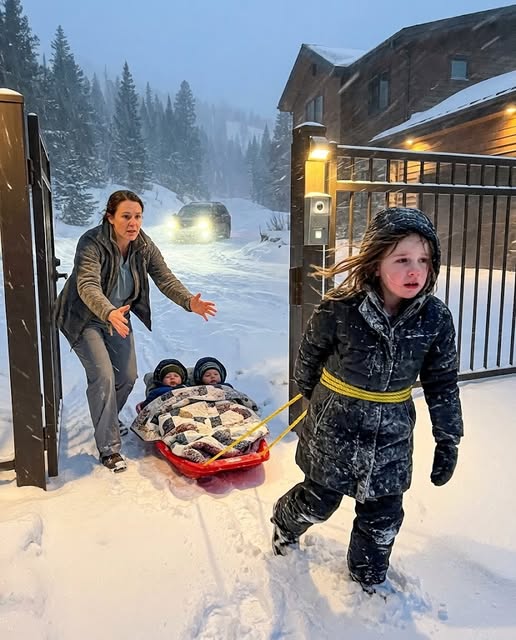
I told Rachel I was coming, trapped Grant between the two gates, and left Tessa with the twins inside my locked medical wing.
It was the worst medical decision available.
It was also the only one that gave all four of them a chance.

I lowered the outer gate just far enough to make Grant think I was surrendering.
His SUV rolled forward, tires slipping on packed snow, until the hood crossed the emergency sensor.
Then I closed the gate behind him and kept the inner barrier locked.
Grant hit the brakes.
For one second, he stared at the steel bars on both sides of his vehicle.
Then he looked directly into the nearest camera.
“Claire, this is not helping Rachel.”
His voice remained soft.
That made it worse.
I switched the intercom off.
The medical wing smelled faintly of antiseptic and the orange peel Tessa had left beside her blanket.
I wrapped Noah and Eli in warmed towels, secured each twin in a padded carrier, and placed both carriers on the floor beside Tessa’s cot.
A purple plastic dinosaur lay under the examination table, something one of my younger patients had forgotten months earlier.
It had no purpose there.
I gave Tessa my phone charger, a bottle of water, and one instruction.
“The dispatcher stays on the kitchen speaker. If any door opens, you tell her before you move.”
Tessa looked toward the coat.
“You’re taking that, right?”
“Yes.”
“And you’re bringing Mom back?”
“I’m going to reach her.”
She studied my face because seven-year-olds know when an adult has replaced a promise with a careful sentence.
Then she pulled Eli’s carrier closer with both hands.
“I can watch them.”
I carried Rachel’s coat into the garage and placed it behind the snowcat’s passenger seat.
As I did, my fingers found a hard rectangle beneath the blue stitches near the cuff.
It was too small to be another packet of papers.
Grant leaned on his horn as the garage door rose.
The sound bounced off the stone walls and made Noah cry through the monitor clipped to my coat.
I started the engine.
The cab filled with the smell of diesel and cold vinyl.
A single green mitten sat in the cup holder, although I had no idea how it had gotten there.
The east maintenance gate opened onto a narrow trail Grant could not reach from the vehicle trap.
I drove into the storm at 2:37 a.m.
The monitor crackled before I reached the first switchback.
“Dr. Hale,” the dispatcher said, “Grant Caldwell has placed a second emergency call.”
I kept both hands on the wheel.
“What is he claiming?”
“He says you lured him inside, threatened him, and fled with a firearm.”
“I don’t have a firearm.”
“I understand, but responding officers will receive both reports.”
Grant was turning my rescue attempt into proof of instability before I had even reached Rachel.
He had the unsigned custody petition.
He had three children who had been exposed to dangerous cold.
And now he had a recording of me locking him between two gates.
The snowcat slid sideways on the next turn, and I eased off the throttle until the tracks caught again.
“Keep the line open with Tessa,” I said.
“We are.”
A beep sounded through my phone.
The gate system had accepted an administrator login.
Not mine.
Grant had entered the installer code.
The camera feeds vanished one by one.
The garage lock changed from green to amber.
Then the medical-wing door showed OPEN.
“Tessa,” I said into the monitor.
No answer.
I stopped the snowcat in the middle of the trail.
Snow struck the windshield in pale sheets, and the heater pushed lukewarm air against my knees.
“Tessa, answer me.”
The dispatcher’s voice came through next.
“She’s moving the babies.”
A scraping noise followed.
Then Tessa whispered, “The door clicked, so I put them in the supply room.”
“Is the inside bolt set?”
“Yes.”
“Stay there.”
Grant had found the strongest piece of leverage left to him.
He could make me turn back without ever touching the children.
I opened the security application, revoked every remote credential, and severed the house from its outside network.
The cameras stayed dark.
So did the monitor.
I had protected the locks by giving up my ability to see the children.
There was no undo button.
I drove on.
Miller’s Cut was less than four miles away, but the storm made distance feel dishonest.
At 2:49 a.m., my headlights found a break in the guardrail.
The Subaru lay upside down below the road, half buried against two fir trees.
One rear wheel still turned slowly.
The air smelled of pine sap and leaking washer fluid.
A bent paper straw remained in the center console, trapped upside down with everything else.
“Rachel!”
Her answer came from below me.
“I’m here.”
I anchored the snowcat’s winch to a tree, clipped myself to the line, and descended sideways through knee-deep snow.
Rachel was suspended by her seat belt with her right shoulder pressed against the roof.
Her lips were gray, but she was awake.
I touched her neck and found a pulse that was fast but steady.
“The children reached me,” I said.
Rachel shut her eyes.
Only for a second.
“All three?”
“All three.”
“Grant?”
“Locked at my gate.”
Her eyes opened again.
“He knows your override code.”
“He already used it.”
Rachel’s left arm hung at an angle that suggested a fracture near the shoulder, but her hand was warm enough to make me risk moving her.
The rescue crew was still thirty-one minutes away.
I cut the belt, lowered her onto a rigid panel from the snowcat, and covered her with the insulated tarp.
She bit down on the edge of her scarf when the movement pulled at her shoulder.
I stopped when her breathing changed.
“Talk to me,” I said.
“The coat,” she whispered.
“I have it.”
“There’s something in the cuff.”
The hard rectangle.
“What is it?”
“A recorder.”
I looked toward the road above us.
“What did you record?”
“Enough to explain why he needed you.”
Her head rolled slightly against the panel.
“Don’t play it here. Get us back.”
I secured her beside me in the snowcat, wrapped the tarp under her chin, and started uphill at 3:02 a.m.
The storm had already covered half my tracks.
The dispatcher reconnected through the snowcat radio because my phone could no longer reach the house network.
“A deputy has reached your west gate,” she said.
“Is Tessa still responding?”
“Yes, but Grant is speaking to the deputy.”
“Can the deputy enter through the maintenance gate?”
“He says he will not enter until he understands who has legal custody.”
Grant had found another locked door that could be opened with paperwork.
He did not need a signed order if he could create enough uncertainty to make everyone wait.
Rachel heard the exchange.
Her uninjured hand closed around my sleeve.
“He’ll say I endangered them.”
“He already has.”
“He’ll make it sound reasonable.”
“He already has.”
She released my sleeve and stared through the windshield.
“Then let Tessa talk.”
I looked at her.
“She’s seven.”
“She’s also the only person he doesn’t know how to edit.”
At the west gate, Deputy Soto stood beside Grant’s SUV with wet snow clinging to the shoulders of his uniform jacket.
The air inside the gatehouse smelled of damp nylon when his radio connected to mine.
A grocery receipt had stuck to one of his boots and fluttered whenever he shifted his weight.
Grant held the custody petition against the glass partition.
“My children need a hospital,” he told Soto.
“My wife is having a psychiatric crisis, and her sister is reinforcing it.”
His words were not angry.
They were arranged to make resistance sound cruel.
Soto asked me to return to the property, surrender the children for medical transport, and provide a statement.
“I am returning with Rachel,” I said.
Grant’s face changed before he could hide it.
Soto noticed.
“You said your wife’s location was unknown,” he told Grant.
“It was.”
“Dr. Hale just said she has her.”
Grant placed one hand against the partition.
“Rachel lies when she’s frightened. Please do not let her pull you into this.”
The dispatcher connected Tessa to the gatehouse speaker.
Her voice was small and clear.
“Daddy made Mom drive.”
Grant turned toward the speaker.
“Tessa, sweetheart, you’re confused because you’re cold.”
“You took Mom’s phone.”
“I was trying to help her.”
“You told her Claire would sign the paper after she saw the babies.”
Nobody spoke for several seconds.
Grant recovered first.
“Officer, she has been coached.”
Then he reached for the manual gate panel.
Soto caught his wrist.
Grant pulled away hard enough to strike the emergency-release cover with his elbow.
The cover broke.
The outer gate began to rise.
Control changed hands in less than three seconds.
Grant lunged into the driver’s seat.
Soto drew his weapon but did not fire as the SUV reversed through the opening.
Grant turned downhill instead of toward the public road.
He was heading for the east maintenance gate.
He knew I would have to pass it.
I saw his headlights through the trees at 3:11 a.m.
Rachel saw them too.
“Don’t stop,” she said.
The maintenance trail narrowed between a rock wall and a drainage ditch.
Grant accelerated toward us, expecting the snowcat to yield.
I moved left until one track climbed the edge of the ditch.
Rachel braced her good hand against the dashboard.
At the last second, I stopped.
Grant swerved around us.
His right tires dropped into the soft shoulder, and the SUV tilted toward the ditch.
He corrected before it rolled, but the rear bumper struck a marker post and spun him sideways across the trail.
He had blocked our path.
Grant climbed out without a coat.
The temperature was low enough that his breath covered half his face.
“Claire,” he called, “Rachel needs care, and you are wasting time.”
I locked the snowcat doors.
“Move your vehicle.”
“Give me the children first.”
“They aren’t here.”
He looked at the passenger seat, saw Rachel under the tarp, and took one step back.
Rachel lifted her head.
“You should have checked the coat better.”
Grant walked toward us slowly, palms visible.
“You hit your head. You don’t know what you’re saying.”
“I know exactly what you said in the garage.”
His eyes shifted to the coat behind my seat.
That was all I needed to see.
I put the snowcat in reverse and drove backward along the trail while Grant ran after us.
He slipped once, caught himself on the rock wall, and kept coming.
Deputy Soto’s headlights appeared behind him.
Grant stopped.
For the first time that night, his voice lost its careful shape.
“You’re destroying this family over paperwork.”
Soto ordered him to turn around and place his hands behind his head.
Grant looked from the deputy to Rachel, then toward the coat.
He moved toward me instead.
Soto took him to the ground before he reached the door.
Grant’s cheek pressed into the snow while he continued speaking as though volume could restore control.
“The babies were freezing because of her.”
“They were freezing because they were running from you,” Rachel said.
Soto secured Grant’s wrists and placed him in the back of the patrol vehicle.
Then he helped clear the trail while I drove Rachel home.
The ambulance arrived at 3:28 a.m., escorted by a county plow whose driver had a coffee stain shaped like a thumb on his reflective vest.
Noah’s cough had eased.
Eli’s temperature was rising.
Tessa had kept both carriers inside the supply room and had counted every breath because she had watched me do it.
When I opened the door, she did not run to Rachel.
She looked at me first.
“Did you tell me before opening the gate?”
“I did.”
She nodded, then crossed the room and placed her hand on her mother’s blanket.
The paramedics stabilized Rachel’s shoulder and treated her for hypothermia before taking her down the mountain.
Soto collected the documents, the gate logs, and my photographs.
A second deputy photographed the broken emergency cover and the tire marks on the maintenance trail.
Grant sat in the patrol car and asked three separate officers whether the children had been properly evaluated.
By dawn, the house was quiet.
Grant was in custody.
Rachel was alive.
The children were warm.
For several minutes, that looked like the ending.
The kitchen clock still blinked 12:00 because the generator had reset it, and someone had left the peanut-butter jar open beside the sink.
Soto returned the coat long enough for me to remove the object from the cuff in front of him.
It was a flat digital recorder wrapped in a freezer bag.
The battery showed nine percent.
We played it once.
Grant’s voice filled the kitchen.
“Once Claire sees what you did to those babies, she’ll sign the physician statement.”
Rachel’s recorded voice sounded farther away.
“She’ll examine them. She’ll know I didn’t hurt them.”
“She’ll see three freezing children and a sister who sounds unstable. People believe the doctor who stays calm.”
Paper rustled near the recorder.
Then Grant said, “The bank only needs incapacity confirmed, and the custody petition only needs a credible emergency.”
The packet contained a fourth document folded behind the financial authorization.
I had photographed it without understanding its purpose.
It was a prepared medical declaration with my name already typed beneath a blank signature line.
Grant had not come to retrieve the children.
He had come to make me complete the story he had written about Rachel.
The freezing babies were supposed to be his proof.
My profession was supposed to make the lie respectable.
Soto stopped the recording and called the investigator handling the crash.
That afternoon, technicians found fresh tool marks and hydraulic fluid beneath the Subaru’s severed brake line.
The recorder did not prove every act by itself, but it connected the paperwork, the staged emergency, and Grant’s reason for following Rachel into the storm.
The bank froze the new authorization before any transfer cleared.
A judge rejected Grant’s unsigned custody petition and issued a temporary protection order after reviewing the hospital records, the gate footage recovered from local storage, and Tessa’s recorded emergency call.
Rachel remained in the hospital for four nights.
Her shoulder required surgery, and two of her fingers stayed numb for nearly three weeks.
Noah and Eli were discharged the next afternoon.
Tessa refused to leave until both carriers were placed beside her in the same vehicle.
Rachel did not ask her to be brave again.
She told her, “You did more than any child should have had to do. The rest belongs to us now.”
Tessa climbed into the back seat and slept before we reached the first paved turn.
The criminal case moved slowly because real cases do.
Investigators compared Grant’s installer login with the security records, examined his financial applications, and recovered deleted drafts of the medical declaration from his laptop.
His attorney called the recording incomplete.
The prosecutor answered with the brake-line analysis, the unsigned petition, the beneficiary change, and Grant’s attempt to reach the coat after seeing Rachel alive.
Eleven months after the blizzard, Grant entered guilty pleas to charges that included aggravated assault, forgery, and child endangerment.
The attempted-murder charge was resolved within the plea rather than tested before a jury.
The court imposed a prison sentence and extended the no-contact order.
Rachel’s accounts remained hers.
The insurance change was voided.
Family court granted her sole legal custody after a separate review that included medical reports, financial records, and testimony from the responding officers.
One cold morning in March, Rachel burned two pieces of toast while Noah pushed a spoon across the kitchen floor and Eli laughed at the sound.
Tessa still checked locks before bed, but she stopped asking whether Grant knew the codes.
Rachel rented a house twelve minutes from mine, close enough for breakfast and far enough to feel like her own decision.
She returned to work part-time after physical therapy restored most of the movement in her shoulder.
On the first anniversary of the storm, Tessa needed a new winter coat because the old one no longer reached her wrists.
Rachel bought a plain navy coat and sat at my kitchen table with a needle, blue thread, and a ceramic bowl full of loose buttons that did not match anything we owned.
She sewed a small pocket into the lining using the same uneven cross-stitches I had recognized that night.
Tessa watched without speaking.
When Rachel finished, she placed a brass house key inside the pocket.
The blue stitches were no longer hiding evidence from a man who believed every door belonged to him.
They held the key to a home Tessa could enter whenever she needed safety.
