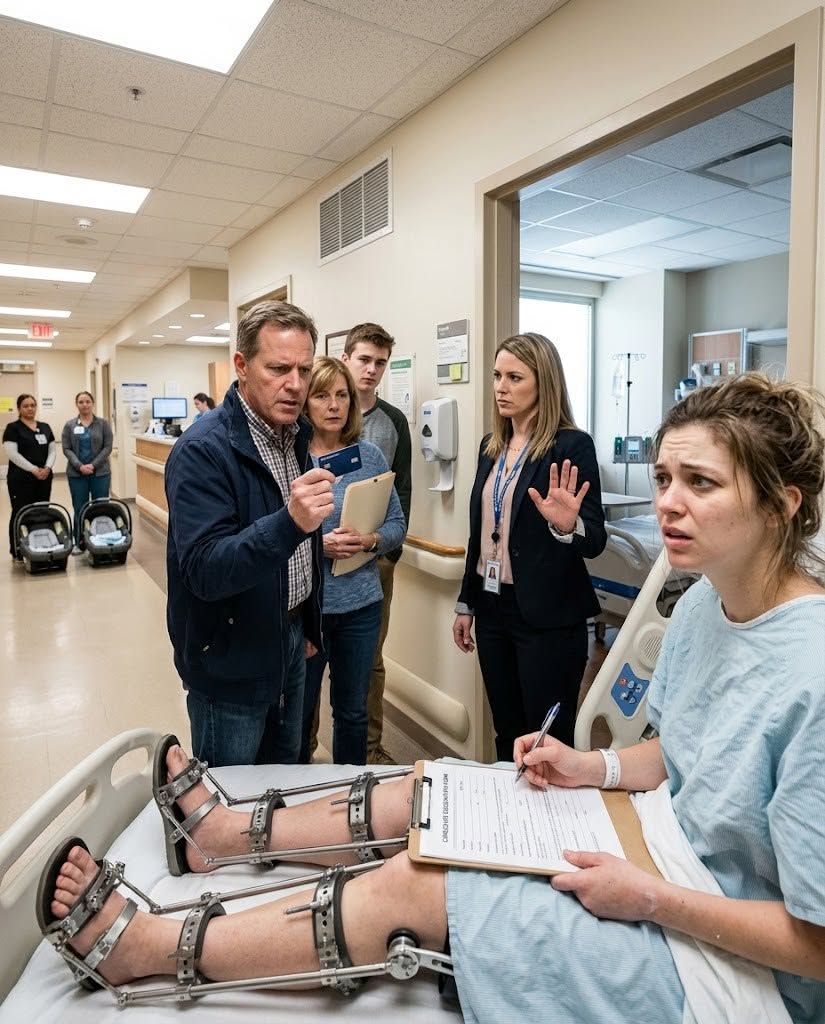
Dana looked at the empty space beside my parents, then at the two agency car seats waiting near the family-room door.
“Then you are not here as caregivers,” she said.
My father lifted the mortgage folder as though she had misunderstood the emergency.

“We’re her parents,” he said. “This is a private financial matter.”
The hallway was cold enough that my mother kept rubbing her bare arms, although she had refused the cardigan Evan offered her.
Dana did not move.
“This floor is treating a patient and arranging safe care for two infants,” she said. “You have declined to participate in either.”
My mother gave me the soft smile she used before asking me to fix something expensive.
“Sweetheart, nobody is declining anything,” she said. “We’re trying to protect you from making a terrible decision while you’re medicated.”
I held out my hand toward Evan.
“The card.”
My father closed his fist around it.
“No.”
One word.
Dana asked him to step away from my doorway.
He stayed where he was and told her I had suffered a traumatic accident, had been given narcotics, and was no longer capable of managing money or signing a thirty-day childcare contract.
My mother nodded beside him.
“She needs rest, not strangers filling her head with legal forms.”
The agency coordinator stopped turning pages.
The two caregivers stood near the wall with their licenses visible in clear plastic sleeves, waiting for someone at the hospital to tell them whether they were still taking my babies home.
My father had found the only attack that could still hurt me.
He could not unfreeze the card, but he might delay the care plan until the sitter’s twenty-four hours expired.
Dana asked the caregivers to remain in the family room while she contacted my attending physician.
Then she asked security to wait near the nurses’ station.
My mother’s smile tightened.
“You see?” she told Evan. “This is exactly what I meant by a breakdown.”
Evan looked at me for the first time since entering the hallway.
He had slept in yesterday’s shirt, and one side of his hair was pressed flat above his ear.
“Did you really cut them off in the middle of the night?” he asked.
“I stopped tomorrow’s transfer at 11:42,” I said. “After they refused to take the twins.”
Mom touched his elbow.
“She’s leaving out six years of history.”
“I have all six years,” I said.
My father slapped the mortgage folder against his leg.
“You offered to help us.”
“I offered help after you lost your job.”
“And we built our life around that help.”
The words came out before my mother could stop him.
Nobody spoke for several seconds.
A cart squeaked at the far end of the hall, and someone in another room asked for apple juice.
My father lowered the folder.
“What I mean is, families make commitments,” he said.
“So do parents,” I said.
My attending physician arrived with a resident and asked everyone except Dana to leave my room.
My parents objected until security took one step forward.
Then they moved into the hallway, where I could still hear my mother telling Evan that the hospital was isolating me from my support system.
The physician asked my full name, the date, where I was, why I had been admitted, and what I understood about the agency contract.
I told him the deposit amount, the thirty-day guarantee, the caregivers’ rotation, and the deadline Dana had given me.
He asked what would happen if I did not sign.
“The emergency sitter leaves at noon,” I said. “Without an approved plan, the hospital contacts child services for temporary placement.”
He asked why I had stopped paying my parents’ expenses.
“Because those expenses were voluntary, and my children’s care is not.”
The resident looked down at his clipboard.
My physician asked whether I understood that my parents might lose their home.
“I understand they may have to pay for it themselves.”
He completed the assessment and wrote that I had decision-making capacity.
Dana carried the signed note into the hallway.
My mother read the first line and said the doctor had spent less than nine minutes with me.
My father demanded another evaluation.
Dana refused.
The agency coordinator returned to my bedside, but before she could hand me the final page, her phone rang.
She listened without speaking.
Then she looked toward the doorway.
“A woman identifying herself as the babies’ grandmother just called our office and tried to cancel the placement,” she said.
My mother raised both hands.
“I was only making sure they knew she was impaired.”
The coordinator closed the folder.
“You were told last night that neither grandparent was authorized to make changes.”
“I’m their grandmother.”
“You are not the client.”
That landed harder than shouting would have.
My mother’s face went still.
The coordinator blocked both of my parents’ numbers from the twins’ file and added a verbal password that only Dana, the caregivers, and I knew.
Then she moved the signature page onto my tray.
My right hand trembled when I picked up the pen, so I rested my wrist against the plastic edge and signed slowly.
The deposit cleared at 8:16 a.m.
One problem was closed.
My father opened the mortgage folder and placed the statement over the agency contract.
The paper smelled faintly of the leather pouch my mother kept in her desk.
“You need to reverse the transfer before the bank finishes processing it,” he said. “We can discuss the rest after your medication wears off.”
I slid the mortgage statement back toward him.
“There is nothing to reverse.”
“Our payment is due tomorrow.”
“Then call the lender.”
My mother leaned close enough that I could see a pale mark where she had removed her airport wristband.
“Your father is sixty-three,” she said. “Do you really want him begging a bank because you’re angry?”
“I asked you to carry two babies out of a hospital.”
“We could not abandon our plans with no notice.”
Evan turned toward her.
“What plans?”
She glanced at Dad.
He answered for her.
“We had reservations.”
“For what?”
“It doesn’t matter.”
Evan took out his phone.
“Mom told me you were at home when she called me last night.”
My mother reached for his wrist.
“Put that away.”
He stepped back.
The control changed hands quietly.
Evan opened the family group messages and read the thread from the previous afternoon.
At 5:07, Mom had written that the airport hotel would not refund the room.
At 5:11, Dad had replied that I always panicked after medical procedures and would solve the baby problem once nobody rushed in to rescue me.
At 5:19, Mom had sent a picture of two boarding passes and told him to stop worrying.
Evan read the final message twice.
Then he looked at the car seats.
“You came here from the airport to get the card,” he said.
Dad pointed at me.
“She has been paying that mortgage for years because she agreed it was her responsibility.”
“No,” Evan said. “You told me you were living on savings.”
Mom’s voice became gentle again.
“We did not tell you because you were still getting established.”
“I’m thirty-one.”
“And she earns more than you.”
There it was.
Not need.
Assignment.
Dad told Evan that none of this concerned him and ordered him to hand over the phone.
Evan put the phone in his pocket.
Then he reached for the navy card.
Dad pulled his hand away.
They stared at each other until Dana asked security to intervene.
My father released the card rather than let a guard remove it from his fingers.
Evan placed it on my tray beside the pen.
The plastic was warm from Dad’s hand.
My mother watched it leave him.
“You will regret humiliating your father in public,” she said.
Dana wrote the sentence into her notes.
My mother noticed.
“Oh, please,” she said. “Are you documenting every emotional thing a frightened parent says?”
“I’m documenting attempts to interfere with an approved infant-care plan,” Dana replied.
Dad took out his own phone.
“If this hospital sends those babies away with strangers, we’ll report every person involved.”
“Report us to whom?” the coordinator asked.
“Child services.”
Dana capped her pen.
“They already know about the plan.”
My father made the call anyway.
He stood near the vending machines and described me as an immobilized mother under heavy medication who had transferred her children to people she had never met.
He did not mention that the caregivers were licensed.
He did not mention that the hospital had vetted the agency.
He did not mention refusing my request.
At 9:03, Dana received confirmation that an intake worker was coming to the floor.
The emergency sitter had less than three hours remaining.
Mom sat in the visitor chair as though the new investigation proved she had been right.
“This is what happens when you turn family matters into a spectacle,” she said.
I asked Dana for a copy of every form I had signed and the names of everyone who had reviewed the placement.
Then I asked the coordinator to remain until the intake worker arrived.
Dad laughed once.
“You think paperwork makes you a mother?”
One of my twins cried from the family room.
I pressed the call button and asked Tasha to bring him to my doorway.
She rolled his bassinet beside the bed, where I could touch his foot without disturbing the frame around my leg.
His sock had a tiny green thread loose at the ankle.
I kept my fingers there while the adults argued around him.
The county intake worker arrived at 9:41 with a canvas bag and a paper cup that smelled like peppermint tea.
She interviewed me first.
I described the crash, the rehabilitation recommendation, the agency schedule, and the thirty-day funding plan.
I showed her the capacity assessment and the transfer receipt.
She asked whether my parents had ever been the twins’ regular caregivers.
“No.”
She asked whether they had offered to help after the crash.
“No.”
She interviewed my parents separately.
Through the closed door, my father’s voice carried when he said he had no obligation to rearrange his life simply because I had failed to prepare for an accident.
The intake worker asked why he believed the agency placement was unsafe.
He said no grandparent would approve of strangers sleeping in a daughter’s apartment.
She asked whether he was volunteering to stay there instead.
He said that was not the point.
She asked my mother the same question.
Mom said they had nonrefundable travel expenses and a mortgage crisis that I had created without warning.
The worker returned to my room holding her cup with both hands.
She asked Evan whether he could provide occasional backup without becoming the primary caregiver.
He said yes.
Then he corrected himself.
“I can do Tuesdays and Saturdays after work,” he said. “I can learn whatever the agency needs me to learn.”
The coordinator wrote those days into the support plan.
My parents had brought a complaint to remove control from me.
Instead, it gave the plan another approved adult.
The intake worker closed the emergency report at 10:38 and documented that the babies had safe housing, licensed care, medical instructions, and financial support.
She also documented that the reporting grandparents had declined placement.
My father asked whether that last sentence was necessary.
She said it was accurate.
By 11:06, the caregivers had both babies secured in the clean car seats.
The white-noise machine was packed between formula containers in a gray tote, and Dana checked the apartment key against the agency receipt.
The sitter signed out forty-seven minutes before her deadline.
For a few minutes, it looked finished.
My parents left with their mortgage folder.
Evan stayed.
The elevators closed on Mom while she was telling Dad that I would call once the pain medication stopped making me vindictive.
At noon, Tasha brought me tomato soup and removed the packet of crackers because someone had accidentally dropped it into my water cup.
I ate four spoonfuls while Evan assembled the charger for the twins’ monitor.
Then my bank called.
The fraud specialist said someone had contacted them twice that morning claiming I was a vulnerable adult being manipulated by hospital employees.
The caller had requested an emergency restriction on outgoing payments and had attempted to restore the frozen card.
The agency deposit was now under review.
Evan stopped working on the charger.
“How long?” I asked.
“Up to three business days unless we complete an identity and capacity verification.”
The caregivers had already left with my babies.
Their contract allowed the agency to suspend service if the deposit failed.
My parents had not needed the card to reach me.
They had used my dependence on other people as the weapon.
The fraud specialist asked whether the man who called was an authorized user.
“He was until 11:42 last night.”
She reviewed the account log.
After the freeze, someone had attempted three password resets, called the automated line using my Social Security number, and supplied the old family password when transferred to a representative.
The password my parents had used to impersonate concerned family at the hospital had become the detail that linked the calls.
The specialist asked whether I wanted to authorize him again.
“No.”
She asked whether I wanted to suspend the complaint against the agency payment.
“Yes.”
She sent a verification link through the bank’s secure app, and my physician joined the call long enough to confirm the capacity assessment already in my chart.
Dana transmitted the signed care plan.
Evan provided the messages showing that my parents had discussed the frozen card before arriving at the hospital.
At 1:27, the bank released the agency deposit.
The fraud specialist separated my account from every phone number, address, and security answer associated with my parents.
She also opened a review of the post-revocation access attempts.
I did not dispute the six years of transfers.
I had sent that money willingly.
I disputed only their right to keep reaching into the account after I said no.
The distinction mattered.
My mother called Evan while the bank specialist was still speaking.
He put her on speaker after warning her that Dana was present.
“Tell your sister to stop this,” she said. “The bank has locked your father out of everything.”
Evan looked at me.
“She didn’t lock him out of his account,” he said. “She locked him out of hers.”
Mom hung up.
My transfer to rehabilitation happened the following morning.
The agency caregivers brought the twins to the center every afternoon and returned them to my apartment at night.
Evan came on Tuesdays and Saturdays, learned the feeding chart, and once arrived with the wrong size diapers because he refused to call Mom for advice.
He exchanged them himself.
My parents canceled their trip.
They sent me the cancellation fee, the mortgage statement, and a list of expenses they believed I owed because they had planned their retirement around my transfers.
I forwarded the envelope to the attorney handling my accident paperwork and asked for one letter confirming that no financial agreement existed.
After the letter was sent, I blocked their numbers.
There was no arrest.
There was no sudden foreclosure.
My father contacted the lender, accepted a temporary modification, and listed the house sixty-seven days later when they could not maintain the payment without my money.
Evan refused to replace me as their source of support.
He offered to help them compare smaller rentals.
They called that betrayal too.
Eleven weeks after the crash, a therapist lowered the parallel bars and asked me to move my left foot the width of a floor tile.
The rehabilitation gym smelled of warm rubber from the exercise mats.
I moved it less than an inch.
It counted.
On the twins’ first birthday, the caregivers brought them into the therapy room wearing shirts Evan had bought one size too large.
I sat in a reinforced chair while one caregiver placed a baby against each side of my chest.
Nobody let go until my arms were secure.
Then they stepped back.
I held both children at the same time.
Only for nineteen seconds.
Long enough.
The old navy card had been cut through the strip and sealed with the bank’s closure letter.
The new emergency card stayed in the twins’ diaper bag, linked only to their care account, with both caregivers listed by name.
