I left the construction site early on my son’s first birthday with a cake buckled into the passenger seat and no idea that I was driving toward the moment my family would split open.
My name is Connor Bradley, and I work as a construction engineer.

Most weeks, my schedule was measured in concrete pours, inspection windows, delayed deliveries, and calls that started before sunrise.
That Friday, however, I had arranged for another engineer to cover the final hours of my shift because my son Frederick was turning one.
I wanted to surprise my wife, Amy, by getting home before the small birthday dinner she believed we were having that evening.
The cake beside me had pale blue frosting, Frederick’s name written across the top, and a single candle tucked into the corner of the box.
On the floor behind my seat was a gift bag containing a small pendant stamped with the letter “F.”
I had bought it for Amy because she had carried our son, endured months of sleepless nights, and somehow still apologized whenever she needed help.
There was also a blue dress folded inside a department-store box.
Amy had been looking at that dress online for weeks, but each time I told her to order it, she said we had more important things to spend money on.
She always put herself last.
At the time, I believed that was simply who she was.
I did not yet understand how much pressure she had been under inside our own home.
My mother, Teresa, had moved in shortly after Frederick was born.
She told me Amy needed another experienced woman around while recovering and learning how to care for a newborn.
Because my job often kept me away for ten or twelve hours at a time, the offer sounded generous.
Teresa said she would handle groceries, household bills, meal planning, and childcare whenever Amy needed rest.
In exchange, I transferred $3,000 to her every month.
The arrangement was supposed to make life easier for everyone.
Whenever I called from a jobsite, Teresa told me the house was running smoothly.
Whenever I asked Amy whether she was getting enough sleep or whether my mother was helping, she said everything was fine.
Her answers were often brief, but Frederick usually cried in the background, a machine would be running, or someone would call my name from across the site.
I accepted the reassurance because I wanted it to be true.
I wanted to believe my mother was helping the woman I loved.
I wanted to believe Amy would tell me if something was wrong.
I wanted to believe I had built a safe home for my wife and son.
The first warning that afternoon was the traffic on our street.
A line of pickup trucks, sedans, and family SUVs stretched past my driveway, leaving barely enough room for me to pull to the curb.
At first, I thought Teresa might have arranged a surprise birthday party.
It would have been excessive, especially since Frederick was too young to understand it, but my mother had always liked being the center of family gatherings.
Then I noticed that several vehicles belonged to relatives who had barely spoken to Amy since our wedding.
Music drifted from the backyard, loud enough to carry halfway down the block.
I could hear laughter, chairs scraping across the patio, and someone calling for another bottle.
I took the cake from the passenger seat, balanced the gift bag against the box, and walked toward the side gate.
The closer I got, the stronger the smell became.
Pulled pork, butter, grilled seafood, spices, and liquor hung in the warm air.
When I rounded the corner, nearly twenty relatives were gathered around folding tables covered with food.
There were platters of seafood, trays of meat, bowls of side dishes, several desserts, and expensive bottles lined up beside red plastic cups.
It looked less like a baby’s birthday and more like a catered reunion.
My mother stood in the middle of the yard wearing a brand-new dress and sparkling jewelry I had never seen before.
She held a bottle of tequila in one hand while relatives laughed around her.
“My son makes excellent money,” she announced as she poured drinks. “He gives it to me so I can treat the family the way they deserve.”
The words stopped me beside the fence.
The monthly transfers were for groceries, utilities, and Frederick’s care.
They were not for jewelry.
They were not for liquor.
They were not for feeding twenty relatives while my wife believed we were trying to control our expenses.
One of my aunts glanced toward the house and asked where Amy was.
Teresa did not lower her voice.
“In the kitchen,” she said. “I ordered her to prepare everything.”
A few relatives shifted in their chairs, but no one interrupted her.
“She thinks she’s fragile just because she had a baby,” my mother continued. “A woman who’s financially supported should earn the food on her plate.”
My grip tightened against the cake box.
Then Teresa raised her cup and spoke loudly enough for everyone to hear.
“In this house, I’m the one who makes the rules,” she declared. “His wife is only good for giving birth and washing dishes.”
No one challenged her.
Not one person stood up.
Not one relative asked whether Amy was all right.
Some looked uncomfortable, but discomfort did not stop them from eating the food my wife had apparently been ordered to prepare.
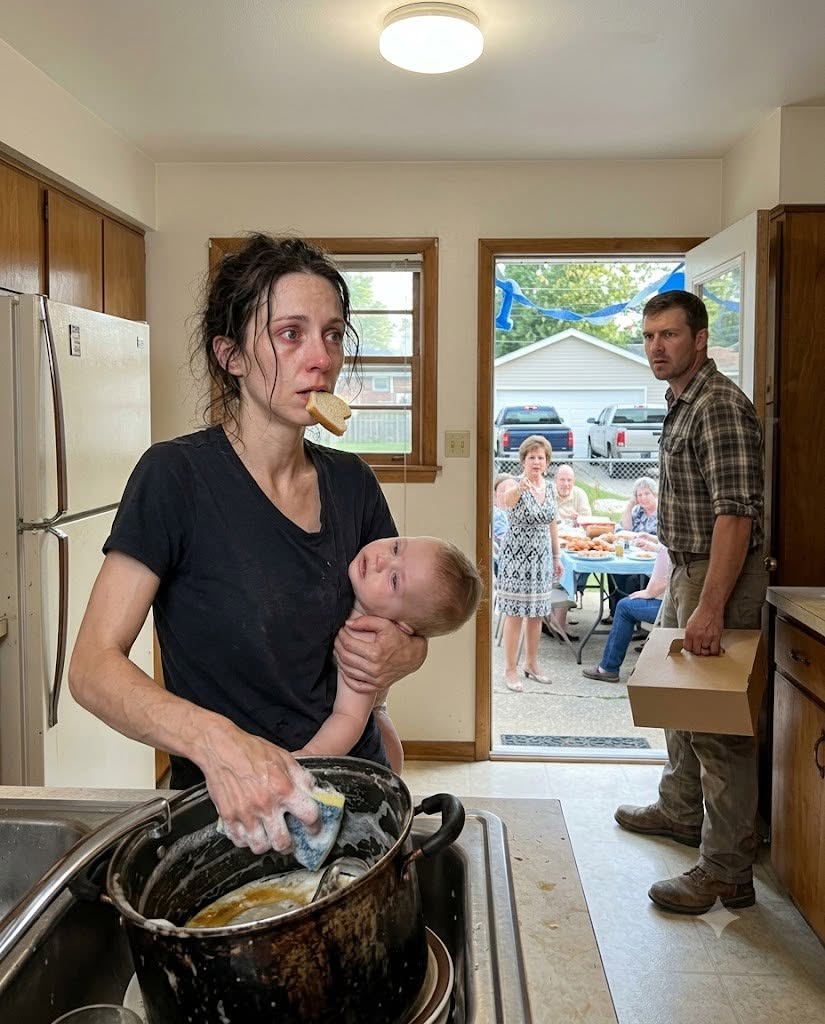
I stepped backward before anyone noticed me and entered through the rear door.
The kitchen looked like the aftermath of a restaurant rush.
Greasy pans covered the stove.
Dirty plates were stacked across the counter.
Serving spoons, trays, bowls, and cups filled every open surface.
The sink was crowded with heavy pots.
Amy sat on a plastic stool beside it.
She held Frederick against her chest with one arm while scrubbing a large pot with the other.
A dry piece of bread was clenched between her lips because both of her hands were occupied and, as I later understood, she had not been given enough time to sit down and eat.
Her shirt was soaked with sweat.
Her hair clung to the sides of her face.
Her cheeks looked hollow, and her wrists seemed painfully thin beneath the sleeves she had pushed back.
Frederick rested against her shoulder, but something about the way he was breathing immediately frightened me.
His breaths were fast and shallow.
His eyes looked glassy.
The bread fell from Amy’s mouth when she saw me standing in the doorway.
For a second, she did not look relieved.
She looked terrified.
“Connor,” she whispered, “your mother said I couldn’t stop yet.”
The scrub brush slipped against the pot.
“I still have to serve the coffee.”
I set the gifts on the counter and crossed the room.
When I took Frederick from her, heat radiated through his clothes.
I pressed the back of my fingers against his forehead and felt my stomach drop.
His skin was burning.
“How long has he been like this?” I asked.
Amy opened her mouth, but her gaze moved toward the backyard door.
That small movement told me more than any explanation could have.
She was checking whether Teresa might hear her.
I reached for Amy’s hand.
“We’re leaving.”
She did not stand immediately.
Instead, she looked toward the backyard again.
“She’s going to be angry.”
Those five words hurt more than anything my mother had said outside.
Amy was afraid to leave her own kitchen in her own home while our feverish son struggled to breathe comfortably against my chest.
I had spent months believing my mother’s presence made Amy feel supported.
Now my wife was asking permission with her eyes before she could protect our sick child.
I pulled the towel from her hand and placed it beside the sink.
“You don’t need her permission,” I said.
Amy’s knees shook when she stood.
I kept Frederick against my shoulder and supported her with my free arm as we moved through the kitchen.
The backyard door opened before we reached it.
A relative stepped inside carrying an empty tray, noticed me, and froze.
I did not explain.
I walked past him with my wife beside me and my son in my arms.
The conversation outside began to fade as people saw us.
Teresa turned from the table with the tequila bottle still in her hand.
Her expression hardened when she noticed Amy leaving the kitchen.
“Where do you think you’re going?” she demanded.
I kept walking.
Frederick’s hot cheek rested against my neck.
Amy’s hand gripped my sleeve.
“Connor, put him down,” Teresa called. “She hasn’t finished.”
Several relatives stared at us, but the only thing I cared about was reaching the car.
I opened the rear passenger door and helped Amy inside.
Then I secured Frederick in his car seat while Amy sat beside him, keeping one hand against his chest.
The birthday cake was still in my other hand.
I placed it on the ground beside the passenger door.
Blue frosting pressed against one side of the clear lid, but I barely noticed.
My mother’s voice grew louder behind me as she crossed the yard.
She demanded to know why I was embarrassing her in front of the family.
She said Amy was being dramatic.
She said babies got fevers all the time.
She said the party had already cost her too much money for me to ruin it.
That sentence made me turn around.
The party had cost her nothing.
The money had come from me.
More precisely, it had come from the account I used to support my wife, my child, and the household I thought Teresa was managing responsibly.
For months, I had sent the same amount on the same date.
Three thousand dollars.
Three thousand more.
Then another three thousand.
I had trusted my mother enough to let the pattern continue without demanding every receipt.
Yet the moment I saw Amy beside the sink, thin and exhausted, I understood that the money had not purchased safety.
It had purchased Teresa’s control.
I pulled out my phone.
Months earlier, after refinancing paperwork had briefly gone missing, I had created a hidden folder labeled HOME.
Inside it, I kept a scanned copy of the deed, copies of household records, and confirmation of every $3,000 transfer I had made to Teresa.
I had saved those documents as a precaution against lost paperwork.
I never expected to use them against my own mother.
Teresa reached the driveway as I unlocked the folder.
“What are you doing?” she asked.
Her voice had changed.
It was no longer the booming voice she had used in front of our relatives.
It was lower now, sharper and more careful.
I looked through the car window at Amy.
She was touching Frederick’s forehead, her face pale with worry.
Then I called 911.
I told the dispatcher that people were inside my home without my permission.
I explained that my wife had been forced to cook, clean, and serve a gathering while caring for our sick baby.
I said my wife was afraid of the person claiming authority over the house.
I also requested an ambulance because my one-year-old son had a high fever and was breathing rapidly.
Teresa shouted over me that I was lying.
She told the relatives gathering near the driveway that Amy had poisoned me against my own family.
Then she reached toward my phone.
I stepped back and continued speaking to the dispatcher.
The relatives who had laughed at her speech were no longer laughing.
A few drifted away from the tables.
Others began gathering purses, containers, and keys.
My mother saw them moving and ordered everyone to stay.
“This is my house,” she shouted. “Nobody leaves until I say so.”
The statement carried across the driveway.
Several people heard it.
So did the dispatcher through my phone.
I gave our address and stayed beside the car.
Amy cracked the window and asked whether help was coming.
“Yes,” I told her. “Stay with Frederick.”
My mother moved closer.
“You have no idea what you’re doing,” she said.
For the first time that afternoon, I looked directly at her rather than at the party, the food, or the people watching us.
“I know exactly what I’m doing,” I said. “I’m protecting my wife and my son.”
Teresa pointed toward Amy through the car window.
“She is the problem,” she said. “She is lazy, ungrateful, and useless unless someone stands over her.”
Amy heard every word.
I saw her shoulders fold inward as though she had heard those accusations many times before.
That was when I realized the kitchen scene had not been a single bad afternoon.
The fear in Amy’s voice had been practiced.
Her silence during my phone calls had been practiced.
Even the way she looked toward the backyard before answering me had been practiced.
My mother had spent months teaching my wife that speaking would make things worse.
I opened the driver’s door so I could leave for the hospital the moment emergency responders arrived.
Teresa planted herself beside it.
“You are not taking my grandson anywhere,” she said.
“He is my son,” I answered.
“And this is my house.”
She laughed at me.
Not nervously.
Not uncertainly.
She laughed as though I were a child who had misunderstood his place.
“You work,” she said. “I run everything here.”
Then she turned to our relatives and raised her voice again.
“Tell him,” she demanded. “Tell him whose house this really is.”
No one answered.
The music was still playing in the backyard, but without the crowd noise it sounded strangely distant.
Someone finally walked over and switched it off.
The sudden quiet made Frederick’s strained crying audible through the cracked car window.
That sound ended whatever hesitation remained in me.
“You used money meant for this household to throw a party,” I said. “You ordered my sick wife to work while holding my feverish child, and now you’re blocking us from leaving.”
Teresa folded her arms.
“I used family money for family,” she replied.
“It was not your money.”
“It came into my account.”
“So did every transfer record.”
Her eyes dropped to my phone.
Behind her, my cousin Mason moved away from the group.
At first, I barely noticed him.
He slipped along the side of the house while the rest of the relatives watched my mother and me argue in the driveway.
Mason had been close to Teresa for years and often helped her carry boxes, move furniture, and handle paperwork she claimed was too complicated.
He avoided looking at me as he disappeared through the front door.
I would have followed him, but Frederick needed medical attention, Amy was frightened, and Teresa was still standing between me and the driver’s seat.
Then a siren sounded at the end of the street.
The first police cruiser turned past the mailbox and headed toward our house.
A second vehicle followed behind it.
The relatives began talking all at once.
Some insisted they had only come for a birthday party.
Others said Teresa had invited them and told them she owned the home.
One aunt quietly placed her plate on the edge of the driveway and stepped away from my mother.
Teresa rushed toward the arriving cruiser before it had fully stopped.
She waved both arms and shouted that I was threatening her.
She said the house belonged to her.
She claimed I had arrived unexpectedly, frightened the guests, and tried to remove her grandson without permission.
The nearest officer stepped out and asked everyone to keep their distance.
Another officer approached the car after hearing that a sick child was inside.
I pointed toward Amy and explained that an ambulance was on the way.
Teresa kept interrupting.
“This is my property,” she insisted. “My son has no right to throw me out.”
The officer asked whether she had identification or documents proving ownership.
“Yes,” she said immediately.
The confidence in her answer made me look toward the house.
At that exact moment, the front door opened.
Mason stepped outside with a thick folder hidden beneath his jacket.
He tried to move behind two relatives standing near the porch, but the folder was too large to conceal completely.
One corner struck his elbow and slid into view.
I unlocked the hidden HOME folder on my phone and opened the scanned deed.
The image showed my name and Amy’s name clearly.
I walked toward the nearest officer and held out the screen.
“This is the deed,” I said. “The original was kept inside the house.”
The officer studied the scan.
Then his gaze shifted past me.
Mason had reached the bottom porch step.
The thick folder was still tucked under his jacket, and one of his hands was pressed against it as if he were trying to keep the contents from slipping out.
The officer looked from the deed on my screen to the folder beneath Mason’s coat.
“Sir,” he said, turning toward my cousin, “take your hands out where I can see them.”
