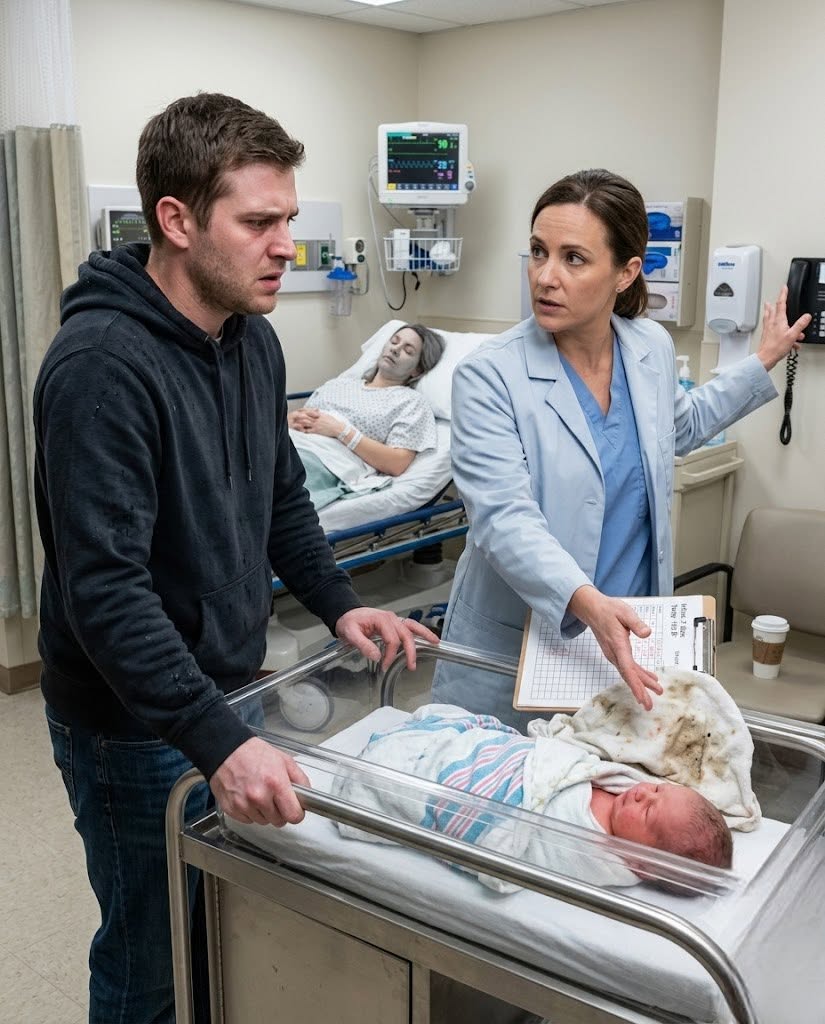
My son was seven days old when I found him burning with fever beside his unconscious mother.
That sentence still feels impossible to say, because every word in it belongs to a life I thought I understood.
Seven days old.

A fever.
His mother unconscious.
And the two people I had trusted to protect them sleeping comfortably in the next room.
My name is Ethan Miller, and I live outside Columbus, Ohio.
I work as a warehouse supervisor for a construction supply company, which means most of my days are spent solving practical problems before they become expensive ones.
A truck arrives short.
A machine shuts down.
A supplier says paperwork is missing.
Someone calls my name, and I start tracing the problem backward until I find the point where it began.
I used to believe that if I paid attention, stayed calm, and worked hard enough, I could fix almost anything.
Then my wife, Emily, gave birth to our first child.
We named him Noah.
When the nurse placed him in my arms, he was wrapped so tightly in a hospital blanket that only his face showed.
A small blue cap kept sliding over one ear.
I remember using one finger to push it back because I was afraid my whole hand would be too rough for him.
Emily watched from the bed, exhausted and smiling.
She had always been like that.
Even when she was the one in pain, she found a way to make the other person feel steady.
She thanked nurses who were only doing their jobs.
She apologized when strangers bumped into her grocery cart.
She could turn our small rented house into a home with a warm meal, a folded blanket, and the way she asked about your day as though the answer mattered.
I thought becoming a father would make me more careful.
Instead, four days after Noah came home, my job gave me a choice that did not feel like a choice.
A serious problem had surfaced at another branch.
Stock paperwork was missing.
A supplier was angry.
Several documents carried my signature, but I did not remember approving them.
My manager told me I had four days to straighten it out.
He did not say directly that I would be fired if I failed.
He did not have to.
Emily and I were living on my paycheck while she recovered from childbirth.
Rent was due every month whether a newborn had kept us awake or not.
Diapers, groceries, gas, and every small hospital expense had already made our checking account feel thinner than it had a week earlier.
I told myself going was the responsible thing.
I told myself I was protecting my family by protecting my job.
The lie was not that my job mattered.
The lie was that leaving was safe because my mother and sister had promised it would be.
Before I drove away, I stood in our kitchen with my mother, Linda, and my younger sister, Ashley.
The room still held the traces of our first days home with Noah.
A bottle sat near the sink.
A folded burp cloth rested on the back of a chair.
Emily was sleeping down the hall with the baby beside her.
I spoke more carefully than I normally did with my family because I did not want them to think I doubted them.
“Please take care of her,” I said. “She needs rest, food, fluids, and help with the baby.”
My mother touched my cheek the way she had when I was a boy.
“Ethan, she’s family now,” she said. “Your wife and grandson will be safe.”
Ashley stood nearby holding Noah’s tiny hand.
“Stop acting like you’re the only one who loves them,” she said with a smile. “We’ve got this.”
That sentence stayed with me during the drive.
We’ve got this.
It sounded comforting then.
Later, it would sound like a door closing.
The work problem consumed every hour after I arrived.
I checked shipments, compared documents, spoke with the supplier, and tried to understand how my signature had landed on paperwork I did not remember seeing.
Still, I called home constantly.
Every time, my mother answered.
At first, that did not seem strange.
Emily was exhausted, and I assumed Mom was letting her sleep.
When I asked to see my wife, Mom would switch to video and carry the phone down the hall.
The camera never stayed still for long.
Emily would appear for only a few seconds.
Her face looked pale.
Her hair clung to her forehead.
Her lips looked dry.
I asked whether she had eaten.
Mom answered before Emily could.
I asked whether she was drinking enough water.
Mom said she was.
I asked whether Noah was feeding.
Ashley called from somewhere nearby that everything was fine.
On one call, Emily looked toward the phone and whispered, “Eth…”
Before she could finish, the image shifted.
My mother’s face filled the screen.
“She’s emotional,” Mom said. “All new mothers cry.”
I wanted to believe that explanation because I needed it to be true.
I was hours away, trying to keep the job that paid for the roof over their heads.
Accepting that something was wrong would mean admitting that every hour I stayed was another hour I had chosen work over the warning in my own chest.
So I asked again whether Emily was okay.
Mom said yes.
I asked whether Noah was okay.
Mom said yes.
Then the call ended.
Another night, I heard Noah crying in the background.
By then, I knew the sound of his normal cry.
This was not it.
It was weak and thin, a desperate little sound that seemed to run out of strength before it finished.
“Why does he sound like that?” I asked.
Ashley laughed.
“Babies cry, Ethan. What did you expect him to do?”
Her answer should have made me angry.
Instead, it made me uncertain.
That is the part I hate admitting.
I let their confidence make me question my own fear.
I had spent years being the dependable one in the family, the person who did not panic, the person who fixed things.
Now the people I trusted were telling me I was overreacting.
Something in my stomach kept telling me to go home.
On the fifth night, the work crisis ended earlier than expected.
I did not call my mother.
I did not tell Ashley.
I put my things in the car and started driving.
Rain streaked the windshield.
The highway lights blurred against the glass.
I stopped once for gas and bought a paper cup of coffee that was too hot, too bitter, and somehow still not strong enough to keep my thoughts from circling the same question.
Why had Emily not spoken to me alone?
I remembered the way Mom moved the phone.
I remembered Ashley laughing while Noah cried.
I remembered Emily trying to say my name.
By the time I turned onto our street, the sky was beginning to lighten.
I pulled into the driveway before sunrise.
The house looked ordinary from the outside.
That almost stopped me.
The porch was wet from the rain.
The windows were dark.
Nothing was broken.
No alarm was sounding.
But the moment I opened the front door, the silence hit me.
It was not peaceful.
It was not the quiet of a house where a mother and newborn were finally sleeping.
It was the kind of silence that reaches your body before your mind can name the danger.
Then came the smell.
Sour milk.
Dirty diapers.
Sweat.
And something metallic I could not place at first.
Pizza boxes, chip bags, and empty soda bottles covered the table.
My mother and Ashley were asleep on the couch.
They looked comfortable.
That detail still makes me sick.
“Where is Emily?” I asked.
Mom stirred and looked at me as though my arrival was the problem.
“In the bedroom,” she said. “She’s probably sleeping.”
Then I heard Noah.
His cry was so thin that I almost missed it.
Almost gone.
I ran down the hall.
The bedroom door opened, and the morning light coming through the blinds showed me everything at once.
Emily lay on the bed, gray-faced and barely breathing.
Her hair was tangled against the pillow.
Her body did not move when I called her name.
Noah was beside her.
His tiny face was red.
His lips were cracked.
The blanket around him was dirty.
I touched his forehead, and the heat under my palm was so intense that my hands began to shake.
For one second, I could not understand how the room and the calls belonged to the same four days.
My mother had said Emily was resting.
Ashley had said babies cried.
They had told me everything was fine.
Nothing in that room was fine.
I shouted for help.
Mom and Ashley appeared behind me.
They froze.
It was not the reaction of two people seeing a tragedy for the first time.
It looked like the reaction of two people seeing the thing they had hoped would remain hidden.
I did not stop to argue.
I pulled off my hoodie and wrapped it around Noah.
Then I lifted Emily.
She felt frighteningly limp in my arms.
I carried my wife out of the bedroom while holding our newborn close enough to feel the heat coming through the fabric.
My mother said my name.
Ashley started asking where I was going.
I kept moving.
Our neighbor, Mr. Harris, opened his door when I pounded on it.
He saw Emily in my arms and Noah bundled against me.
He did not ask for an explanation.
He grabbed his keys.
The ride to the hospital passed in broken pieces.
Mr. Harris drove.
I watched Emily.
I checked Noah.
I said both their names as though hearing my voice might keep them with me.
At 5:42 a.m., we reached the emergency room.
Hospital staff took one look at Noah and moved immediately.
A nurse wrote “7 DAYS OLD — FEVER” across his chart.
The words were simple.
They were also terrifying.
Seven days old meant there was no room to wait and see.
Noah disappeared behind moving bodies, bed rails, and medical equipment.
Another team took Emily.
I stood between the two treatment spaces in the same rain-damp clothes I had worn through the drive, unable to follow both of them.
That helplessness was worse than anything I had felt at work, because there was no missing shipment to trace and no machine I could open with a wrench.
There were only two people I loved, and I did not know whether I had reached them in time.
A doctor examined Emily first.
Then she moved toward Noah.
She looked at his face, his blanket, and the condition in which he had arrived.
She asked questions in a calm voice.
How old was he?
Seven days.
How long had I been away?
Four days.
Who had been helping Emily?
My mother and sister.
The doctor looked at me more directly.
“Who was caring for them at home?” she asked.
“My mother and sister,” I said. “Why?”
She turned toward the nurse.
Her expression had changed.
The room did not become louder.
No one shouted.
That made what happened next feel even more serious.
The doctor spoke quietly.
But everyone heard her.
“Call the police.”
For a second, I thought I had misunderstood.
The nurse did not hesitate.
She stepped away from Noah’s treatment bed and reached for the phone while another nurse guided me toward a chair.
My knees gave out before I reached it.
Through the open doorway, I could see doctors working around my seven-day-old son.
Behind a curtain only a few feet away, Emily lay on a gurney.
I kept repeating the same defense, though no one had accused me yet.
“I was gone four days. I called every day.”
The doctor faced me.
“Tell me exactly what you saw on those calls,” she said. “Who held the phone? How long did you see your wife? Did you ever speak to her alone?”
Every interruption returned at once.
Mom cutting Emily off.
Ashley laughing at Noah’s cry.
The camera held close to Emily’s face.
The room around her never shown.
My phone began vibrating in my pocket.
MOM.
Then ASHLEY.
Then MOM again.
I watched the names flash until the calls stopped.
A message appeared almost immediately.
Where did you take them?
I read it twice.
The question was not whether Emily was alive.
It was not whether Noah was safe.
It was where I had taken them.
I handed the phone to the nurse.
The doctor read the message and looked through the glass toward Noah.
Then she asked me one question that changed what I thought those four days had been.
“Ethan, before you left, did Emily have her own phone—and was she physically able to get food, water, or help without your mother and sister?”
I looked toward the treatment rooms where my wife and son were fighting through the consequences of a decision I had made in trust.
For the first time, I stopped asking whether my family had failed to care for them.
I began asking what my mother and sister had been preventing me from seeing.
