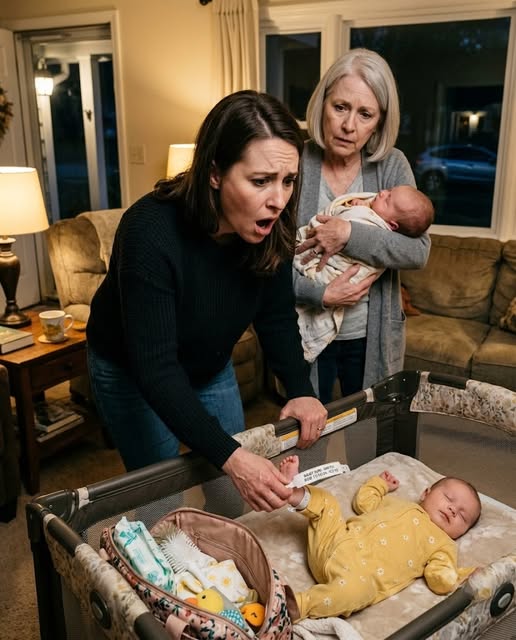
The name on the bracelet belonged to my ex-husband.
Not mine. Not Lily’s. His.
The birth date was twelve days earlier.

I gripped the crib rail while my mother held Lily against her chest and watched my face. “Morgan,” she whispered, “what does it say?”
Before I could answer, my phone began vibrating in my pocket.
The number was blocked, but I knew who it was before I picked up.
My ex spoke without saying hello. “Do not call anyone. I can explain.”
I stared at the sleeping baby. “Is she yours?”
He went quiet long enough to answer me.
Then he said the baby’s mother believed he had arranged a safe overnight visit with Diane. He claimed he had only needed a few hours and that everything had gotten “mixed up.”
“Mixed up?” I said. “Someone walked into my mother’s house pretending to be me.”
He lowered his voice. “Your mom assumed what she wanted to assume.”
That sentence changed the room.
He knew about her forgotten appointments. He knew about the keys she had left in the refrigerator and the tea she reheated twice. He had taken the small mistakes we were trying not to fear and turned them into cover.
Mom heard him through the phone.
Her face tightened, but she did not look away.
“Who brought the baby?” I asked.
He told me the baby’s mother had made the drop-off because he had promised Diane was expecting her. She had used the diaper bag he packed, the sleeper he bought, and the travel crib he knew was still in the attic.
Then he said, “She’s coming back now, and she cannot find you there.”
I locked the front door.
“No,” I said. “This time, everyone is going to hear the same story.”
Headlights swept across the living room wall.
A car stopped in my mother’s driveway—
The woman who stepped out was not a stranger to my ex, but she was a stranger to us.
She looked exhausted, with a loose sweatshirt over pajama pants and her hair pulled into a knot that had mostly fallen apart.
She hurried toward the porch, then stopped when she saw me through the glass.
Her eyes moved from my face to my mother, then to the two babies in the living room.
I did not open the door.
“Tell me your name and why you left your child here,” I said through the wood.
She raised both hands where I could see them.
“I was told Diane knew I was coming,” she said. “He said you had already explained everything.”
Behind me, the baby in the travel crib made a soft restless sound.
The woman’s whole body leaned toward it before she caught herself.
That was the first thing I believed about her.
She was the baby’s mother.
It did not make her innocent, but it made the fear on her face real.
Mom shifted Lily higher against her shoulder and said, “Did you tell me you were Morgan?”
The woman looked stunned.
“No. You opened the door and called me Morgan.”
Mom’s fingers tightened around Lily’s sleeper.
“You answered me.”
The woman’s face folded with shame.
“I said I was here about the baby. He told me you sometimes mixed up names and that correcting you would only upset you.”
My ex was still on my phone.
He had not disconnected.
I lifted the screen and said, “You heard that.”
He answered quickly. “She is twisting it.”
The woman pulled out her own phone and held it toward the window, not as proof for me but as if she needed to remind herself that the instructions had been real.
“I am not twisting anything,” she said. “You told me to leave her for three hours. You said your former mother-in-law had agreed.”
Former mother-in-law.
The phrase made my mother flinch because it was true and because he had used the relationship only when he needed something.
I unlocked the deadbolt but kept the chain in place.
“You can come in when you tell me one thing,” I said. “Did you know he was still married when you got pregnant?”
Her mouth opened, then closed.
The answer was in the delay.
She had not known at first.
By the time she learned, I had already left him.
He had told her our marriage had ended months before it actually did, then told me there was no one else when I found messages I was not supposed to see.
For eight months, I had been trying to remove his name from bills, delivery accounts, emergency forms, and every small place where a life keeps remembering someone after the relationship is over.
Now his name was fastened around a baby’s ankle in my mother’s living room.
I opened the door.
The woman stepped inside and went directly to the crib.
She did not reach for the baby until I nodded.
Then she placed both hands gently beneath the child and lifted her against her chest.
The baby woke with a thin cry, and the woman pressed her cheek to the yellow sleeper.
“I thought she was safe with him,” she whispered.
“She was safe,” Mom said, and her voice broke. “But not because of him.”
My ex began talking over the phone, telling both of us that the situation looked worse than it was.
He said he had panicked.
He said he had not slept.
He said the woman needed rest, he had nowhere quiet to take the baby, and Diane had always loved children.
Each sentence contained one piece of truth arranged around the lie.
Mom would have helped if he had called honestly.
I might even have helped, not for him but for a newborn who had done nothing wrong.
He had chosen deception because honesty would have forced him to admit that the two lives he had kept apart had finally touched.
The woman sat on the edge of the couch with the baby against her shoulder.
“Why the same sleeper?” I asked.
She looked down at the stitched daisies.
“He bought it,” she said. “He said his daughter had one like it and it was the softest kind.”
His daughter.
Lily.
He had taken a detail from the child he already had and used it to dress the child he had hidden.
The matching wipes and bottle brush were not part of some elaborate disguise.
They were the brands he remembered from our house because he had never bothered to learn anything new.
That realization hurt differently from the affair.
Even his second life had been furnished with pieces of the first.
Mom lowered herself into the armchair.
“I carried the crib down from the attic,” she said slowly. “The woman did not bring it.”
I looked at her.
The story she had told me on the phone had already shifted.
She pressed one hand to her forehead.
“I thought you asked me to get it,” she said. “But maybe she said the baby needed somewhere to sleep, and I decided you must have meant the crib.”
The woman nodded carefully.
“I said I did not have a portable crib. You told me Morgan kept one upstairs.”
Mom closed her eyes.
She had remembered a request that had never been spoken because it fit the person she believed was standing at the door.
My anger at my ex remained sharp, but the fear beneath it grew heavier.
This was no longer only about what he had done.
It was about how easily my mother’s memory had helped him do it.
I crouched beside her chair.
“Mom, look at me.”
She opened her eyes and locked them on mine.
“You protected that baby,” I said. “You called me when something stopped making sense. That was the right thing.”
“I let someone into my house.”
“Yes.”
“I believed she was you.”
“Yes.”
I would not comfort her with another lie.
Her mouth trembled, but she nodded.
“Tomorrow,” I said, “we are calling your doctor and telling the truth about every mistake, not just the ones that are easy to laugh about.”
My ex laughed once through the phone, a small bitter sound.
“You are making this into something it is not.”
Mom reached for my phone.
I gave it to her.
She held it close enough that he could hear every word.
“You knew I was forgetting things,” she said.
He tried to interrupt.
She continued.
“You knew, and instead of telling Morgan you were worried, you used it because you needed a door that would open.”
There was no speech after that.
No perfect line.
My mother simply pressed the red button and ended the call.
The woman watched her do it.
Then she looked at me.
“He told me you hated me,” she said. “He said you would try to take the baby if you knew.”
“I do not want your baby,” I said. “I want him to stop using children as shields.”
She absorbed that without defending him.
The baby settled against her chest, one tiny hand gripping the drawstring of her sweatshirt.
Lily slept through most of it, warm and heavy in my mother’s arms.
For a moment, the four of us were arranged around the consequences of one man’s cowardice: two mothers, one grandmother, and two girls who had been turned into secrets before either could speak.
My phone lit up again with a message from him.
He said he was coming over.
I showed it to the woman.
Fear crossed her face.
“Do you want him here?” I asked.
She shook her head.
It was the first clear decision she had made since arriving.
I locked the chain, checked the back door, and turned off the porch light.
Then I texted him one sentence.
Do not come inside.
He replied that it was his baby and he had every right to explain.
The woman read the message over my shoulder.
“She is my baby too,” she said, almost to herself.
Then she took her phone and typed that he was not taking the child anywhere that night.
He called her immediately.
She declined it.
He called again.
She turned the phone face down on the coffee table.
That action changed more than any accusation could have.
Until then, he had been controlling the story by keeping each of us alone with a different version.
Now we were in one room, comparing what he had said.
He had told me there was no other woman.
He had told her our marriage was already over.
He had told Mom that help had been arranged.
He had told each of us that the others were unstable, angry, confused, or dangerous.
The stories did not survive contact with one another.
A car door slammed outside.
My mother stiffened.
I moved Lily’s car seat away from the front window and told the woman to stay with both babies in the living room.
Then I stepped onto the porch and closed the door behind me.
My ex stood near the bottom step in jeans and a dark jacket, breathing hard as if he had rushed there.
For one second, I saw the man I had once waited for at dinner, the man whose coffee I had poured without asking, the man I had believed when he said work had run late.
Then he looked past me toward the window.
“Move,” he said.
“No.”
“I need to talk to her.”
“You had months to talk.”
His jaw tightened.
“This does not concern you.”
I almost laughed.
The baby was wearing a copy of Lily’s sleeper in my mother’s crib after being left under my name.
There was no part of it that did not concern me.
“You do not get to use my mother’s house, my daughter’s things, and my identity, then tell me I am outside the story,” I said.
He stepped closer, but I did not move.
The porch was narrow, and the wet boards reflected the light from the living room.
Behind the curtain, I could see my mother’s outline.
She was not hiding.
She was standing where he could see her.
My ex lowered his voice.
“Morgan, I made a bad decision.”
“You made a series of decisions.”
“I was trying to help.”
“You were trying not to be seen.”
His eyes shifted toward the driveway.
He had always done that when he wanted an exit more than an answer.
He said the baby’s mother was overwhelmed and that he had promised to give her one quiet night.
He said his apartment was a mess.
He said he could not bring a newborn there.
He said Diane had more experience and would never let a baby cry alone.
All of that might have made sense if he had called and asked.
Instead, he had packed a bag with familiar brands, sent a tired woman to a house where an older woman lived alone, and counted on confusion to erase the edges.
“You did not choose Mom because she was the best person,” I said. “You chose her because you thought she would doubt herself before she doubted you.”
He looked at me then.
He did not deny it.
The front door opened behind me, but the chain remained latched.
Mom spoke through the narrow gap.
“You cannot come in.”
He turned toward her with the patient expression he used when he wanted someone to feel unreasonable.
“Diane, I am sorry you got confused.”
My mother’s face changed.
Not dramatically.
She simply stood straighter.
“I did get confused,” she said. “And you planned on it.”
He began another apology, but she closed the door.
The deadbolt turned.
That sound ended the argument.
He could still send messages, invent explanations, and blame exhaustion.
He could not enter.
He stood in the driveway for another minute before returning to his car.
I stayed on the porch until his taillights disappeared.
When I went inside, the woman was crying quietly, but she was not passive.
She was repacking the diaper bag with quick, practical movements.
She checked the bottles, counted the diapers, and tightened the cap on a small container of formula.
“I am taking her home,” she said.
I looked at the baby, now awake and blinking against her mother’s shoulder.
“Do you have someone you trust who can stay with you tonight?”
She nodded.
“My sister.”
I did not ask for a name or a promise.
I asked her to call while we were standing there.
She did.
The conversation was brief and ordinary.
Yes, something happened.
Yes, bring the extra blanket.
No, do not call him.
The ordinary language made the decision feel real.
Before leaving, the woman removed the hospital bracelet from the baby’s ankle.
She held it in her palm for a moment, then placed it in the diaper bag.
“I kept thinking his name meant he would act like a father,” she said.
I did not answer with a lesson.
I only opened the front door and watched her fasten the baby into the car seat correctly.
My mother stood beside me, holding Lily.
The woman looked back once.
“I am sorry I did not correct you,” she told Mom.
Mom nodded.
“I am sorry I believed what was easiest.”
Neither apology erased what happened, but both belonged to the person speaking.
That mattered.
After the car pulled away, the house became very quiet.
The travel crib remained beside the couch.
The pink blanket was rumpled, and the air still carried baby powder.
Mom looked at the empty crib as though it might accuse her.
I folded the blanket and placed it on the armchair.
Then I took Lily from her.
“You need sleep,” Mom said automatically.
“So do you.”
“I do not think I can.”
“Then we will stay awake together for a while.”
We sat at the kitchen table with the lights on.
Mom made tea and forgot to put the tea bags in the cups.
This time, neither of us laughed.
She wrote down every recent mistake she could remember.
The keys in the refrigerator.
The appointment on the wrong day.
The burner she had checked three times.
The name she had given a stranger because she expected to see me.
The list frightened her, but hiding it had frightened her longer.
In the morning, I made the call with her sitting beside me.
We did not demand an answer from one appointment or pretend that one difficult night had given us a diagnosis.
We simply told the truth and asked for the next step.
Then we changed the practical things we could change immediately.
No opening the door after dark without checking who was there.
No baby drop-offs without a direct call to both of us.
No spare key for my ex.
No pretending a mistake had not happened because naming it felt cruel.
I changed the lock that afternoon.
Mom protested about the cost until I reminded her how much she had spent replacing keys she thought she had lost.
That made her smile, but only for a second.
My ex sent long messages to both of us.
He apologized for the “misunderstanding.”
He said he had never intended harm.
He asked me to tell the baby’s mother he deserved a chance to explain.
I sent one reply.
You will speak for yourself, and only to people who choose to answer.
Then I blocked him again.
The baby’s mother contacted me two days later.
She said she and the baby were staying with her sister and that she had not allowed him to take the child alone.
She did not ask me to become her friend.
I did not offer.
What connected us was not trust yet.
It was the decision to stop helping him keep two separate stories alive.
She also told me something I had not expected.
When Mom opened the door that night and called her Morgan, she had almost corrected her.
Then she saw the travel crib box at the top of the stairs and believed my ex’s claim that everything had been arranged.
She thought the house itself was proof.
Mom had thought the familiar diaper bag was proof.
I had thought the hospital bracelet was only proof of betrayal.
Each of us had looked at an object and supplied the story we had been prepared to believe.
The bracelet did prove he was the father.
It did not prove he knew how to care for anyone.
The crib proved my mother had made a safe place for a baby.
It did not prove she had agreed to be used.
The matching sleeper proved he remembered what Lily wore.
It did not prove he understood either daughter.
Weeks passed before Mom stopped checking the front window every time headlights crossed the wall.
Her appointment led to more questions and more careful follow-up, not one simple answer.
Some days she remembered everything.
Other days she called to ask the same thing twice.
We built routines around honesty rather than embarrassment.
I put a large notepad beside her phone.
She kept a basket by the door for keys.
We wrote appointments on the kitchen calendar and confirmed them together.
None of those things made her less herself.
They made it harder for someone else to use uncertainty against her.
The woman sent one photograph of the baby sleeping at her sister’s house.
The yellow daisy sleeper was gone.
The baby wore plain white pajamas, and one tiny hand rested beside her cheek exactly the way Lily slept.
I showed the picture to Mom.
“She is safe,” Mom said.
“Yes.”
“And Lily is safe.”
“Yes.”
Mom looked toward the travel crib, which I had folded and carried back upstairs after that night.
“Bring it down next weekend,” she said. “For Lily.”
I studied her face.
“Are you sure?”
“Yes. But call first.”
So I did.
The next Saturday, I parked in the same driveway under a clear afternoon sky.
I called from the car even though I could see Mom through the window.
She answered on the second ring.
“Morgan?”
“It is me.”
“And you have Lily?”
I looked into the back seat, where my daughter was kicking both feet beneath a yellow sleeper stitched with tiny daisies.
“I have Lily.”
Mom came to the door only after she saw my face through the glass.
Then she unlocked it.
Inside, the travel crib stood beside the couch in the same place as before, but this time it was empty because it was waiting for the child we had named together.
I set Lily inside.
Mom checked the straps on the diaper bag, placed her phone on the armchair within reach, and sat beside the crib.
No one had assumed.
No one had borrowed my name.
And when Lily opened her eyes, my mother was already looking directly at her.
