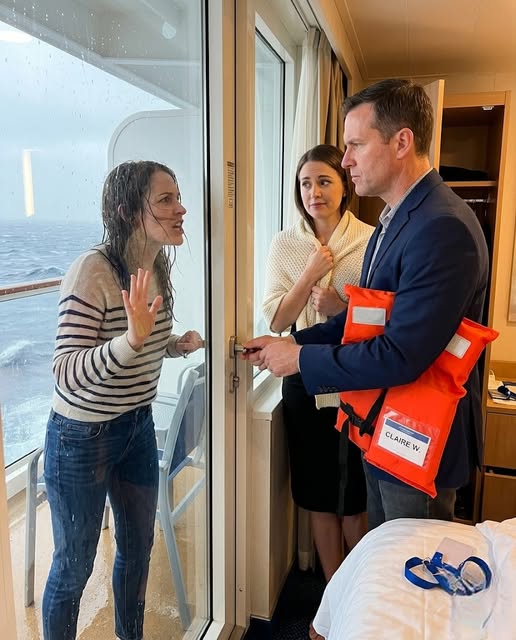
Owen did not walk me into the dining room. He kept me behind the service doors while two security officers crossed the room toward table seventeen.
The storm rattled the service door behind us, but no one looked away.
Through the narrow window, I saw Mark sitting beneath warm chandelier light with my orange life jacket hooked over the back of his chair.

Avery wore my cream shawl and had my SeaPass beside her plate.
When an officer asked for her name, she answered, “Claire Ellis,” without hesitating.
Mark looked toward the service doors, and for one second his face changed. Not guilt. Calculation.
Owen turned his tablet so I could see the passenger record attached to my name. Avery’s boarding photo filled the screen.
“She did not just borrow your card,” he said quietly. “She boarded as you.”
My hands tightened around the emergency blanket.
Security separated them before Mark could reach for Avery’s wrist. He began talking fast, calling it a clerical mistake, then a misunderstanding, then a surprise he had planned for me.
Owen placed the storm alert beside the dining-room scan.
“Your wife was locked outside during a weather warning,” he said. “Her credential was used here six minutes later.”
Mark stopped talking.
Owen opened the passport record under Mark Ellis.
The photograph was not my husband.
It was another woman.
And according to the ship’s system, that woman had used his passport to board.
Owen lowered the tablet, but he did not close the record.
He asked me whether I recognized the woman in the photograph.
I did not.
The woman had dark hair pulled back from her face, no makeup, and the stiff expression people wear when they are told to look straight ahead for an identification photo.
Nothing about her was familiar.
That should have made me feel safer.
Instead, it meant the lie was larger than Avery, larger than the lipstick, and larger than one cruel decision made in the middle of a storm.
Mark had not simply taken his mistress to dinner.
Someone had altered the basic story of who was on the ship.
The steward guided me to a small office off the service corridor, where the walls vibrated softly with the engines.
My emergency blanket crackled every time I moved.
I could still feel the balcony floor shifting beneath me, even though the chair was bolted down.
Owen asked me to tell him exactly what happened, beginning with the moment Mark opened the balcony door.
I told him about the towel.
I told him about the lock.
I told him about the life jacket with my name card in its plastic sleeve.
I told him Avery was wearing my shawl.
When I reached the part where Mark stopped at the mirror to smooth his hair, my voice failed.
That small gesture hurt more than I expected.
He had left me in a storm and still cared how he looked when he entered the dining room.
Owen did not fill the silence with sympathy.
He entered the details into the safety report one at a time.
Balcony door locked from inside.
Weather-warning sensor active.
Passenger exposed to severe wind and rain.
Assigned life jacket removed from cabin.
Assigned SeaPass used at table seventeen six minutes after the alert.
Each line turned what Mark had done from something unbelievable into something measurable.
The storm had left bruising along my hip where I hit the rail, but the deeper damage was harder to describe.
I had spent years assuming that marriage meant being the person who knew the private version of someone.
Now I was staring at evidence that my husband had built a second version of me.
Owen explained why the steward had known my name before I said it.
The balcony alert was tied to our cabin assignment, and the cabin assignment still displayed Claire Ellis as the registered passenger.
The system had sent the crew to rescue “Claire Ellis.”
But the boarding image attached to that identity was Avery.
The ship knew my name.
It just did not know my face.
That sentence settled over me colder than the rain.
A security officer entered carrying my life jacket in a clear evidence bag.
The orange nylon was wet where Mark’s sleeve had pressed against it, and my name card remained visible through two layers of plastic.
He had carried it through a dining room full of people because he thought it made Avery look legitimate.
Instead, it had become the simplest proof that the woman at his table was performing my place.
The officer also returned my cream shawl in a separate bag.
Avery had taken it from the cabin before Mark locked the door.
I remembered leaving it folded across the end of the bed while I searched the bathroom for my earrings.
I had never seen her pick it up.
That meant she had been inside our cabin while I was still there, close enough to touch my things, while Mark kept me arguing in the bathroom doorway about a lipstick he insisted did not matter.
The lipstick had mattered only because it kept my attention pointed in the wrong direction.
Owen asked whether Mark had controlled our travel documents.
I said he had kept both passports in the cabin safe after boarding.
That was not unusual for us, and I did not turn it into a confession of some larger pattern.
It was simply the truth.
He had the documents.
He had the safe code.
He had decided when we needed them.
Owen wrote that down without suggesting what it proved.
Then he told me the ship’s security team had frozen all changes to our passenger records and disabled the credential Avery had used.
They were also reviewing the record created with Mark’s passport.
He did not tell me they had solved it.
He did not claim to know who the second woman was, how Mark had boarded while his passport record pointed to someone else, or whether someone had duplicated information before the cruise.
He said only that the discrepancy was real and that no one connected to it would be allowed near me without my consent.
That was the first decision anyone had offered me all night.
I said no.
No private conversation.
No explanation in our cabin.
No chance for Mark to stand close enough to lower his voice and make me doubt the order of what I had seen.
Owen nodded and asked the steward to prepare another cabin.
Mark requested to speak to me three times in the next hour.
The first request came through security.
He said there had been a misunderstanding.
The second came through Owen.
He said Avery had panicked and used the wrong card.
The third arrived as a handwritten note on hotel stationery.
Claire, please let me explain before strangers turn this into something it is not.
I read the sentence twice.
He was still calling the crew strangers.
The strangers had climbed down the side of a moving ship to bring me inside.
My husband had watched me through glass and turned the lock.
I folded the note once and handed it back.
“Please attach it to the report,” I said.
That choice changed the room more than any speech could have.
Until then, I had still been reacting to Mark.
After that, Mark had to react to me.
Security moved him away from the dining room and restricted his access to the cabin corridor while the records were reviewed.
Avery was kept separate from him.
I was not told what either of them said in those interviews, and I did not need the story to pretend that every answer arrived in one dramatic confession.
What mattered was that their explanations no longer controlled the facts.
The balcony sensor had a timestamp.
The rescue team had a call log.
My SeaPass had a dining-room scan.
The passenger manifest linked my name to Avery’s face.
Mark’s passport linked his identity to another woman.
The life jacket connected the cabin to table seventeen.
No single item explained the entire plan.
Together, they made one thing impossible to deny: what happened on that balcony was not an accident.
A medical crew member examined my hip and the swelling along my cheek where I hit the floor.
Nothing was broken.
I was cold, bruised, exhausted, and alive.
The word alive felt too large to say aloud.
The steward brought me dry sweatpants, a plain T-shirt, and a pair of rubber-soled slippers from the ship’s emergency supply.
He set a paper cup of hot tea on the desk and turned the handle toward my right hand because my left was trembling.
That ordinary kindness nearly broke me.
I had expected fear to make me cry.
Instead, it was the careful placement of a cup.
Owen returned with a replacement room key that had been created only after he checked my face against the identification I carried separately in my wallet.
He asked me to state my full name.
“Claire Ellis,” I said.
Then he asked me to look at the photo before he activated the card.
For the first time that night, my name and my face appeared together on the same screen.
He slid the card across the desk.
“This one belongs to you,” he said.
I carried it myself.
The new cabin was small and plain, with no balcony, and I was grateful for every inch of solid wall.
The storm continued outside, but the sound was different there.
It was weather against steel, not weather against a thin glass door controlled by someone else’s hand.
The steward placed my sealed life jacket on the shelf beside the entrance.
He asked whether I wanted it removed because seeing it might upset me.
“No,” I said. “Leave it where I can reach it.”
I did not sleep.
Every time the ship rolled, my body remembered the rail.
Every time footsteps passed in the corridor, I waited for Mark’s knock.
He never reached the door.
Near midnight, Owen called from the desk and told me security had confirmed that Avery’s dining-room access was not an isolated card error.
Her image was attached to my boarding identity in the manifest.
The second woman’s image was attached to Mark’s passport record.
The team still did not know the full purpose of the arrangement, and Owen would not guess.
He said the ship would preserve the digital logs, the identification records, the life jacket, the written note, and the balcony alert for review at the next port.
He also asked whether I wanted a staff member stationed near my corridor until morning.
“Yes,” I said.
I was finished being polite about my own safety.
A little after one, another message came from Mark.
This time he did not call it a misunderstanding.
He said Avery had convinced him that using the records would make dinner “simpler.”
He claimed he had never intended for the storm to become dangerous.
The wording was careful.
He did not deny locking the door.
He did not deny taking my life jacket.
He did not deny that Avery was using my identity.
He only tried to separate his intention from the danger he had created.
I handed that message to the staff member outside my cabin.
“Please add this one too.”
The ship steadied before dawn.
By then, the storm had moved farther east, leaving gray water and a low ceiling of clouds beyond the windows in the interior lounge.
I met Owen there because I refused to return to our cabin while Mark’s belongings were still inside.
He brought the tablet, but this time he placed it face down.
He asked what I needed before the ship reached port.
The question startled me.
For hours, everyone had needed facts from me.
Now someone wanted a decision.
I asked for my wallet, medication, phone charger, and one change of clothes from the cabin.
I asked that a crew member collect them while Mark remained elsewhere.
I asked that the rest of my belongings be packed under observation.
I asked for copies of the safety incident number and the record showing when my SeaPass was used.
I did not ask to see Mark.
Owen made the arrangements without praising me for being strong.
That mattered.
I did not feel strong.
I felt like a woman making one necessary choice after another because the alternative was handing control back to the person who had locked the door.
When the crew member returned with my bag, my passport was inside.
The cover was dry.
The document itself appeared untouched.
That did not solve the manifest problem, but it clarified something important.
My identity had not disappeared because I lost my passport.
Someone had used access to the ship’s records and credentials to place another face where mine belonged.
The passenger system would have to explain how.
Mark would have to explain why.
Neither explanation required me to stand beside him while it happened.
Avery asked to speak with me once.
Her request came through Owen, just as Mark’s had.
She said she wanted to apologize.
I thought about her standing in the hallway with my shawl around her shoulders.
I thought about the moment she looked at me through the glass and chose to turn away.
An apology could not change that choice.
I told Owen I would not meet her privately, but I would allow any statement she made to be included in the report.
Avery submitted nothing.
The silence did not surprise me.
It only confirmed that her concern ended where accountability began.
When the ship approached port, passengers gathered at the windows with coffee cups and phones, talking about the storm as if it were a story the ocean had performed for them.
No one knew what had happened on our balcony.
I was grateful.
I did not want applause, whispers, or the strange attention people give survivors when they have already decided what the ending should mean.
I wanted a locked door that only I could open.
I wanted my documents in my own hands.
I wanted the record to show that I had been there.
Security escorted me through a separate corridor before disembarkation procedures began.
Mark and Avery were kept apart from me.
The ship’s team transferred the preserved records for formal review without promising me an outcome they could not control.
No one told me there would be an immediate arrest.
No one promised a perfect punishment.
They promised documentation, separation, and a clear chain of custody for the evidence they had collected.
For that morning, those promises were enough.
At the gangway checkpoint, a staff member scanned my replacement SeaPass.
My name appeared.
My photograph appeared.
The light turned green.
I stood there for one extra second, staring at the screen.
The night before, my name had been used to seat another woman at my husband’s table.
Now it opened a path for me to leave him.
Owen carried the sealed life jacket until we reached the final desk.
Then he asked whether I wanted it placed with the other evidence or returned to me after it was photographed.
I looked at the orange nylon and the small card beneath the plastic.
CLAIRE ELLIS.
Mark had taken it because he thought my name was a prop he could move from one woman to another.
I asked Owen to return it.
Outside the terminal doors, the morning air was cool and still.
I sat on a bench with my bag at my feet and the life jacket across my knees while arrangements were made for me to continue home separately.
I did not know what every record would prove.
I did not know who the second woman was or what promise had convinced her to use Mark’s passport.
I did not know how long the investigation would take.
But I knew what had happened to me, and for the first time since the balcony door closed, I was not being asked to trade that knowledge for Mark’s comfort.
Before I left, I slid my replacement SeaPass into the clear sleeve beside my name card.
It was not required.
I did it because I wanted my face, my name, and the object meant to keep me safe in the same place.
Then I zipped the life jacket into my bag myself.
No one carried it for me.
No one wore my shawl.
No one answered to my name.
And no one else held the lock.
