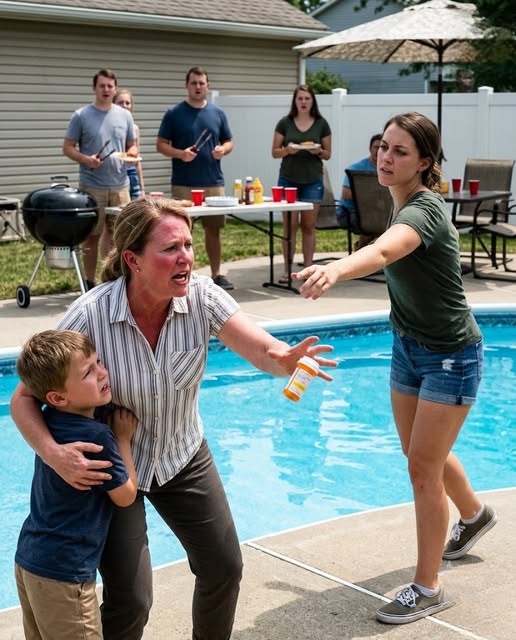
By the time the burger grease began snapping over the grill, I had already checked on Noah four times.
That was not unusual for us, and it should not have been unusual for anyone who knew him.
My son had an emergency prescription for a condition our family had been taught to take seriously, and the instructions were simple: recognize the warning signs, stay calm, and do not waste time arguing with someone who said he needed help.

Emily knew all of that.
She was my older sister, and she had heard the doctor explain it in words clear enough for a child.
She had even sat beside me at the kitchen table months earlier while I wrote the emergency steps on an index card and taped a copy inside Noah’s backpack.
Still, she had always treated caution as a character flaw.
According to Emily, I worried too much, hovered too closely, and gave Noah too much permission to describe what was happening inside his own body.
At family gatherings, she would make little comments that sounded harmless until you noticed how often they landed on him.
“Let him be a kid.”
“He knows you will stop everything if he looks scared.”
“You are teaching him to expect special treatment.”
I had answered those comments before.
I had answered them gently, then firmly, then not at all.
That Saturday, our family reunion filled my parents’ backyard with folding chairs, coolers, paper plates, and the smell of charcoal under a white-hot afternoon sun.
The pool pump hummed steadily beneath the noise of cousins arguing over music and uncles comparing grill temperatures as though dinner depended on a federal inspection.
Noah stayed close to me at first.
He was eleven, old enough to hate being watched and young enough to still look for me when something felt wrong.
He ate half a hot dog, drank water, and asked whether he could swim after the adults finished their annual group picture.
I told him we would see how he felt.
Emily heard me and laughed.
“You mean how you feel,” she said.
I ignored her.
That choice would bother me later, not because silence caused what happened, but because I had spent years making room for Emily’s behavior so everyone else could stay comfortable.
Families sometimes call that keeping the peace.
Most of the time, it means choosing the person who creates the conflict over the person who pays for it.
About an hour after we arrived, Noah stopped following the conversation around him.
His shoulders pulled inward.
He pressed one hand against his chest and stared at the patio as if he were concentrating on standing still.
I crossed the yard before he said my name.
“Mom,” he whispered. “I need it.”
I felt the temperature of the day disappear.
The noise around me flattened into the pool filter, the grill hiss, and the soft scrape of my own shoes across concrete.
I reached into the zippered pocket of my bag and pulled out the orange prescription bottle.
The label had curled slightly at one corner from being handled, but Noah’s name, the dosage instructions, and the manufacturer information were still clear.
I had the cap under my thumb when Emily stepped between us.
She smelled like sunscreen and sweet iced tea.
“What are you doing?” she asked.
“He asked for his medication.”
“He was fine thirty seconds ago.”
“He is not fine now.”
She looked over her shoulder at Noah.
He had one hand on the back of a lawn chair.
His face had gone pale, and his eyes were fixed on me.
Emily turned back with a smirk.
“He knows you will panic.”
I moved to go around her.
She caught my wrist.
At first, I thought she was trying to slow me down so she could keep talking.
Then her fingers closed around the bottle.
“Emily, let go.”
“You need to stop rewarding this.”
“Let go.”
She ripped the bottle from my hand.
The motion was so sudden that my knuckles struck hers, and for half a second the bottle sat in her palm between us.
I saw the pharmacy label.
I saw Noah’s name.
I saw Emily look at the lower edge of the label where the batch information was printed.
Something changed in her face.
It was not concern.
It was recognition.
Before I could understand it, she pulled her arm back and threw the bottle toward the pool.
The bottle turned once in the air and hit the water with a flat plastic slap.
Sunlight flashed across the white label.
Then it sank.
“He’s only pretending for attention,” Emily laughed.
The backyard stopped.
My uncle’s grill tongs remained open over a row of burgers.
My mother stood beside the folding table with a serving spoon suspended above a bowl of potato salad.
A cousin held a red plastic cup at an angle while soda ran across his fingers and dripped onto the patio.
One aunt stared down at a folded napkin instead of looking at Noah.
Nobody moved.
For one ugly heartbeat, I pictured grabbing Emily by the shoulders and sending her into the same water.
I pictured wiping the laugh from her face.
Then Noah’s knees bent.
Anger had to wait.
I caught him beneath the arms before his shoulder struck the chair.
“Call 911,” I shouted.
My cousin Jessica was the first person to move.
She pulled out her phone, gave the dispatcher the address, and followed me toward the patio door while I lowered Noah onto a clean towel.
My father grabbed the pool skimmer.
My mother crouched beside me, shaking so hard the spoon she had been holding clattered onto the concrete behind her.
Emily did not come closer.
“You are making him worse,” she said.
Jessica turned on her.
“He asked for medication, and you threw it into a pool.”
“He does this every time the attention leaves him.”
Noah gripped my sleeve.
“I’m not acting,” he said.
His voice was thin, but everyone heard it.
That sentence did what years of family arguments had failed to do.
It forced the room, the yard, and every person standing in it to choose between Emily’s version of him and the frightened child directly in front of them.
My father dragged the skimmer through the deep end.
The bottle had rolled beneath two floating decorations and drifted toward the intake.
He missed it once.
Then again.
I kept my eyes on Noah and repeated the calm instructions we had practiced, though my own voice sounded far away.
“Stay with me.”
He nodded.
“You did the right thing telling me.”
Another nod.
“You are not in trouble.”
His fingers tightened.
Behind me, Emily muttered that nobody had accused him of being in trouble.
I did not turn around.
Three weeks earlier, our regular pharmacy had told me Noah’s refill would be delayed.
The pharmacist had been apologetic, but the shipment had not arrived, and our remaining supply was close to its replacement date.
I mentioned the problem to Emily during a phone call.
She worked at a clinic and often spoke about medication inventory as though she personally controlled the entire system.
The next evening, she came to my apartment carrying a sealed emergency unit from the same manufacturer.
“My clinic had an extra,” she said.
I asked whether it had been prescribed for Noah.
“It is the same medication and the same dosage.”
“That is not what I asked.”
She sighed and said the clinic kept authorized emergency stock for situations exactly like ours.
When I asked for paperwork, her expression hardened.
“You trust a stranger behind a counter more than your sister?”
I should have stopped there.
I should have called the clinic.
Instead, I looked at the sealed package, saw the correct medication, and let relief make the decision for me.
I apologized.
Emily peeled off a small inventory sticker before handing me the box.
At the time, I assumed she was removing clinic information that did not belong in our home.
Now, beside the pool, I remembered the speed of that motion.
I remembered how she folded the sticker into her palm.
I remembered that she had asked me twice whether Noah had used the medication yet.
The ambulance arrived through the side gate with its engine still running.
Two paramedics came in carrying their bags.
One knelt beside Noah and began assessing him while the other asked me what had happened.
“My sister took the medication from my hand and threw it in the pool.”
The second paramedic looked toward Emily.
She gave him the same wounded smile she used whenever someone questioned her.
“That is an emotional version of what happened.”
Jessica still had the phone in her hand.
“It is the exact version,” she said.
My father caught the bottle against the skimmer basket.
When he lifted it from the water, a thin stream ran from the pole and splashed across the concrete.
The cap had held.
The label was wet and wrinkled, but it was readable.
I passed it to the paramedic.
He checked Noah’s name.
Then he checked the dosage.
His thumb moved to the manufacturer line and stopped.
He wiped the label with his glove.
He read the batch number once, then again.
I watched recognition settle across his face.
He glanced at the clinic badge clipped to Emily’s shorts.
“Ma’am,” he said, “this batch number was included in a missing-medication notice sent to local emergency crews.”
Emily’s laugh disappeared.
Nobody in the backyard understood the full meaning yet, but everyone understood the tone.
The paramedic photographed the label.
Then he asked Emily where she had obtained the medication.
She said batch numbers repeated.
He told her that manufacturer batches could contain many units, but the notice included packaging details and a clinic inventory range connected to the missing stock.
Emily said the clinic must have made a mistake.
The paramedic did not accuse her of anything.
He simply asked for the name of the supervisor on duty.
“You cannot call my workplace because my sibling is overreacting,” Emily said.
Jessica stepped between Emily and the gate.
She kept her hands at her sides.
“You threw a child’s medication into a pool,” she said. “Nobody here is helping you leave before they finish asking questions.”
My mother began to cry quietly.
Not the loud, dramatic crying Emily always accused other people of using for attention.
Just small breaths behind one hand as she looked from Noah to the wet bottle and realized how many times she had asked me to be patient with Emily.
The paramedic’s phone rang several minutes later.
He asked the clinic supervisor for permission to use speakerphone because the information affected an active medical response and the people present needed to hear instructions about the medication.
The supervisor agreed.
She confirmed that several emergency units had been reported missing from a locked cabinet two days earlier.
Then she gave a detail Emily had not expected anyone outside the clinic to know.
The electronic access record showed Emily’s employee badge opening that cabinet at 6:12 that morning.
Emily’s face changed.
She stopped looking angry and began looking trapped.
“It was not for me,” she whispered.
The paramedic asked who it was for.
Emily looked at me.
Then she said something that made my stomach drop again.
“You need to check the rest of Noah’s medication before someone gives him the next dose.”
The paramedics transported Noah for observation after stabilizing him.
I rode with him.
My mother followed in her SUV, and Jessica stayed behind long enough to give a statement about what she had seen.
At the hospital, the medication from my bag was separated and reviewed.
The bottle recovered from the pool contained the correct medication, but its chain of custody was immediately questioned because it had come from missing clinic stock.
The remaining packages Emily had given me were sealed, yet two carried inventory markings beneath the pharmacy stickers that did not match the explanation she had offered weeks earlier.
A hospital pharmacist told me not to use any of them until Noah’s regular prescriber and pharmacy verified a replacement supply.
That was the first time I understood the difference between something looking correct and something being safe to trust.
Emily had used our family relationship to bypass every question I would have asked a stranger.
She had counted on my relief.
She had counted on my embarrassment.
Most of all, she had counted on the old family rule that challenging her would create more trouble than believing her.
The investigation that followed stayed painfully ordinary.
There were no dramatic raids or shouted confessions in a hallway.
There were phone calls, inventory sheets, access records, sealed packages, a clinic incident report, and a police report documenting the medication thrown into the pool.
There was also Jessica’s video.
She had begun recording after Emily first grabbed my wrist because she had seen enough family arguments to know memories changed when people became afraid of consequences.
The video showed Emily taking the bottle.
It showed her looking at the label.
It showed the split second of recognition before she threw it.
That moment mattered.
Her claim that she acted only because she believed Noah was pretending did not explain why she studied the batch information first.
The clinic’s review found that Emily had removed emergency medication from the locked cabinet more than once.
She had originally taken one unit for a friend whose family said they could not afford an immediate replacement.
That did not make the decision lawful, safe, or hers to make, but it explained the sentence she repeated that afternoon: it was not for me.
Then she took another unit to replace the first one before inventory was checked.
When that created a second gap, she moved a third package.
By the time she gave medication to me, she was no longer helping one person in one desperate moment.
She was covering the previous decision with another decision, then using her job and our trust to keep the chain from being examined.
The missing batch notice meant the clinic had finally connected the units.
When Emily saw the label in my hand at the reunion, she recognized that the evidence had traveled directly into a yard full of witnesses.
She did not throw the medication because she believed Noah was pretending.
She threw it because she knew where the bottle had come from.
That truth hurt in a different place.
Cruelty during an emergency was terrible enough.
Realizing my sister had used my son’s medical vulnerability to hide her own choices made the betrayal feel calculated, even if the first bad decision had not begun that way.
Noah recovered.
The sentence sounds simple, but I learned not to treat simple sentences like small gifts.
He recovered because he told me what he felt.
He recovered because Jessica called quickly.
He recovered because trained people arrived and did their jobs.
He did not recover because Emily was right about him.
For weeks afterward, he asked whether the reunion had been ruined because of him.
Each time, I gave him the same answer.
“You did not ruin anything by needing help.”
The first few times, he nodded without believing me.
Then one evening, while I replaced the emergency card in his backpack, he said, “Aunt Emily ruined it because she wanted everyone to believe her instead of me.”
I stopped writing.
“Yes,” I said. “That is what happened.”
He looked relieved.
Children often know the truth long before adults decide it is polite enough to say.
My parents struggled with what came next.
My mother wanted accountability but also wanted the family to remain a family.
My father kept using phrases like terrible mistake and difficult season.
I understood why.
Naming what Emily had done meant naming all the smaller moments we had excused before it.
It meant admitting that peace had never been equally distributed in our family.
Emily received consequences through her workplace and the legal process tied to the missing medication and the incident at the pool.
I will not pretend those consequences repaired everything.
Punishment can stop access, document facts, and draw a boundary.
It cannot make a child forget an adult laughing while his medication disappears underwater.
The repair happened elsewhere.
It happened when my parents completed an emergency-response class and posted Noah’s instructions in their kitchen.
It happened when Jessica handed me the original video without sharing it with anyone who did not need it.
It happened when my father apologized to Noah directly instead of speaking around him.
“I should have moved sooner,” he said. “You deserved adults who believed you right away.”
Noah studied him for a long moment.
Then he said, “Next time, move before the bottle hits the water.”
My father nodded.
“There will not be a next time.”
The sentence was not a promise that emergencies would disappear.
It was a promise that nobody in that family would be allowed to turn Noah’s need for help into a debate again.
Months later, we had another cookout in the same backyard.
The pool was closed for the season, covered in dark green fabric that snapped softly in the wind.
Noah kept his verified medication in a small pouch clipped inside my bag, and a second approved supply remained with my parents under the instructions of his doctor and pharmacy.
Nobody joked about it.
Nobody called him dramatic.
When he asked for a break, the conversation kept moving without making him defend the request.
Emily was not there.
Her absence did not feel like victory.
It felt like space.
I used to think family loyalty meant staying close enough to absorb the damage and quiet enough to keep everyone seated at the same table.
Now I think loyalty begins with telling the truth about who is safe at that table.
The paramedic who read the label did more than recognize a batch number.
He interrupted a family habit.
He treated a wet bottle like evidence, a frightened child like a credible witness to his own body, and my sister’s confidence like something that still required verification.
That is why I remember his thumb stopping on the label.
Not because the number itself saved us.
Because someone finally looked closely at the thing Emily expected everyone else to overlook.
