Claire Dawson had imagined her homecoming hundreds of times.
In every version, her daughter ran first, her husband followed, and the ache in her left leg became background noise the moment she stepped into the house.
The real homecoming smelled like diesel, wet pavement, and rain trapped beneath a summer sky.

Claire had spent 22 years in the Army as a logistics officer, building routes, moving supplies, and solving problems before they became emergencies.
Three months before her retirement, a military transport truck slid off a flooded road during a supply mission in Kuwait.
Everyone survived.
Claire’s left leg did not come through unchanged.
Surgeons repaired what they could, but nerve damage left her with weakness, pain, and a permanent limp that worsened when she was tired or cold.
She had accepted that before the shuttle brought her back to Kentucky.
She had not expected her family to treat survival like a defect.
Emma reached her before Claire could lower her duffel.
“Mom!”
The ten-year-old wrapped both arms around Claire’s waist, then loosened them almost immediately.
Someone had clearly told her to be careful.
Claire kissed the top of her daughter’s head and held on long enough to feel the small tremor in Emma’s shoulders.
“I missed you more than you know,” Claire whispered.
“I made you a sign.”
Crooked construction-paper letters hung across the dining room wall.
WELCOME HOME, MOM.
Two letters were backward, the tape sagged at one corner, and it was the most beautiful thing Claire had seen in a year.
Brian sat on the couch with his phone in his hand.
“You’re home,” he said.
There was no hug.
There was not even the embarrassed half-smile of a man who knew he should have offered one.
Linda Dawson sat at Claire’s kitchen table with a coffee mug as though she had been waiting to inspect a delivery.
Her gaze traveled from Claire’s face to her left leg.
“So this is how you came back.”
Claire rested one hand on the chair beside her until the burning in her calf eased.
“The doctors say I should keep improving.”
Linda shrugged.
“I guess we’ll see.”
Dinner was roast chicken, canned green beans, and a silence so tight that every scrape of a fork sounded hostile.
Emma tried to fill it with stories about school, soccer practice, and the stray cat she had been feeding behind the garage.
Each time she laughed, Brian’s mouth flattened.
Claire watched him avoid her eyes and remembered late-night calls from Kuwait when he had said he was proud of her.
She wondered when those words had stopped being true.
After Emma went upstairs to shower, Brian placed both hands on the table.
“We need to be honest with each other.”
Claire knew the sentence before he finished it.
People often used honesty as a clean word for something they had already decided to do.
“What is it?” she asked.
“I didn’t expect things to be like this.”
Claire looked down at her leg.
“Because I’m limping?”
“I mean everything.”
He stood and moved to the window.
“I’ve been thinking for months. I don’t think I can do this anymore.”
“Do what?”
“This marriage.”
The refrigerator clicked on behind them.
Claire heard water moving through the pipes upstairs where Emma was showering.
She had spent a year wondering whether she would make it home, and Brian was ending their marriage before her duffel had been unpacked.
“I don’t need someone to take care of me,” she said.
“You say that now.”
Then he said the sentence that would follow Claire for months.
“I spent a year realizing I don’t want to spend the rest of my life taking care of someone.”
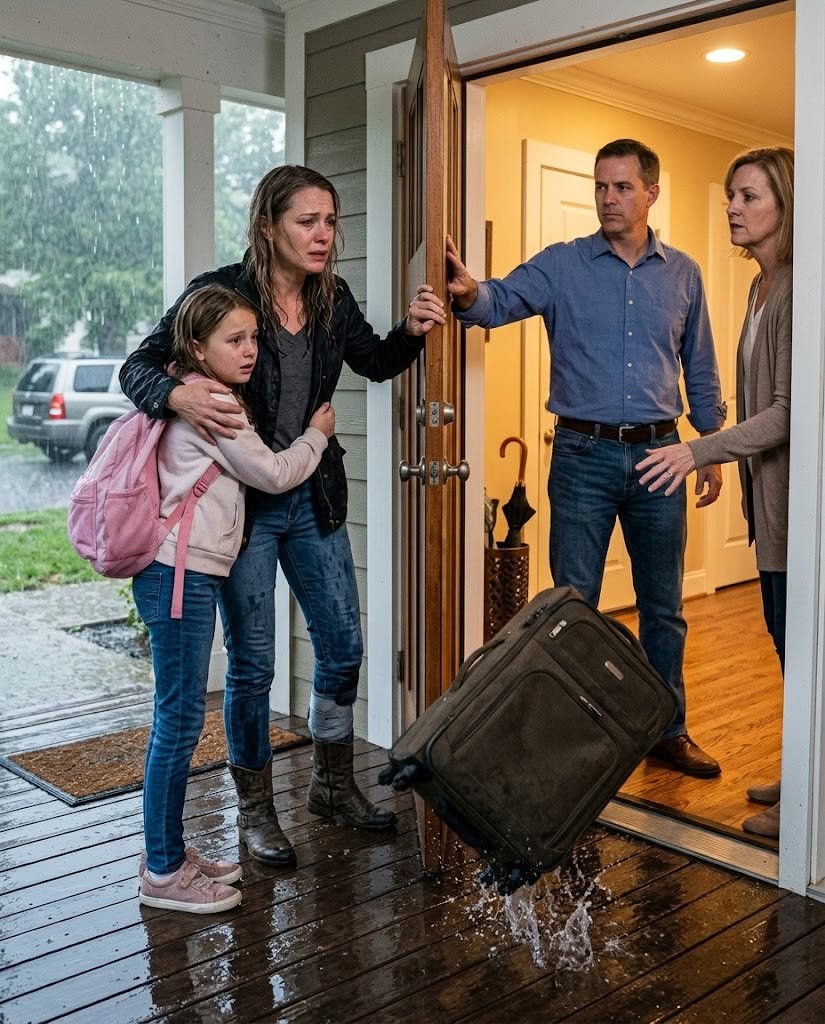
Linda entered carrying Claire’s suitcase.
She dropped it beside the front door hard enough to make the umbrella stand rattle.
“Brian deserves a chance to be happy,” she said.
Claire stared at the woman who had once held Emma as a newborn and cried over how lucky the family was.
Emma appeared on the stairs with wet hair, her pink backpack strapped over both shoulders.
“Mom?”
Brian looked at the floor.
Linda opened the front door.
Cold rain sprayed across the tile.
Claire lowered herself carefully, ignoring the nerve pain, and held out her hand.
“We’re going for a drive.”
“In the rain?”
“Yeah, baby.”
Emma took her hand without asking where they were going.
Children understand abandonment long before adults are willing to name it.
Twenty minutes later, the Explorer’s wipers struggled against sheets of rain on Interstate 64.
Emma fell asleep with her stuffed rabbit under one arm and the backpack still on her shoulders.
Claire drove east with no reservation, no destination beyond a memory, and almost no money.
At the first gas station where her phone had enough signal, she checked the joint account.
The balance was nearly empty.
The next morning, a bank manager confirmed Brian had withdrawn the money two days before Claire came home.
He had not panicked after seeing her injury.
He had prepared before she arrived.
That realization hurt more than the limp.
Claire turned toward the one property Brian had never controlled.
Her father’s farmhouse sat beyond Miller Creek Road, where gravel replaced pavement and old barns leaned into the dark.
Frank Miller had died almost 18 years earlier.
Claire had locked the farmhouse, paid the taxes, and told herself she would sell it someday.
Every room reminded her of a father she still missed and a mother who had died even earlier.
At 1:30 in the morning, her headlights found the white farmhouse through the rain.
The porch light was on.
Walter Jenkins stepped outside leaning on a cane.
He was 83, with thinning white hair and shoulders rounded by time, but Claire recognized him instantly.
“I was wondering how long it would take you,” he said.
Walter had been Frank’s closest friend.
He looked at Claire’s uneven stance, then toward Emma asleep in the passenger seat.
“That your little girl?”
“Emma.”
“She’s beautiful.”
Walter reached inside his canvas jacket and removed a large manila envelope in a plastic sleeve.
The paper was worn at the corners.
Four words crossed the front in Frank’s block handwriting.
For Claire when she comes home.
Claire touched the plastic with both hands.
“Dad wrote this?”
“The week before he passed.”
“Did he know I’d come tonight?”
“No,” Walter said. “He only knew life might bring you back here one day.”
Inside, the farmhouse smelled of pine floors, old coffee, and cedar from the closet beside the door.
Frank’s reading glasses still rested on the table beside his recliner.
Emma woke long enough to eat chicken soup Walter had warmed in the kitchen, then curled beneath one of her grandmother’s quilts.
Walter slid the envelope across the table.
Frank’s letter began with a sentence that stole Claire’s breath.
If life has brought you back to this house, then something has gone terribly wrong.
He wrote that he admired Claire’s habit of giving people another chance.
Then he wrote that there was one man he had never fully trusted.
Brian.
A year before Claire’s wedding, Brian had visited while she was away at training.
He asked how much land came with the farm.
He asked whether Claire would inherit everything.
He asked about debts, savings, life insurance, and mineral rights.
Frank had written down every question and the date.
“He never told me,” Claire said.
Walter looked toward the dark window.
“Your father hoped he was wrong.”
The letter explained that Frank had created a trust to protect the farmhouse, all 38 acres, the mineral rights, his investments, and the life insurance he had never spent after Claire’s mother died.
Walter then carried a wooden box to the table.
Inside were black notebooks labeled by year.
Frank had written almost every day.
Some entries were ordinary.
He changed tractor oil, repaired fences, recorded rainfall, and noted every time Claire called.
Other entries documented Brian.
The first loan was $3,000.
Then came $5,000.
Later amounts were smaller but more frequent.
Some were marked repaid.
Most were not.
One entry contained the sentence Claire could not stop rereading.
Brian asked me not to tell Claire.
Frank had protected Brian’s pride because he did not want Claire carrying extra worry while she balanced military duty, marriage, and motherhood.
Near dawn, Claire found an entry written six months before Frank died.
Claire called tonight. She sounds happy. Brian still smiles when she is around. I hope that smile is real.
The final line was worse.
If she ever comes back to this house alone, I’ll know I was right to prepare.
Claire closed the notebook and pressed both palms against her face.
For weeks she had believed her marriage ended because she returned injured.
Frank’s journals showed that Brian’s interest in the farm began before the wedding.
The injury did not create Brian’s greed.
It removed the last reason he had to hide it.
The following days were not miraculous.
The farmhouse roof leaked.
The porch railing had rotted.
The water heater banged whenever Emma showered.
Claire’s leg stiffened before dawn and sometimes refused to carry her weight without a long stretch and a clenched jaw.
Emma watched all of it.
One morning she carried Claire’s boots into the kitchen.
“I thought I’d save you a trip upstairs,” she said.
“When did you get so thoughtful?”
Emma shrugged.
“I’ve been watching you.”
Claire carried that sentence into every repair.
Children do not learn strength from speeches.
They learn it from what adults do when no one is applauding.
Harold Benson’s office sat above an old pharmacy in Winchester.
He had handled Frank’s estate planning and was now in his seventies, with suspenders, polished loafers, and reading glasses that slipped down his nose.
“I’ve been expecting you,” he said.
“That seems to be happening a lot.”
“Your father planned further ahead than most people.”
Harold explained the trust for nearly two hours.
Frank had not been wealthy by city standards, but he had saved steadily, avoided debt, and protected every major asset.
The farm, land, mineral rights, investments, and insurance were worth far more than Claire had known.
Then Harold slid a folder across the desk.
Brian’s signature appeared at the bottom of a legal acknowledgment signed 15 years earlier.
“He knew the estate belonged solely to you,” Harold said.
Claire read the signature twice.
A second document was even clearer.
The postnuptial waiver stated that neither Brian nor his future heirs would have any right, title, interest, or claim in Frank Miller’s estate.
“He signed this voluntarily?” Claire asked.
“With independent representation available and proper notarization.”
“So if he fights me?”
“He can file,” Harold said. “Winning is another matter.”
Claire left the office with the first sense of safety she had felt since coming home.
Not because the farm made her rich.
Because Frank had built a wall Brian could not quietly move.
Walter gathered neighbors to repair the farmhouse.
Six pickup trucks rolled into the driveway one Saturday morning carrying ladders, lumber, paint, and toolboxes.
Mike Reynolds, a hardware-store owner who had served in the Marines, shook Claire’s hand.
“Walter says you’re Army.”
“I was.”
“Once Army, always Army.”
Claire tried to refuse the help.
Mike pointed toward the roof.
“You already did your part. Let us do ours.”
By lunch, a folding table beneath the maple tree held sandwiches, potato salad, lemonade, and homemade pies.
Emma laughed with neighbors who called her the foreman.
The sound reached Claire from across the yard and loosened something inside her.
People who barely knew her anymore had shown up without being asked.
The people she had lived with for nearly 20 years had thrown her into the rain.
A month later, Brian arrived in a black BMW.
He wore the blue shirt Claire had bought for their anniversary and carried gift bags for Emma.
He said he had made mistakes.
He said he had started counseling.
He said he missed his family.
Claire listened because 20 years of marriage do not disappear merely because the ending is ugly.
Then Linda pulled into the driveway wearing expensive sunglasses and a rehearsed smile.
“Families forgive,” she said.
Brian looked toward the farmhouse.
“We can fix this. We’ll sell the place, come back home, and start over.”
There it was.
Not “I’m sorry.”
Not “I will replace the money.”
Sell the farmhouse.
Emma stood beside Claire and looked at her father.
“If you loved us, why did you leave us in the rain?”
Brian lowered his head.
Linda opened her mouth and found no answer.
Claire told Brian she hoped counseling helped him.
Then she told him some doors did not reopen after people closed them on a child in a storm.
Three days later, Harold called.
Brian had filed a lawsuit.
The complaint claimed Claire had manipulated Frank into changing his estate plan while he was confused and vulnerable.
Frank had been dead for 18 years.
Claire had been deployed when many of the documents were signed.
The accusation was weak, but it was designed to frighten her into settling.
Brian had emptied the bank account, rejected her injury, and now wanted the only future he had failed to seize.
The hearing took place at the Clark County Courthouse.
Claire wore the navy suit from her retirement ceremony but left her medals at home.
This was not about her service.
It was about her father’s competence and her right to keep what he had protected.
Walter drove her.
Behind Claire and Harold sat Mike, Susan, Mrs. Carter, several veterans, and Claire’s former English teacher.
Across the aisle, Brian looked confident.
Linda looked annoyed by the inconvenience.
Brian’s attorney described Frank as a lonely, confused man manipulated by an ambitious daughter.
Claire’s fingers curled beneath the table.
Harold rose when it was his turn.
“This case is not about assumptions,” he said. “It is about evidence.”
He introduced Frank’s journals.
The handwriting had been verified.
The entries were dated.
He introduced the original trust, notarized signatures, property records, and the chain of custody for the envelope.
Walter testified about the promise he made to Frank.
Brian’s attorney asked whether an 83-year-old man could trust his memory.
Walter smiled.
“I forget where I leave my truck keys. I don’t forget promises I made to my best friend.”
The judge’s expression softened, but Brian’s confidence remained.
Then Harold placed the postnuptial waiver on the bench.
The courtroom grew quiet enough for Claire to hear the air conditioner.
Brian saw his signature.
His shoulders stiffened.
Harold read the clause aloud.
Neither Brian Dawson nor his future heirs had any right, title, interest, or claim in Frank Miller’s estate.
The judge looked over his glasses.
“Mr. Dawson, were you represented when you signed this?”
Brian swallowed.
“I don’t remember.”
Harold opened a second folder.
Inside were bank records showing transfers from Frank’s account to Brian’s, followed by handwritten receipts that matched the journal entries.
$3,000.
$5,000.
$1,200.
$800.
Each receipt carried Brian’s signature and the same promise.
I’ll pay you back soon.
The records did not show a confused father being exploited by his daughter.
They showed a careful father repeatedly helping the man who later accused him of incompetence.
Brian’s attorney asked for a recess.
The judge granted ten minutes.
Near the windows, Brian paced while Linda spoke rapidly beside him.
For the first time that morning, neither looked confident.
When court resumed, the attorney argued that journals were merely personal opinions.
Harold agreed.
“That is why we submitted the bank records, receipts, notarized trust, and Mr. Dawson’s own waiver.”
Linda asked to address the court.
She stood, smoothed her jacket, and said families should not destroy one another over old misunderstandings.
Claire almost laughed.
Throwing an injured woman and a ten-year-old child into a thunderstorm was not a misunderstanding.
Emptying a joint account was not a misunderstanding.
Filing a lawsuit for property Brian had waived in writing was not a misunderstanding.
The judge stopped Linda before she could continue.
“This court is not deciding whether your family had disagreements,” he said. “It is deciding whether any legal basis exists for this claim.”
Linda sat down.
The judge reviewed his notes for several minutes.
Then he ruled that Frank had legal capacity, the trust was valid, the estate plan was valid, and Brian’s waiver was valid.
The case was dismissed with prejudice.
Brian could not simply refile the same claim.
The judge looked directly at him.
“The evidence suggests this lawsuit should never have been filed. I strongly advise you to consider that before pursuing any further legal action.”
Brian’s shoulders dropped.
His confident smile had disappeared.
Outside, a local reporter asked Claire for a comment.
Claire looked at Brian climbing into his car.
She could have listed every cruel sentence, every missing dollar, and every lie.
Instead, she remembered something Frank used to say.
You do not have to win every argument.
Sometimes living well is enough.
“I don’t have anything to add,” Claire told the reporter.
She walked down the courthouse steps beside Walter.
Her gait was uneven.
It probably always would be.
But she was no longer measuring her worth by whether Brian considered her useful.
By spring, the farmhouse porch wore fresh white paint.
Emma planted tomatoes, green beans, and peppers in crooked rows beside the house.
Walter visited most evenings with sweet corn, biscuits, or simply time.
Mike gave Claire part-time inventory work at the hardware store, then encouraged her to restore old furniture in Frank’s barn.
The first rocking chair took three weeks.
The second took ten days.
Soon, families from nearby towns brought her tables, cabinets, and chairs they wanted repaired instead of replaced.
Claire discovered satisfaction in restoring things with good bones.
She also learned that not everything broken deserved restoration.
Furniture, sometimes.
Trust, not always.
Harold eventually brought the final paperwork closing Brian’s case.
There were no remaining claims and no appeal moving forward.
Claire expected triumph.
What she felt was peace.
Revenge had never been the real victory.
The victory came when she stopped calculating her future by what Brian had taken.
He moved out of Lexington and took a job in another state.
Linda never contacted Claire again.
Claire did not chase either of them for an explanation.
Holding on to bitterness would have given them one more room inside her life, and she had already carried their weight too far.
One evening, Claire and Emma walked to the family cemetery at the edge of the property.
They placed flowers beside Frank’s headstone.
“Do you think Grandpa knew he’d still be taking care of us?” Emma asked.
Claire looked toward the farmhouse, where the porch light glowed through the trees.
“I think he believed love should leave something useful behind.”
Frank had not saved Claire merely by leaving her land.
He had left dates, signatures, receipts, a trust, a waiver, and the truth about a man she had trusted for nearly 20 years.
That truth gave Claire the courage to stop begging for love from people who had already decided not to give it.
The night Brian threw her and Emma into the rain, he believed he was discarding a burden.
What he actually did was send Claire back to the home, the evidence, and the people her father had quietly placed in her path.
She still limped.
Cold fronts still hurt.
Some mornings were harder than others.
But every day she crossed the porch she had repaired, passed the crooked garden Emma had planted, and entered the barn where broken furniture waited for patient hands.
Her life had not become perfect.
It had become hers again.
