Wade slammed his palm against the glass. Then, before the woman from the bank could finish documenting my statement, he shouted the one thing I had not expected him to admit.
“Caroline knew about the loan!” Everything inside me went still. Not quiet. Still. There is a difference. Quiet is the absence of sound. Stillness is when your body understands something before your heart is willing to accept it.
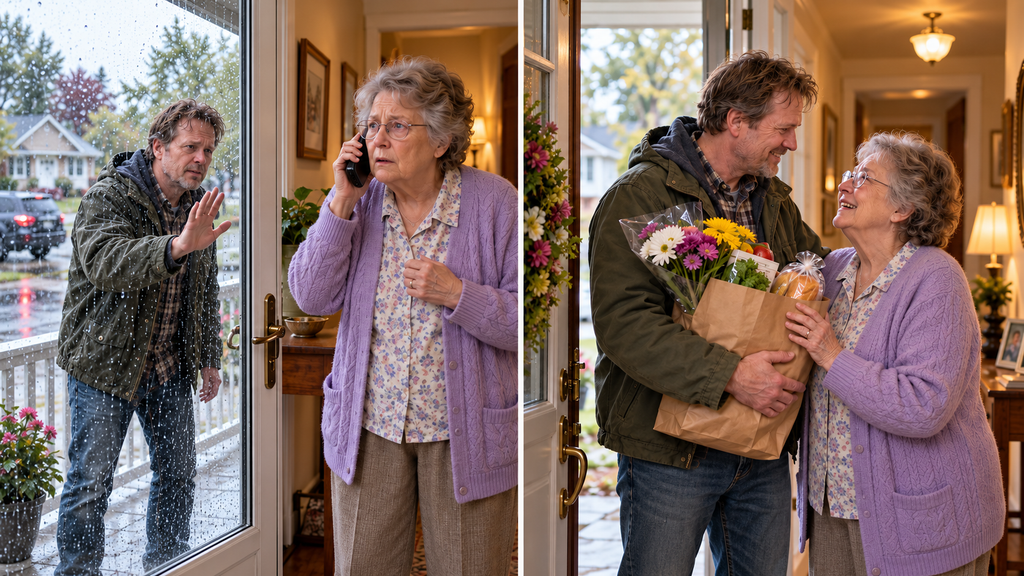
I stood in my hallway wearing slippers and a bathrobe, one eye blurry from cataract surgery and the other protected beneath a plastic shield, while the man who had married my only daughter stood on my porch and told me she had helped use my identity to borrow $19,400.
The bank representative was still on the phone.
She had heard him.
Wade seemed to realize that a second too late.
“Wait,” he said.
His voice dropped.
“Margaret, I didn’t mean—”
I lifted the phone.
“Did you hear that?”
The woman answered immediately.
“Yes, Mrs. Mercer.”
Wade stepped closer to the door.
“Margaret.”
I didn’t answer him.
“Mrs. Mercer,” the bank representative continued, “I strongly recommend that you do not discuss the account with anyone involved while our fraud department is reviewing it.”
Wade heard that too.
He backed away from the glass.
For the first time since I had known him, my son-in-law looked frightened of me.
Not because I was threatening him.
Because I wasn’t.
People like Wade understand anger.
They understand shouting.
They understand accusations because accusations can be argued with.
Silence is harder.
Silence gives them nothing to push against.
“Please leave my property,” I said.
“Margaret, listen.”
“No.”
“It isn’t what you think.”
“I don’t know what I think yet.”
“Then let me explain.”
“I said leave.”
He stared at me through the glass.
Then he said the sentence he had used in one form or another for nearly nine years.
“Think about the children.”
I looked straight at him.
“I have spent years thinking about the children.”
My voice didn’t rise.
“Today I’m thinking about their grandmother.”
His jaw tightened.
That was the moment I understood something I should have understood much sooner.
Wade didn’t hate selfish people.
He hated selfishness when it wasn’t benefiting him.
I closed the inner door.
Then I locked it.
My hands started shaking only after I could no longer see him.
Outside, I heard Wade stand there for perhaps another thirty seconds.
Then his boots crossed the porch.
A truck door slammed.
An engine started.
And finally the house became quiet.
The bank representative stayed on the phone.
“Mrs. Mercer?”
“Yes.”
“Do you have somebody who can come stay with you?”
The question nearly broke me.
Not the fraud.
Not Wade.
That question.
Because my surgery had been yesterday.
My husband was dead.
My daughter wasn’t speaking to me.
And somehow a stranger at a bank was the first person in weeks to ask whether I needed somebody.
“I’ll be all right,” I whispered.
She paused.
“Being able to manage isn’t the same as having to manage alone.”
I sat down on Royce’s church-pew bench.
The green accordion file rested across my knees.
Royce had built that bench twenty-eight years earlier from reclaimed oak.
It was heavy enough that three grown men had complained while moving it into our house.
He had laughed and said, “Good. Means it’ll still be here when we’re gone.”
I ran my thumb over a scratch in the wood.
For a second, I could almost see him sitting beside me.
Then the bank representative began explaining what would happen next.
The account would remain frozen.
Their fraud department would preserve the application records.
They would review the authorization documents.
I would receive paperwork.
There might be additional questions.
And because the disputed application had apparently relied on a revoked power of attorney, I should contact my attorney immediately.
I thanked her.
Before hanging up, she gave me a case number.
I wrote it on the back of Caroline and Wade’s letter about their “family unit.”
That felt appropriate.
Then I called Otis.
He answered on the fourth ring.
“Margaret?”
“I’m sorry it’s early.”
“What’s wrong?”
I told him.
Not dramatically.
I simply told him what the bank had said and what Wade had shouted through my door.
Otis was silent for several seconds.
Then he asked, “Did you let him inside?”
“No.”
“Good.”
“He said Caroline knew.”
Another silence.
“Did anyone else hear him say that?”
“The bank employee.”
“Very good.”
There was nothing good about it.
But I understood what he meant.
“Margaret, listen carefully. Don’t call Caroline. Don’t call Wade. Don’t send either of them anything about this account.”
“What am I supposed to do?”
“You’re supposed to recover from surgery.”
I almost laughed.
“Otis.”
“And you’re supposed to let me do my job.”
I closed my eyes.
The operated eye throbbed faintly.
“Royce would be furious.”
“Yes.”
“I don’t mean about the money.”
“I know.”
“He’d be furious that Caroline let it get here.”
Otis’s voice softened.
“Royce loved your daughter.”
“So do I.”
“That doesn’t mean either of you would have approved of everything she did.”
I looked down at the green file.
“Did I make her this way?”
Otis answered so quickly that I knew he had expected the question.
“No.”
“You don’t even have to think about it?”
“I’ve known you thirty-six years, Margaret. I’ve watched you take responsibility for things that happened in three different zip codes while you were asleep. No, I don’t need to think about it.”
Despite everything, I smiled.
Then he became serious again.
“I’m coming over.”
“You don’t have to.”
“I know.”
That sentence made my throat tighten.
I know.
Not I have to.
Not you need me.
Just:
I know.
Otis arrived forty minutes later carrying coffee, scrambled eggs from the diner near his office, and a folder thick enough to frighten a tax auditor.
He was seventy-two, had knees that complained about stairs, and still wore ties even when nobody expected him to.
The first thing he did was inspect my face.
“You look terrible.”
“Thank you.”
“Medical observation.”
“You’re a lawyer.”
“Which is why you should trust me when I say I have no idea what I’m talking about.”
I laughed.
It hurt.
But it felt good.
Then we sat at my kitchen table.
I showed him the case number.
I repeated the conversation.
I told him exactly what Wade had shouted.
Otis wrote everything down.
When I finished, he leaned back.
“There’s something else.”
My stomach dropped.
“What?”
“The revocation wasn’t the only paperwork I filed.”
I stared at him.
“What else did you do?”
“What you instructed me to do.”
The week before my surgery, after bringing him that green file, I had changed my estate plan.
I had removed Caroline as financial power of attorney.
I had removed her as executor.
I had created a trust structure for Hudson and May so that anything I eventually chose to leave them could not be controlled directly by either parent.
And I had changed the beneficiary on one account Caroline had assumed would eventually pass to her.
At the time, those changes had felt severe.
That morning, they felt prophetic.
Otis folded his hands.
“There is another problem.”
I waited.
He opened his folder.
Then he slid a photocopy toward me.
It was the loan application.
My name appeared at the top.
Margaret Louise Mercer.
My address.
My birth date.
My Social Security information partially masked.
And near the bottom—
a signature.
Mine.
Except it wasn’t.
Whoever had copied it had done a respectable job.
But Royce used to tease me that I signed my last name like I was trying to outrun it.
The M in Mercer always leaned forward.
This one stood perfectly straight.
I touched the page.
“That isn’t my signature.”
“I know.”
“How did you get this?”
“The bank’s legal department sent it after I contacted them.”
Then I noticed something else.
The requested amount had not been $19,400.
It had been $25,000.
My breath caught.
“Otis.”
“Yes.”
“They asked for twenty-five thousand.”
“Yes.”
“Then why did the bank say nineteen-four?”
“Because that appears to be the amount already advanced before the freeze.”
I felt cold.
Not because someone had tried to borrow against my name.
Because they had already spent nearly twenty thousand dollars.
“On what?”
“We don’t know yet.”
I stared at the paper.
“What could they possibly need nineteen thousand dollars for?”
Otis didn’t answer.
Instead, he pulled out another sheet.
“Recognize this email address?”
I read it.
It belonged to Caroline.
The application confirmation had been sent there.
I put the page down.
For several seconds, I couldn’t breathe properly.
Wade hadn’t lied about that part.
Caroline knew.
My daughter knew.
I thought of her at eight years old, standing on a kitchen chair while Royce taught her how to make pancakes.
At thirteen, crying because her best friend moved away.
At seventeen, screaming that she hated me because I wouldn’t let her drive to Virginia Beach with a boy I didn’t trust.
At twenty-six, calling me from a hospital bathroom after her first miscarriage.
At thirty-two, placing newborn Hudson in my arms and whispering, “Mom, look what we made.”
A mother carries every version of her child simultaneously.
That is the cruelty of it.
The adult who hurts you still has the face of the toddler who once reached up and asked to be carried.
“Why?” I whispered.
Otis didn’t pretend to know.
We found out three days later.
Not from Caroline.
From Wade’s sister.
Her name was Melissa.
We weren’t close, but we had always been friendly at birthdays and holidays.
She called just after lunch.
“Margaret?”
“Yes.”
“Is Wade there?”
“No.”
“Caroline?”
“No.”
She exhaled.
“Thank God.”
That was not how ordinary conversations began.
“What’s happening?”
“I need to tell you something, and Wade is going to hate me for it.”
I sat down.
“What?”
“His firm fired him in February.”
I gripped the phone.
Wade worked for a commercial insurance brokerage.
At least, I thought he did.
He still left home every weekday in pressed shirts.
He still complained about clients.
He still talked about quarterly bonuses.
“What do you mean, fired?”
“He hasn’t had a job in almost four months.”
My mouth went dry.
“Caroline knows?”
“Yes.”
“Since when?”
“Since the day it happened.”
I closed my eyes.
The Hilton Head trip.
The preschool tuition.
The reversed $800.
The house.
The truck.
All of it rearranged itself.
“Why was he fired?”
Melissa hesitated.
“For using client money to cover personal expenses.”
I stood so quickly my chair scraped backward.
“What?”
“It wasn’t as much as it sounds.”
“How much does it sound?”
“About eleven thousand dollars.”
I said nothing.
“He paid some of it back,” she rushed on. “The company didn’t press charges. They let him resign officially, but Margaret, he hasn’t been able to get hired anywhere else.”
“Why are you telling me this now?”
“Because he called me this morning asking for fifteen thousand dollars.”
I nearly laughed.
Not because anything was funny.
Because sometimes reality becomes so absurd that your body reaches for the wrong reaction.
“What did you tell him?”
“I don’t have fifteen thousand dollars.”
“And?”
“He said if I didn’t help him, his family was going to lose everything.”
There it was.
Family.
Always family.
A word Wade treated like a crowbar.
Melissa continued.
“He said you had ruined a financing arrangement.”
“A financing arrangement?”
“That’s what he called it.”
I looked at the forged signature sitting beside Otis’s business card.
“What else?”
“Margaret—”
“What else?”
She began crying.
“He said Caroline had convinced you to help them and then you changed your mind.”
I closed my eyes.
“He told you I approved the loan?”
“Yes.”
“And revoked the power of attorney afterward?”
“Yes.”
“Melissa, the revocation was filed before they applied.”
Silence.
Then:
“Oh, God.”
I heard her crying harder.
“I didn’t know.”
“I believe you.”
“There is something else.”
Of course there was.
There is always something else when a lie has been fed long enough.
“He borrowed from Dad’s estate too.”
Wade’s father had died two years earlier.
I had given Caroline and Wade $4,000 toward funeral expenses because they told me the estate was tied up and the family couldn’t cover everything immediately.
“What do you mean?”
“Before Dad died, Wade was helping manage some accounts. Around twenty-seven thousand dollars disappeared.”
My heart began beating harder.
“Was it ever recovered?”
“No.”
“Did your father know?”
“We think he discovered it right before his stroke.”
I stared at the rain sliding down my kitchen window.
“And you never told Caroline?”
“She knew.”
That hurt almost more than the loan.
Caroline knew.
Again.
I thanked Melissa for calling.
Then I sat alone for a very long time.
At 3:18 that afternoon, Caroline finally called.
I watched her name appear on my screen.
For years, whenever Caroline called, I answered.
If I was asleep, I answered.
If I was in the shower, I dried one hand and answered.
If I was standing in the grocery checkout line, I answered.
If I was sick, tired, angry, busy, grieving, cooking, driving, gardening, praying—
I answered.
That afternoon, I let it ring.
She called again.
And again.
Then came the text.
Mom, please answer. Wade told me what happened. This has gotten completely out of control.
I read it twice.
This.
Not what we did.
This.
As though a storm had blown in.
As though nobody had caused it.
Another message appeared.
We need to talk before lawyers make this worse.
That sentence almost impressed me.
She had learned Wade’s language beautifully.
I typed a response.
Then deleted it.
Typed another.
Deleted that too.
Finally, I wrote:
My lawyer will contact you regarding the account. I am recovering from surgery. Do not come to my house without permission.
I stared at the message before pressing send.
It was the coldest thing I had ever written to my daughter.
It was also one of the healthiest.
Her reply came immediately.
Seriously?
Then:
You’re going to do this to your own daughter?
And finally:
Hudson keeps asking for you.
There it was.
The key she had used for years.
Hudson.
I put my phone facedown.
And cried until my eye hurt badly enough that I had to call the surgical clinic.
Two days later, Caroline came anyway.
I saw her through the living-room window.
She was alone.
She stood on my porch holding May.
Hudson was beside her clutching the stuffed dinosaur I had bought him at Christmas.
My first instinct was to open the door.
My second was to remember why they were there.
Then Hudson saw me.
“Grandma!”
He ran toward the glass.
That was it.
Whatever strength I had disappeared.
I opened the door.
But I didn’t invite Caroline inside.
I stepped onto the porch.
Hudson wrapped both arms around my legs.
“Your eye is funny.”
I laughed through tears.
“Yes, baby.”
“Does it hurt?”
“A little.”
He looked genuinely worried.
That nearly destroyed me.
Because a four-year-old had asked the question his mother hadn’t.
May reached for me.
I instinctively lifted my hands.
Then stopped.
The doctor had told me not to lift anything heavy.
Caroline noticed.
For a second, shame crossed her face.
“She’s almost twenty pounds now,” she murmured.
“I know.”
May stretched toward me again.
I touched her tiny hand instead.
Caroline looked exhausted.
No makeup.
Hair pulled back carelessly.
Dark circles beneath her eyes.
“Can we talk?”
“Not with the children here.”
“Mom.”
“Not with the children here.”
Her mouth tightened.
“Wade said you accused us of fraud.”
“I haven’t accused you of anything.”
“You froze the account.”
“The bank froze an account opened in my name.”
“We were going to pay it back.”
I looked at her.
She stopped.
Behind her, Hudson was driving his dinosaur along my porch railing.
“Did you sign my name?”
“No.”
“Did Wade?”
“I don’t know.”
That answer came too quickly.
“Did you know he was applying?”
She looked away.
“Yes.”
“Did you know he was using the power of attorney?”
“Yes.”
“Did you know it had been revoked?”
“No.”
I studied her face.
“Caroline.”
“I didn’t.”
“Your attorney—”
“My attorney didn’t revoke it. Mine did. And I told you I was meeting with Otis.”
“You never said why.”
“Did you think maybe you should ask before borrowing twenty-five thousand dollars in my name?”
Her eyes filled.
“We were desperate.”
“So you did know the amount.”
She realized her mistake.
“Mom—”
“Why twenty-five?”
She pressed her lips together.
“Wade lost his job.”
“I know.”
Her face changed.
“Who told you?”
“That doesn’t matter.”
“Melissa.”
“That doesn’t matter.”
“She has hated Wade for years.”
“Did he lose his job?”
“Yes.”
“For misusing client money?”
Caroline went pale.
“Who told you that?”
I waited.
Her shoulders dropped.
“Yes.”
“Did you know?”
“Yes.”
“Did you know about his father’s estate?”
She closed her eyes.
“Yes.”
I had thought there would be a dramatic moment.
A scream.
An accusation.
Something worthy of the pain.
Instead, I just felt tired.
“Why didn’t you tell me?”
“Because you already hated him.”
“I never hated Wade.”
“You never trusted him.”
“Apparently I should have trusted myself more.”
She flinched.
Hudson turned.
“Mommy?”
Caroline immediately smiled.
“Everything’s okay, honey.”
Everything’s okay.
The family motto of people standing in the wreckage.
She looked back at me.
“We’re behind on the mortgage.”
“How far?”
“Three months.”
My heart sank.
“The preschool?”
“Behind.”
“The truck?”
“Two payments.”
“Credit cards?”
She didn’t answer.
“How much?”
“Mom.”
“How much, Caroline?”
“About thirty-eight thousand.”
I stared at her.
That was before the mortgage arrears.
Before the truck.
Before my $19,400.
“Where did the money go?”
“Living.”
“No.”
Her eyes flashed.
“What do you mean, no?”
“I mean no. I lived on one salary while raising you. I know what groceries cost. I know what electricity costs. I know what diapers cost. Forty thousand dollars doesn’t disappear into cereal and utility bills in four months.”
She looked away.
And suddenly I knew.
“Wade is gambling.”
Her head snapped toward me.
That was my answer.
I felt sick.
“How long?”
“It’s not like that.”
“How long?”
“He started with sports apps.”
“Caroline.”
“Two years, maybe.”
Two years.
While I paid preschool tuition.
While I bought groceries.
While I covered repairs.
While they told me things were “tight.”
I whispered, “How much?”
“I don’t know.”
“You know.”
“Mom—”
“How much?”
Her voice broke.
“Maybe sixty thousand.”
I gripped the porch railing.
The world blurred, and for one terrifying second I thought something had happened to my eye.
Then I realized I was crying.
“Sixty thousand dollars?”
“Over time.”
“As opposed to what? All at breakfast?”
“Please don’t be cruel.”
I stared at my daughter.
“Cruel?”
She immediately regretted the word.
But it was too late.
“You called me selfish because I wouldn’t postpone eye surgery so you could go to Hilton Head.”
“We weren’t going.”
“What?”
She wiped her face.
“We canceled it weeks ago.”
I felt the porch shift beneath me.
“What?”
“We weren’t going to Hilton Head.”
“Then why did you need me to babysit?”
She said nothing.
“Caroline.”
“Wade needed me to go with him somewhere.”
“Where?”
“Atlanta.”
“For what?”
She whispered it.
“A meeting.”
“What meeting?”
“With someone he owed money.”
I stared at her.
The pieces snapped together so violently that I almost wished they hadn’t.
They hadn’t needed a grandmother for a vacation.
They had needed childcare while handling Wade’s gambling debt.
And when I said no because I was having cataract surgery, they had punished me.
The reversed tuition.
The letter.
The silence.
Then, the next day, they had begun trying to access money in my name.
“Get off my porch.”
“Mom.”
“Take the children and go.”
“Please.”
“Go.”
“I came here because I need you.”
“No.”
She began crying harder.
“I’m scared.”
That stopped me.
Not because it erased anything.
But because beneath the adult woman who had lied to me, I suddenly heard my child.
“What are you scared of?”
She looked toward Hudson.
Then lowered her voice.
“Wade.”
Every hair on my arms rose.
“Has he hurt you?”
“No.”
“Has he threatened you?”
“No.”
“Has he hurt the children?”
“No. Never.”
“Then what?”
“He’s changing.”
“How?”
“He doesn’t sleep. He checks his phone constantly. He gets angry. He keeps saying everything will be fixed if he can get one good break.”
I knew enough about gambling to understand those words.
One good break.
The miracle always one wager away.
The hole always one shovel deeper.
“Has he threatened himself?”
She began crying.
That was another answer.
I opened the door.
“Come inside.”
Not because the debt disappeared.
Not because the forgery disappeared.
Because there were two children standing on my porch.
And because boundaries are not the same thing as cruelty.
Hudson ran immediately toward his toy basket.
Caroline put May into the portable crib I kept in the living room.
Then we sat at my kitchen table.
For the first time in years, I did not offer my daughter money.
I offered her choices.
“You can stay here tonight with the children.”
She looked up.
“Wade will come.”
“Then we call the police if he causes trouble.”
“He’ll lose it if I leave.”
“That is his responsibility.”
She wiped her nose.
“You make everything sound simple.”
“No. I make it sound separate.”
“What?”
“His choices are his. Yours are yours. Mine are mine. I’ve spent thirteen years mixing all three together.”
She stared at me.
I continued.
“I will help you get legal advice. I will help make sure Hudson and May are safe. I will help you find counseling. I will buy groceries for those children if they are hungry.”
Her face crumpled.
“But I will not pay Wade’s debts.”
She looked down.
“I will not pay your credit cards.”
She nodded faintly.
“I will not rescue the house.”
Another nod.
“I will not withdraw the fraud complaint.”
Her head rose.
“Mom.”
“No.”
“He could go to jail.”
“If he committed a crime, that is a possibility.”
“You would let Hudson’s father go to jail?”
“I didn’t fill out that application.”
“But you can stop this.”
“Can I?”
“Yes.”
“How?”
“Tell the bank you misunderstood.”
I looked at her.
And there it was.
The real reason she had come.
Not only fear.
Not only the children.
She wanted me to lie.
“Did Wade tell you to ask me that?”
“No.”
“Caroline.”
Her silence answered.
I stood.
“I think you should leave.”
“Mom, please.”
“You came here carrying my grandchildren because you knew I would open the door.”
Her face went white.
“That isn’t fair.”
“You knew.”
“I needed to talk to you.”
“You could have come alone.”
“I didn’t have anyone to watch them.”
I stared at her.
The irony was almost unbearable.
“You didn’t have anyone to watch them.”
She understood.
Her shoulders collapsed.
“I’m sorry.”
It was the first apology.
Not enough.
But real.
At least it sounded real.
I sat down again.
“Tell me exactly what happened with the loan.”
She cried for nearly ten minutes before speaking.
Then the truth came out in pieces.
Wade had discovered that the old power of attorney was still in their home files.
He had suggested they could use it to open a line of credit temporarily.
Caroline said no at first.
Then a collection notice arrived.
Then another.
Wade told her they were weeks away from losing the house.
He said the loan would be repaid when he found work.
He told her I would never know.
Caroline gave him my personal information.
She gave him copies of old tax documents I had once stored at their house while renovating my spare room.
She let the application confirmation go to her email.
And when the bank asked for a signature—
she claimed she walked away.
“Who signed it?”
“I don’t know.”
“Caroline.”
“I swear.”
“Did you sign it?”
“No.”
“Did Wade?”
“I didn’t watch him.”
That distinction mattered.
She hadn’t seen him forge my signature.
But she had helped build the table where he did it.
Then came another revelation.
The $19,400 had not all gone toward household bills.
Nine thousand had gone to a company I didn’t recognize.
Otis later discovered it was connected to a gambling payment processor.
Another $6,000 had gone toward overdue mortgage payments.
The rest had been moved into Wade’s checking account.
The debt wasn’t a rescue.
It was fuel.
The next morning, Caroline called a family-law attorney.
Not because I forced her.
Because I handed her my phone and said, “You decide what happens next.”
She stared at it for nearly a minute.
Then she dialed.
That mattered.
For once, the choice was hers.
Wade arrived at 11:20.
He did not pound this time.
He stood on my porch looking like he hadn’t slept.
Caroline froze when she saw him.
Hudson was coloring at the kitchen table.
May was asleep.
I stepped outside and closed the door behind me.
“Where’s my wife?”
“Inside.”
“Tell her we’re going home.”
“No.”
His eyes narrowed.
“This is between me and Caroline.”
“Then why did you borrow money in my name?”
His face tightened.
“I told you we were going to fix that.”
“How?”
“I have money coming.”
“From where?”
“That’s none of your business.”
“You made it my business when you forged my name.”
“I didn’t forge anything.”
“Then who did?”
He looked toward the door.
That look told me more than his words.
“Don’t you dare,” I said.
“What?”
“Don’t you put this on her just because you’re frightened.”
He laughed bitterly.
“You think your daughter is innocent?”
“No.”
That surprised him.
“I think Caroline has made terrible decisions.”
He blinked.
“And she will answer for them.”
His expression shifted.
“But I’m talking to you.”
“You’ve always hated me.”
“No, Wade.”
I stepped closer.
“I’ve always been useful to you.”
He stared at me.
“As long as I babysat, paid tuition, covered repairs, bought groceries, and solved emergencies, you called me family.”
“That isn’t true.”
“The first time I said no, you punished me.”
His jaw flexed.
“You made Caroline feel abandoned.”
“I had eye surgery.”
“It was cataract surgery, Margaret. People get it every day.”
I actually smiled.
There it was.
The entire story in one sentence.
My pain was ordinary.
Therefore it did not count.
“You’re right,” I said.
He looked confused.
“Millions of people have cataract surgery.”
I touched the plastic shield over my eye.
“And every single one of them deserves to recover without being told they are betraying their grandchildren.”
He looked away.
I continued.
“You know what finally changed me?”
He said nothing.
“It wasn’t nineteen thousand four hundred dollars.”
His eyes returned to mine.
“It was that text.”
“What text?”
“The one Caroline sent me.”
His expression hardened.
“You’re blowing up a family over a text message?”
“No.”
I shook my head.
“That text simply made me notice the explosion had already happened.”
Behind us, the door opened.
Caroline stepped onto the porch.
Wade’s entire posture changed.
“Get the kids.”
“No.”
“Caroline.”
“No.”
His voice lowered.
“We need to go home.”
“I called an attorney.”
His face emptied.
“What?”
“I called an attorney.”
“You did what?”
“I need space.”
“Because of her?”
He pointed at me.
Caroline shook her head.
“Because of us.”
He laughed.
Not pleasantly.
“You’re unbelievable.”
She flinched.
“You helped me with the loan.”
“I know.”
“You knew exactly what we were doing.”
“I knew some of it.”
“You gave me the documents.”
“I know.”
“So don’t stand there pretending you’re some victim.”
“I am not pretending.”
Her voice trembled.
“I helped you do something wrong.”
That was the first time either of them said it plainly.
Something wrong.
Not financing.
Not misunderstanding.
Not family emergency.
Wrong.
Wade stared at her.
Then at me.
Then he said, “Fine.”
He walked toward his truck.
I thought it was over.
It wasn’t.
At the driveway, he turned.
“You know what, Margaret? Ask your precious daughter where the preschool money really went.”
Caroline went completely still.
Wade smiled.
It was ugly.
Then he climbed into his truck and drove away.
I turned toward Caroline.
“What did he mean?”
She shook her head.
“Nothing.”
“Caroline.”
“Mom, please.”
“What happened to the preschool money?”
She began crying again.
And I realized I had reached the point where tears no longer frightened me.
“Tell me.”
“We were already behind.”
“How far?”
“Four months.”
“But I paid two of those months.”
She nodded.
“Where did the money go?”
She couldn’t look at me.
“Wade moved it.”
“You knew?”
“Afterward.”
“And the eight hundred dollars I sent?”
“He reversed it because the account was overdrawn and he wanted it available.”
I stared at her.
“So Hudson could have lost his preschool place.”
“Yes.”
“While you told me I was choosing myself over him.”
She covered her face.
That hurt more than the forged signature.
Money is numbers.
That was my grandson.
“You used those children against me while money meant for them was being taken.”
“I know.”
“No.”
My voice broke.
“I don’t think you do.”
She cried.
And for the first time, I let her.
I did not cross the kitchen.
I did not put my arms around her.
I did not tell her everything would be okay.
Because sometimes comforting someone too quickly is another way of helping them escape the truth.
The investigation took six weeks.
Six long weeks.
My eye healed beautifully.
The second cataract procedure was scheduled for August.
Otis drove me to two appointments.
My neighbor Jean brought chicken casserole.
Melissa called twice.
And Caroline moved with the children into a small furnished apartment owned by a friend from church.
I did not pay the deposit.
That is important.
Caroline paid it herself.
She sold a designer handbag.
Then another.
She canceled subscriptions.
She returned clothes that still had tags.
She took a part-time bookkeeping job that allowed her to work from home.
Small things.
Ordinary things.
Things adults do when there isn’t a mother standing behind them with an open wallet.
Wade moved into an extended-stay motel.
Then he began attending a gambling recovery program.
At first, I assumed it was another performance.
Maybe it was.
People can begin changing for dishonest reasons and still eventually change honestly.
I learned not to predict.
The bank concluded that I had not authorized the account.
I was not responsible for the $19,400.
That should have felt like victory.
It didn’t.
Because fraud investigations do not restore families.
They simply identify transactions.
The bank referred the matter onward.
Wade eventually admitted signing my name.
Caroline admitted providing information used in the application.
Their attorneys handled the consequences.
I will not pretend I enjoyed watching them face those consequences.
I didn’t.
There were nights I sat in bed wondering whether I should call someone and make everything disappear.
Then I would look at Royce’s side of the bed.
And I would remember something he said years earlier when Caroline wrecked our old Honda and tried blaming a patch of ice.
It had been July.
Royce listened patiently.
Then said:
“Sweetheart, love isn’t believing every story somebody tells you. Love is caring enough to tell them when the story won’t save them.”
Back then, Caroline had rolled her eyes.
Now I understood the sentence differently.
My money had saved her too many times.
So often that she had stopped learning what consequences felt like.
I had confused rescue with love.
Worse, I had allowed her to confuse them too.
Three months after Wade stood on my porch, Caroline came over alone.
She carried the green accordion file.
I stared at it.
“Where did you get that?”
“You left it at my apartment.”
I had brought it one afternoon while helping her identify old bills.
She placed it on my table.
“I read it.”
My stomach tightened.
“All of it?”
“Yes.”
I sat down.
She remained standing.
“I didn’t know.”
“Know what?”
“How much.”
I said nothing.
“Seventy-three thousand four hundred and twenty dollars.”
I looked toward the window.
“I wasn’t keeping score.”
“I know.”
“Your father started that file.”
“I know.”
She touched the worn green edge.
“There’s a receipt in here from when Hudson was in the NICU.”
“Yes.”
“You paid $6,800.”
“Yes.”
“You told me insurance covered it.”
“You were recovering from childbirth.”
Her eyes filled.
“And the apartment deposit after Wade and I got married.”
“Yes.”
“The IVF medication.”
“Yes.”
“The water heater.”
“Yes.”
“The mortgage payment when Wade’s commission was late.”
“Yes.”
She swallowed.
“Dad’s handwriting is on some of them.”
I nodded.
The earliest receipts had little notes from Royce.
Paid.
Handled.
Don’t mention unless necessary.
Caroline sat opposite me.
“I thought we were struggling because everything is expensive.”
“Some things are.”
“I thought everybody’s parents helped like this.”
“Some do.”
“I thought…”
She stopped.
“What?”
“I thought you had more money than you needed.”
I almost smiled.
There it was.
A strange belief children sometimes carry into adulthood.
Mom has infinite money.
Infinite patience.
Infinite time.
Infinite health.
Infinite forgiveness.
“I have enough,” I said.
“But not infinite.”
“No.”
She nodded.
“I understand that now.”
“Do you?”
“I think I’m starting to.”
That answer I believed.
Not I understand.
I’m starting to.
Growth rarely announces itself as certainty.
She looked at me.
“Why didn’t you ever say no?”
That question landed harder than any accusation.
“I did sometimes.”
“Not really.”
I thought about it.
She was right.
I complained.
I sighed.
I worried.
I occasionally said I couldn’t afford something and then found a way.
But no?
A clean no?
Almost never.
“Because I knew what it felt like to need help.”
She waited.
“When your father and I got married, we had nothing. Your grandmother once mailed us forty dollars inside a birthday card because she knew our electricity was about to be shut off.”
Caroline smiled faintly.
“Grandma?”
“Yes.”
“She always acted like Dad couldn’t manage money.”
“Your grandmother had selective memory.”
That made us both laugh.
The laughter disappeared quickly.
I continued.
“When I finally had enough money to help you, it felt good. It felt like I had beaten something.”
“Poverty?”
“Fear.”
She stared at me.
“I wanted you never to feel the fear I felt.”
“And instead I stopped being afraid of consequences.”
I looked at her.
That sentence came from somewhere deeper.
“Yes,” I said.
“I think maybe you did.”
She nodded.
Then she pushed the accordion file toward me.
“I want to pay it back.”
“No.”
Her face fell.
“Why?”
“Because you can’t.”
“I can over time.”
“Caroline, I’m sixty-eight. At fifty dollars a month, you’ll be mailing checks to my cemetery.”
She almost laughed.
I continued.
“I don’t want repayment.”
“Then what do you want?”
I thought about that.
Really thought.
“I want the pattern to end.”
She began crying.
Quietly this time.
“I don’t know if Wade and I are going to stay married.”
“That is your decision.”
“He’s been going to meetings.”
“Good.”
“He got a job.”
I had heard.
A smaller insurance office had hired him for administrative work that did not involve access to client funds.
“Good.”
“He says he’ll spend the rest of his life proving he’s changed.”
“Maybe he will.”
“You don’t believe him.”
“I don’t know him well enough anymore to believe or disbelieve him.”
“He wants to apologize.”
“He already has.”
“Not properly.”
I remembered the email.
Three pages.
Apologies.
Explanations.
Promises.
I had read it once.
Then given it to Otis.
“An apology doesn’t require an audience,” I said.
Caroline absorbed that.
“Will you ever forgive him?”
“I don’t know.”
“Will you forgive me?”
There it was.
The question I had known was coming.
I reached across the table.
But I did not immediately take her hand.
“Do you know what forgiveness means to me now?”
She shook her head.
“It means I don’t want to spend the rest of my life carrying what you did.”
Her eyes filled.
“It does not mean pretending it didn’t happen.”
“I know.”
“It doesn’t mean putting you back on my accounts.”
“I know.”
“It doesn’t mean giving you another power of attorney.”
“I understand.”
“It doesn’t mean paying your bills.”
She nodded.
“And it does not mean you can use Hudson and May to frighten me into doing things.”
Her lips trembled.
“I will never do that again.”
“I hope not.”
Not I know.
Not I believe you.
I hope not.
Trust is not rebuilt by promising that a bridge exists.
You rebuild it plank by plank.
She reached for my hand.
This time, I let her.
“I am sorry, Mom.”
“I know.”
“No.”
She tightened her fingers.
“I need to say all of it.”
So I listened.
She apologized for the loan.
For giving Wade my information.
For the letter.
For the reversed preschool money.
For using the children.
For not asking about my surgery.
For standing inside her house while I rang the doorbell and telling Hudson not to answer.
That one nearly broke me.
“You heard him?” I whispered.
She nodded.
“He wanted to open the door.”
I closed my eyes.
“I told him Grandma needed space.”
I pulled my hand away.
Not angrily.
I simply needed it back.
“That was cruel.”
“I know.”
“You punished a four-year-old because I wouldn’t babysit.”
“I know.”
“And you let him think I didn’t want to see him.”
“Yes.”
I looked away.
“That’s the one I’m going to have the hardest time forgiving.”
“I know.”
We sat there in silence.
Then she whispered:
“I was angry because you said no.”
“I know.”
“I had gotten so used to your yes that your no felt like rejection.”
I turned toward her.
There it was.
The heart of everything.
Not the money.
Not Wade.
Not the trip.
Not even the loan.
My yes had become expected.
And once a gift becomes expected, people stop experiencing it as generosity.
They experience its absence as theft.
I squeezed her hand.
“That is something we both need to remember.”
Christmas came seven months later.
For the first time in years, I did not host everyone.
I did not cook a turkey large enough to feed a marching band.
I did not buy twenty presents.
I did not hand Caroline an envelope.
Instead, we had brunch.
Eggs.
Biscuits.
Fruit.
Coffee.
Hudson gave me a drawing of our family.
He had made me very tall.
“Why am I bigger than everybody?”
“Because you’re Grandma.”
Apparently that explained it.
May toddled around the living room wearing one red sock.
Caroline laughed more easily than she had in months.
Wade was not there.
They were separated.
Whether permanently or temporarily, I did not know.
I had learned to stop demanding endings before people were ready to write them.
At noon, the doorbell rang.
I expected Jean.
It was Wade.
He stood on the porch holding a small package.
My entire body tightened.
Caroline rose from the couch.
“I didn’t invite him.”
“I know.”
I opened the door but remained inside.
“Hello, Wade.”
“Margaret.”
He looked different.
Thinner.
Older.
There are consequences that no courtroom needs to impose.
Sometimes a person simply has to wake up every morning knowing what he has done.
“I won’t stay,” he said.
“Okay.”
He handed me the package.
Inside was a small wooden box.
I opened it.
There was a check.
Five hundred dollars.
I stared at him.
“What is this?”
“The first payment.”
“No.”
“Margaret—”
“I told Caroline I don’t want repayment.”
“This isn’t for Caroline.”
He swallowed.
“This is mine.”
I tried handing it back.
He wouldn’t take it.
“I need to do this.”
“Why?”
“Because for years I thought you were helping us because you liked having control.”
That surprised me.
“Control?”
“Every time you paid something, I felt like you were proving I couldn’t provide.”
“I never said that.”
“I know.”
He looked down.
“I know that now.”
The cold December air moved between us.
“I resented you for solving problems I had created.”
That sentence was more honest than anything Wade had ever said to me.
“So I told myself you were the problem.”
I said nothing.
“When you refused Memorial Day, I was already panicking. I owed money. Caroline was terrified. And instead of admitting what I’d done, I made your surgery the problem.”
He looked at my eyes.
Both were clear now.
The second surgery had gone beautifully.
“I forged your signature.”
“I know.”
“I told myself I’d repay it before you found out.”
“I know.”
“I probably wouldn’t have.”
That surprised me most.
Not because I disagreed.
Because he finally didn’t protect himself with a better version.
He reached into his coat.
Another envelope.
“This is for Hudson.”
I didn’t take it.
“What is it?”
“His preschool balance.”
“You paid it?”
“Yes.”
“With your own money?”
“Yes.”
I looked at Caroline.
She nodded.
Wade continued.
“I sold the truck.”
That truck had been his pride.
Lifted suspension.
Leather interior.
More vehicle than anyone living in suburbia required.
“I drive a twelve-year-old Corolla now.”
“Those are reliable.”
He laughed.
A real laugh.
Brief, embarrassed.
“That’s what everyone keeps telling me.”
Then he looked at me again.
“I don’t expect you to forgive me.”
“Good.”
He nodded.
“I deserved that.”
“I wasn’t trying to hurt you.”
“I know.”
“I just don’t want forgiveness to become another thing you’re trying to get from me.”
His eyes watered.
That landed.
“I understand.”
He stepped backward.
“Merry Christmas, Margaret.”
“Merry Christmas, Wade.”
He turned.
Then Hudson saw him through the window.
“Daddy!”
Wade stopped.
He looked at Caroline.
She hesitated.
Then opened the door.
Hudson ran outside in his socks.
Wade dropped to his knees and hugged his son.
I watched Caroline watch them.
There was love there.
And pain.
And uncertainty.
Real families are rarely one emotion at a time.
Wade did not come inside.
That mattered.
He hugged Hudson.
He kissed May.
Then he left.
The following spring, I planted tomatoes.
Royce used to grow them badly.
He would put six plants too close together, forget to stake them, then act shocked when the garden became a jungle.
I had spent years telling him he was doing it wrong.
After he died, I planted them exactly the way he had.
Six plants.
Too close.
No stakes until absolutely necessary.
Grief makes hypocrites of us.
One Saturday morning, Hudson was helping me dig.
He was five now.
He had a green plastic shovel and absolutely no understanding of spacing.
“Grandma?”
“Yes?”
“Mommy says you have rules now.”
I looked at him.
“Does she?”
“Yes.”
“What kind of rules?”
He shrugged.
“Grown-up rules.”
I smiled.
“Those sound serious.”
“Are rules mean?”
That question made me put down my trowel.
“No.”
“Mommy says sometimes people get mad at rules.”
“That’s true.”
“Why?”
I considered how to explain boundaries to a five-year-old.
“Do you remember when you wanted to run into the street after your ball?”
“Yes.”
“And Mommy stopped you?”
“Yes.”
“Was she being mean?”
“No.”
“Sometimes a rule is just a fence around something important.”
He considered this.
“Like the tomatoes?”
I laughed.
“Exactly like the tomatoes.”
He nodded, satisfied, and resumed digging a hole large enough to bury a bicycle.
I watched him.
Then I looked toward my house.
The porch had been repaired.
The storm glass Wade had rattled was still there.
For months, I had considered replacing it.
I never did.
Not because I wanted a reminder of him pounding on my door.
Because I wanted a reminder of the woman who stood behind it and finally did not open it.
There is a difference between closing your heart and closing a door.
I had spent most of my life believing good mothers kept every door open.
Then I learned that sometimes love requires a lock.
Not forever.
Not against everyone.
Just long enough for the person on the other side to understand that access to you is not ownership of you.
Caroline and I rebuilt slowly.
She stopped asking me for money.
At first, almost stubbornly.
One afternoon her washing machine broke.
I found out from Hudson.
The old Margaret would have transferred eight hundred dollars before Caroline finished explaining.
Instead, I waited.
Three days later, Caroline called.
“Can I ask your opinion?”
“Of course.”
“There’s a used appliance place in town. They have a washer for two hundred eighty dollars with a six-month warranty. Does that sound reasonable?”
I smiled.
“Yes.”
“I thought so.”
“Do you need help?”
There was a pause.
“No.”
Then she added:
“But thank you for asking instead of just sending it.”
That sentence told me we were healing.
I babysat again too.
But not automatically.
Caroline asked.
I checked my calendar.
Sometimes I said yes.
Sometimes I said no.
The first time I said no after everything happened, my heart raced.
She wanted me to watch the children on a Saturday because she had been invited to a friend’s birthday dinner.
I already had tickets to a community-theater production with Jean.
The old guilt rose immediately.
A voice in my head whispered:
You can see a play anytime.
The children need you.
A good grandmother would—
I stopped it.
“I’m sorry,” I told Caroline. “I have plans.”
There was a tiny silence.
Then she said:
“Okay. I’ll ask Melissa.”
That was all.
No punishment.
No accusation.
No withdrawal.
No “choosing yourself.”
After hanging up, I sat at my kitchen table and cried.
Not because I was sad.
Because I had just discovered how ordinary a boundary could be when two people respected it.
Caroline eventually divorced Wade.
It wasn’t because of me.
I want to be clear about that.
It wasn’t because I demanded it.
I never did.
It wasn’t because he failed recovery.
As far as I know, he stayed in his program.
He kept working.
He continued paying restitution.
He became more present with his children.
But Caroline told me something had changed inside her.
“I spent so long managing his emergencies,” she said, “that I forgot to ask whether I was happy.”
I understood that better than she knew.
Their divorce was painful but not vicious.
Wade moved into a small apartment fifteen minutes away.
He saw the children regularly.
He attended Hudson’s kindergarten graduation.
He sent May home wearing mismatched shoes once and Caroline nearly lost her mind.
Ordinary divorced-parent problems.
I was grateful for ordinary problems.
The extraordinary ones had exhausted us.
A year after the morning Wade pounded on my porch, I received an envelope.
No return address.
Inside was a cashier’s check.
$1,900.
And a note from Wade.
Only three sentences.
I am paying what I can.
I understand this does not buy forgiveness.
Thank you for not making my children pay for what I did.
I sat with that note for a long time.
Then I put it in the green accordion file.
Not because I intended to keep score.
Because Royce had been right.
Sometimes we need records so we remember the truth if we ever start forgetting.
But I changed the label.
I removed the old strip that said:
C&W.
I replaced it with one word.
BOUNDARIES.
Inside, I kept the receipts.
The forged application.
The revocation.
The bank letter clearing me of responsibility.
Caroline’s apology.
Wade’s note.
And one other thing.
The text message that had started everything.
I had printed it.
You’re choosing yourself over your own grandchildren, and that’s a hill you want to die on. Fine.
For a long time, reading it made me angry.
Then sad.
Eventually, it simply looked like words.
That surprised me.
Pain changes size when you stop feeding it.
Two years later, on Memorial Day weekend, Caroline called.
“Mom?”
“Yes?”
“What are you doing Saturday?”
I looked at my calendar.
“Nothing yet.”
“We’re taking the kids to the lake. Just for the day.”
“That sounds nice.”
“Would you like to come?”
Not:
Can you babysit?
Not:
We need you.
Not:
Can you watch them while—
Would you like to come?
I smiled.
“Yes.”
“Really?”
“Yes.”
Hudson grabbed the phone.
“GRANDMA!”
I pulled it away from my ear.
“I can hear you, sweetheart.”
“We’re getting a boat!”
“You’re renting a boat.”
“That’s what I said.”
Behind him, Caroline laughed.
I closed my eyes.
Royce would have loved that sound.
On Saturday morning, Caroline picked me up.
She had coffee waiting in the cup holder.
Exactly the way I liked it.
One cream.
No sugar.
“Your eyes okay?” she asked.
I looked at her.
“What?”
“The sun. I brought an extra pair of sunglasses if it’s too bright.”
Such a small question.
My eyes okay?
Two years earlier, she hadn’t asked.
Now she remembered.
That is what changed behavior looks like.
Not speeches.
Not promises.
Remembering.
“I’m fine,” I said.
Then I added, “Thank you.”
At the lake, Hudson insisted I sit beside him.
May, now almost three, spent forty minutes collecting rocks she believed were treasure.
Caroline had packed sandwiches.
She had forgotten mustard.
Royce would have declared that a felony.
At one point, while the children played near the shoreline, Caroline and I sat beneath a tree.
She handed me a bottle of water.
“Do you ever wish you had handled everything differently?”
I knew what she meant.
“Sometimes.”
“Like what?”
“I wish I’d said no sooner.”
She looked surprised.
“Really?”
“Yes.”
“I thought you’d say you wished you’d never called the bank.”
“No.”
“Or never changed the power of attorney.”
“No.”
She picked at the label on her bottle.
“Do you regret helping me all those years?”
I thought carefully.
“No.”
“Even knowing how entitled I became?”
“No.”
“Why?”
“Because generosity wasn’t the mistake.”
She looked at me.
“Giving without boundaries was.”
The breeze moved through the trees.
“Your father and I helped you because we loved you. I won’t rewrite that into something ugly just because things eventually went wrong.”
Her eyes watered.
“But?”
I smiled.
“But love should help people stand. Not make standing unnecessary.”
She nodded slowly.
“I wish Dad were here.”
“So do I.”
“He would have been so disappointed in me.”
I looked toward the lake.
Maybe Royce would have been.
But that wasn’t the whole truth.
“He would have been disappointed in what you did.”
She swallowed.
“That’s different from being disappointed that you exist.”
She turned toward me.
“Your father understood that difference better than I did.”
I reached for her hand.
“He would have been angry.”
She laughed through tears.
“Oh, definitely.”
“He would have paced the kitchen.”
“Yep.”
“He would have called Wade words that would have made me threaten to wash his mouth out with soap.”
She laughed harder.
“And then?”
I squeezed her hand.
“Then he would have asked what you were going to do next.”
We sat quietly.
Because that is the question that matters after a mistake.
Not only:
What did you do?
But:
What are you going to do next?
Caroline had spent two years answering it.
She worked.
She parented.
She went to therapy.
She rebuilt her credit.
She learned to budget.
She apologized without demanding immediate forgiveness.
She stopped using access to my grandchildren as currency.
She became, slowly and painfully, someone I could trust again.
Not the same way.
Maybe trust should never return in exactly the same shape after being broken.
The repaired thing is different.
That doesn’t mean it is worthless.
Sometimes the repaired thing is stronger precisely because everyone can see where it cracked.
That evening, after the lake, Caroline dropped me home.
Hudson was asleep in the back seat.
May had one fist wrapped around a plastic bucket of rocks.
Caroline walked me to the porch.
“Mom?”
“Yes?”
“Thank you for coming.”
“Thank you for inviting me.”
She smiled.
Then she glanced at the storm door.
“Do you ever think about that morning?”
I knew exactly which morning.
“Sometimes.”
“I do.”
She looked ashamed.
“I still can’t believe Wade came here like that.”
I said nothing.
“And I can’t believe what I did.”
“You don’t have to keep punishing yourself.”
“I know.”
“But don’t forget either.”
She nodded.
“I won’t.”
I kissed her cheek.
“Drive safely.”
She walked toward the car.
Then stopped.
“Mom?”
“Yes?”
“I’m glad you chose yourself.”
The words hit me so unexpectedly that I couldn’t answer.
She smiled.
“About the surgery.”
My eyes filled.
“I know what I said back then.”
I swallowed.
“So do I.”
“I was wrong.”
“Yes.”
She laughed softly.
“You could make this easier.”
“I’ve spent my whole life making things easier.”
She grinned.
“Fair enough.”
Then she drove away.
I stood on the porch until her taillights disappeared.
Inside, the house was quiet.
But it was not the terrible quiet from that Thursday afternoon two years earlier.
Back then, I had stood in my kitchen listening to a kettle scream while believing my daughter had withdrawn her love because I dared to need something for myself.
That night, I filled the kettle again.
Set it on the stove.
Waited.
The whistle came.
I poured myself tea.
Then I sat on Royce’s bench by the window.
For years after my husband died, I believed the hardest part of widowhood was having nobody beside me to help make decisions.
I had been wrong.
The hardest part was learning that I was still allowed to make them.
For myself.
Without permission.
Without apology.
Without proving that my needs were serious enough to deserve space.
My daughter had once accused me of choosing myself over my grandchildren.
For months, those words haunted me.
Now I understood the trick hidden inside them.
She had presented love as a scale.
Them on one side.
Me on the other.
As though somebody had to lose.
But healthy love does not demand that one person disappear so everybody else can remain comfortable.
I could love Hudson and May fiercely and still protect my eyesight.
I could love Caroline and refuse to pay her debts.
I could hope Wade rebuilt his life and still refuse to excuse what he did.
I could forgive without forgetting.
Help without rescuing.
Give without surrendering.
Say yes without obligation.
Say no without guilt.
And perhaps most importantly—
I could choose myself without choosing against anyone else.
The following morning, I opened the green accordion file one last time.
I took out the page where I had totaled thirteen years of help.
$73,420.
I stared at the number.
Then I crossed it out.
Not because it hadn’t happened.
Because it no longer needed to be a balance due.
Underneath, I wrote:
PAID IN LESSONS.
I could almost hear Royce laughing at how sentimental that was.
“Terrible bookkeeping, Margaret,” he would have said.
Maybe.
But I closed the folder anyway.
Then I put it back in the closet.
Not hidden.
Not displayed.
Just stored.
Where history belongs when it has taught you everything it can.
On my way downstairs, my phone rang.
Caroline.
For one second, some old instinct tightened in me.
Emergency?
Money?
Babysitting?
Problem?
Then I answered.
“Hello?”
“Mom, don’t panic.”
I smiled.
“That’s a terrible way to start a conversation.”
“I know. Hudson left his dinosaur at your house.”
I looked toward the living room.
The stuffed dinosaur was lying upside down beneath the coffee table.
“I see him.”
“Can we grab it tomorrow?”
“Of course.”
Then Hudson shouted in the background:
“Tell Grandma he gets scared alone!”
I laughed.
“He can sleep here tonight.”
Caroline repeated it.
Hudson apparently considered that acceptable.
Then Caroline said:
“Okay. Love you.”
There was no request attached.
No debt.
No emergency.
No price.
Just love you.
“Love you too.”
I hung up.
The house went quiet again.
And this time, I realized something.
Quiet had never been the enemy.
Silence had frightened me because I had spent years filling it with other people’s needs.
Royce’s needs.
Caroline’s needs.
Wade’s emergencies.
Hudson’s schedules.
May’s bottles.
Bills.
Appointments.
Problems.
Rescues.
Somewhere along the way, I had become so accustomed to being needed that I had forgotten how to simply be alive.
I walked onto the porch.
The morning sun was bright.
Two years earlier, brightness had been a blur around the edges.
Now I could see everything.
The cracks in the sidewalk.
The veins in the maple leaves.
A spiderweb shining between two porch posts.
Jean’s ridiculous pink garden flag across the street.
The tiny scratches Wade’s wedding ring had left on my storm glass the morning he pounded on the door.
I could see all of it.
Clearly.
Maybe that is why I still think about the cataract surgery.
It restored more than my eyesight.
Before that week, I had spent years looking at my family through a haze.
I saw need and called it love.
I saw dependence and called it closeness.
I saw manipulation and called it stress.
I saw my own exhaustion and called it motherhood.
Then one small surgery forced me to say no.
And that no cleared everything.
Not immediately.
Clarity rarely arrives gently.
Sometimes it comes as a bank representative saying:
Nineteen thousand four hundred dollars.
Sometimes it comes as your son-in-law pounding on your door.
Sometimes it comes as your daughter admitting she helped him.
Sometimes it comes when the people you love become angry because you finally stop making their lives easier at the expense of your own.
But clarity is still a gift.
Even when it hurts.
Especially when it hurts.
I stood there for several minutes.
Then I went inside.
The kettle began to whistle.
I smiled.
And this time—
I didn’t let it scream.
I turned off the stove.
Poured my tea.
Opened the curtains.
And chose, without guilt, what I wanted to do with the rest of my morning.
Because at sixty-eight years old, after forty-one years of work, one marriage, one funeral, one daughter, two grandchildren, seventy-three thousand four hundred and twenty dollars’ worth of rescues, a forged signature, a bank investigation, two cataract surgeries, and more second chances than I could count—
I had finally learned something I wished someone had taught me when I was twenty.
Being needed is not the same thing as being loved.
Being useful is not the price of belonging.
And saying no does not make a mother selfish.
Sometimes no is the word that saves what is left of a family.
Sometimes no is what forces the people you love to grow up.
Sometimes no is the first honest thing anyone has said in years.
And sometimes—
the person standing outside your door is not the one who most needs to hear it.
Sometimes you need to hear yourself say it.
Clearly.
Calmly.
Without apology.
No.
Then lock the door.
Let the consequences knock for a while.
And when you are ready—
not when guilt tells you,
not when fear tells you,
not when somebody else’s emergency tells you—
but when you are truly ready,
you can decide for yourself whether to open it again.
That decision belongs to you.
It always did.
I just needed sixty-eight years,
one screaming kettle,
and $19,400
to finally understand it.
THE END! THANK YOU FOR READING!❤️
