My brother told himself a simple story about me.
In that story, Marcus was the successful one, and I was the sister who never quite got her life together.
He had the larger house, the clean driveway, the newer vehicles, and the backyard where the family gathered for cookouts.

I had a small apartment, an old car that rattled when I turned onto the main road, and a quiet life he mistook for failure.
Marcus liked visible proof.
Square footage counted.
A polished grill counted.
A full driveway counted.
A child laughing beside an expensive patio set counted.
Anything private, slow, or carefully built did not seem real to him unless he could point at it in front of other people.
I learned years ago that arguing with him only gave him another stage.
So I stopped explaining.
I did not tell him what I earned.
I did not tell him which clients trusted me.
I did not tell him how many nights I worked after Daniel went to sleep, or how often I checked the apartment door twice before opening my laptop again.
I did not tell him how good it felt to pay every bill with money I had earned myself.
I let Marcus believe whatever made him feel taller.
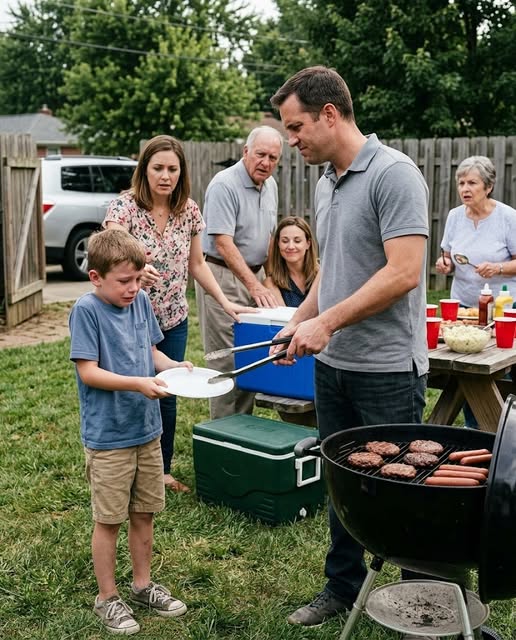
That Sunday, his backyard smelled like charcoal, onions, and grease.
Smoke drifted over the fence while music played from a speaker near the patio door.
Red plastic cups sweated on the picnic table.
A cooler sat open near my father, its lid bumping lightly against his wrist whenever someone reached inside.
My mother carried out a bowl of potato salad and pushed a serving spoon into the middle.
Cousins moved between the lawn chairs and the fence.
Children ran through the grass with the loose, happy energy of kids who believed every plate would eventually be filled.
Daniel had been watching the grill for almost twenty minutes.
He was 7, old enough to wait politely and young enough to think patience would be noticed.
I had told him he could ask for food when Marcus finished the story he was telling.
Daniel nodded and held an empty paper plate against his stomach.
He did not interrupt.
He waited until Marcus stopped talking, then walked toward the grill.
“Can I have a burger?” he asked.
His voice was quiet, but everyone near the patio heard him.
Marcus looked down at my son.
For a second, I thought he was about to lift a burger from the platter.
Instead, he smiled.
“Those are only for kids with a future.”
The sentence landed before anyone seemed willing to admit what it meant.
The tongs stayed suspended above the grill.
My father’s hand stopped on the cooler lid.
My mother stared at the serving spoon buried in the potato salad.
Marcus’s wife made a small sound that might have passed for a laugh if the joke had not been a hungry child.
The music kept playing.
The smoke kept rising.
Daniel stood there with the empty plate.
He did not understand all the history behind Marcus’s words.
He did not know about the loan.
He did not know how often Marcus had reminded our parents that he had once helped me.
He did not know that his uncle had spent five years turning one signature into a family legend.
Daniel only knew that every other child was allowed to eat and he had just been told he did not belong among them.
His fingers tightened around the rim of the plate.
The cheap paper bent beneath his thumbs.
His shoulders pulled inward.
Then he looked at me.
His eyes were wet, and the question on his face was worse than anything Marcus had said aloud.
Maybe Uncle Marcus is right.
That was what I saw.
For one ugly heartbeat, I imagined grabbing the platter and throwing every burger into the grass.
I imagined the silence afterward.
I imagined making Marcus feel watched in the same way Daniel was being watched.
But Daniel did not need a bigger scene.
He needed one adult to choose him without hesitation.
I walked over, took the paper plate from his hands, and set it on the picnic table.
“Come on, sweetheart,” I said. “We’re going home.”
Nobody tried to stop us.
That part stayed with me.
My father looked down at the cooler.
My mother moved the serving spoon a fraction of an inch, then stopped again.
Marcus’s wife looked toward the patio door.
Every person in that yard had heard a grown man tell a 7-year-old that food was only for children with a future.
Every person understood the insult.
Not one of them defended him.
Marcus gave a soft laugh behind me.
It was not loud.
It did not need to be.
The laugh said that my leaving proved his point, that I was too sensitive, too proud, too weak to handle the truth as he defined it.
I kept walking.
Daniel climbed into the car and buckled himself in.
He held both hands in his lap as though he were afraid to touch anything.
Marcus’s house disappeared through the rear window while my old car rattled away from the curb.
The air conditioner pushed out more noise than cold.
For two blocks, Daniel watched the road.
Then he asked, “Mom… why doesn’t Uncle Marcus like us?”
“It’s complicated, honey.”
“Is it because we don’t have a big house?”
That question reached a place in me Marcus never could.
A child does not measure a home the way adults do.
Daniel did not care that our apartment was small when we made pancakes on Saturday mornings.
He did not care that the couch was secondhand when we watched movies under the same blanket.
He did not care that the car was old when it got him to school, the grocery store, and every appointment on time.
Until that afternoon, those things had simply been ours.
Now Marcus had turned them into evidence against us.
I kept both hands on the steering wheel.
“Uncle Marcus doesn’t understand everything about our life,” I said.
Daniel wiped his cheek with his sleeve.
“Can we still get a burger?”
“Yes,” I told him. “We can still get a burger.”
We stopped at a roadside diner with chrome-edged tables, red vinyl booths, and a bell that jingled when the door opened.
The place smelled like coffee, fries, and grilled onions.
A paper menu stood between the ketchup bottle and the napkin dispenser.
Marcus would have called the diner cheap.
Daniel called it perfect before we had even sat down.
He slid into the booth and studied the menu as if he had been handed something important.
When the burger arrived, it came with fries, extra pickles, and a toothpick through the top of the bun.
Daniel looked at me for permission even though the plate was already his.
“Go ahead,” I said.
He took the first bite.
His whole face changed.
The hurt did not disappear completely, but hunger did.
For that moment, he was simply a boy eating a burger in a red booth while the bell over the door rang behind him.
That smile was worth more than anything in Marcus’s driveway.
On the ride home, Daniel talked about the pickles.
He said the diner had put more on his burger than anybody ever had before.
He asked whether we could come back someday.
I told him we could.
I did not tell him that I was still replaying the backyard in my mind.
I did not tell him that the silence of my parents hurt almost as much as Marcus’s words.
I did not tell him that a family can train itself to tolerate cruelty when the cruel person pays for enough dinners, hosts enough holidays, or owns the house where everyone gathers.
I carried the grocery bag from the car with one hand and held Daniel’s hand with the other.
Upstairs, our apartment looked exactly as it had that morning.
The same shoes were by the door.
The same stack of mail leaned against the fruit bowl.
The same small kitchen waited under the yellow light.
Nothing had changed, yet Marcus had made me see every worn corner through Daniel’s eyes.
I hated him for that.
I hated myself more for wondering whether I had made silence look like shame.
Daniel took a bath, put on his pajamas, and asked for the same story he had heard twice that week.
I read it anyway.
Halfway through, his breathing slowed.
By the final page, he was asleep with one hand tucked under his cheek.
I stayed beside him for a few minutes.
His face looked younger when he slept.
The insult had not followed him into the room, but I knew it would return someday if I did nothing.
Children remember the first time an adult assigns them a smaller future.
They may forget the weather, the music, or the color of the plate.
They remember who agreed.
I went back to the kitchen.
The refrigerator hummed.
A neighbor crossed the hallway outside, footsteps passing our door and fading toward the stairs.
My keys rested beside a stack of client notes.
Next to them was the folder Marcus had never seen.
The folder did not look dramatic.
It was plain, slightly bent at one corner, and thick enough that the top would not lie flat.
Inside were copies of records I kept because keeping records had taught me not to depend on anyone else’s memory.
Marcus depended on memory all the time.
More specifically, he depended on the version of memory that made him generous.
Five years earlier, when I needed a business loan, he had agreed to guarantee it.
I had been grateful.
I said so.
I thanked him privately, then again in front of our parents because he wanted them to know he had helped.
What I did not understand then was that Marcus did not view help as a moment.
He viewed it as ownership.
The loan became his favorite explanation for everything I accomplished afterward.
If I got a new client, he reminded people that I would not have had a business without him.
If I skipped a family dinner because I had work, he joked that I was too busy to remember who gave me my start.
If I disagreed with him, the guarantee returned as proof that I lacked gratitude.
He never asked how quickly I began making extra payments.
He never asked when the balance reached zero.
He never asked why the bank stopped sending notices with his name attached.
He liked the original story too much to check whether it was still true.
The truth was simple.
I paid the loan off four years ago.
The final payment had cleared.
The balance had reached zero.
The guarantee had ended.
I kept the payoff confirmation, the loan agreement, and the release page.
I kept the email showing that Marcus’s name had been removed from the account.
I kept transfer records related to the work I had completed and ownership papers connected to what I had built.
The folder contained dates, signatures, account references, and confirmation numbers.
Nothing inside it depended on family opinion.
For years, I left it closed.
I did not want a showdown.
I did not want to parade my records around a holiday table just to prove that my life counted.
I wanted my work to support Daniel.
I wanted rent paid on time.
I wanted groceries in the kitchen and enough left over for a diner burger when somebody tried to make my child feel small.
That had been enough.
At 11:55 p.m., my phone buzzed on the table.
Marcus’s name appeared on the screen.
His message read, “Remember who guaranteed your business loan five years ago. Remember who believed in you when nobody else did. You owe me respect.”
I read it once.
Then I read it again.
The third time, one word held my attention.
Respect.
He had humiliated a hungry child and still believed the night should end with me thanking him.
He believed my leaving was weakness.
He believed my small apartment meant I had no leverage.
He believed silence meant he still owned the story.
I looked toward the hallway where Daniel was sleeping.
Marcus had not only insulted me.
He had used my son as a collection notice for a debt that no longer existed.
That changed the decision.
My silence had never been surrender.
It had been restraint.
At 12:07 a.m., I opened the folder on my laptop.
The screen lit the edge of the paper stack beside me.
I clicked through the bank records first.
The dates lined up exactly as I remembered.
The original loan agreement showed Marcus’s guarantee.
The payoff confirmation showed a zero balance four years earlier.
The release page showed the end of his obligation.
The transfer documents carried their own timestamps.
The ownership papers carried signatures he had never bothered to ask about.
I checked each file name before attaching anything.
No blurry screenshots.
No emotional summary.
No accusation I could not support.
Just records.
I thought about my father’s hand on the cooler lid.
I thought about my mother staring at the potato salad.
I thought about Marcus’s wife laughing because silence was easier than choosing a side.
Most of all, I thought about Daniel asking whether a small house made us less worthy of food.
I opened a new message.
For a moment, the cursor blinked in the empty box.
Marcus had spent five years believing that one old signature gave him the right to define me.
He had spent one afternoon teaching my son the same lie.
I attached the first document.
Then I started typing.
“Marcus, I’m glad you brought up the loan…”
