The first thing I remember about the call is not Emma’s voice.
It is the cold carton of milk sweating through the bottom of my grocery basket while a store freezer hummed beside me.
Then I heard trays clattering in the background, a burst of laughter, and my daughter whispering, “Mom, please don’t come in angry.”

That sentence made my hands go numb.
Emma had never been a child who asked me to fight her battles.
She was fifteen, careful with her words, careful with money, and careful not to take up more space than she thought she had earned.
When she was eight, she once wore a winter coat with a broken zipper for two weeks because she knew I was waiting for payday.
When she was twelve, she started babysitting for a neighbor and saved every dollar in a coffee tin hidden behind her books.
The white high-top shoes had come from that money.
She had wanted them for months, not because they were fashionable, but because most of her clothes were hand-me-downs and she wanted one thing that had belonged only to her from the beginning.
She cleaned them with an old toothbrush after every rainy day.
When one eyelet loosened, she repaired it with green thread because that was what we had in the sewing drawer.
That little green stitch would later matter more than either of us could have imagined.
I left the groceries with the cashier, drove to the school, and reached the main office at 1:09 p.m.
The hallway smelled like floor cleaner and cafeteria grease.
A bell rang while I was signing in, and students poured past the glass doors in loud clusters before the corridor emptied again.
Emma was waiting in the nurse’s office in borrowed socks.
Her gray hoodie was damp with milk and streaked with tomato sauce.
Bits of pasta clung to one sleeve.
There was a red scrape across her palm where the cafeteria tile had taken the top layer of skin, but the deeper damage was in the way she held her shoulders, folded inward as if she could make herself smaller than what had happened.
The nurse had given her water and a clean towel.
No one had found her shoes.
I sat beside her and asked her to tell me everything from the beginning.
She stared at the paper cup in her hands.
“Ashley said I was acting better than everybody.”
Emma had corrected a rumor in class that morning.
Ashley claimed Emma had reported her for cheating on a test, but Emma had not.
By lunch, Ashley had turned the accusation into a performance.
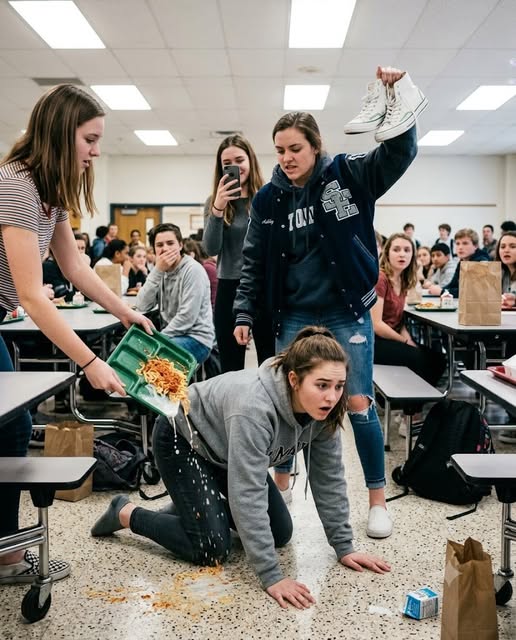
Megan took Emma’s tray.
Jessica started recording.
Ashley grabbed the white high-tops after Emma slipped them off because milk had splashed inside one shoe.
Then the three girls told Emma she could have them back if she crawled across the cafeteria.
At first Emma refused.
Megan dumped the food over her hoodie.
Ashley held the shoes above her head.
Jessica kept filming while students laughed, backed away, or stood frozen with their phones in their hands.
Emma got down on the floor because she thought the humiliation would stop sooner if she obeyed.
It did not.
Ashley kicked one shoe under a table.
Megan picked up the other.
Then they walked out with both.
I asked who had seen it.
Emma named several students, including most of the varsity girls’ basketball team.
She knew them because she helped the student manager during home games.
She filled water bottles, carried towels, checked numbers in the scorebook, and stayed late after games to collect warm-up jackets left under the bleachers.
She was not officially part of the team.
Still, she had become part of their routine.
Olivia, the team captain, had stood up during the humiliation.
Two other players followed.
Before they reached Emma, someone from the athletics office entered the cafeteria and ordered everyone to sit down.
“The game is tomorrow,” he told them.
“This does not leave this room until the school reviews it.”
Emma remembered the sentence because it sounded less like concern than command.
The assistant principal joined us at 1:24 p.m.
He carried a folder but never opened it.
He called what happened “an incident involving several students” and said the school was collecting statements.
I asked why Emma had been separated from her phone.
He said staff wanted to prevent online escalation.
I asked why the three girls had returned to class.
He said there were procedures.
I asked why my daughter had been sent to the nurse without shoes.
He looked at the office door.
Some adults tell the truth with words.
Others tell it by choosing exactly where not to look.
At 2:18 p.m., I filed a written incident report with the school office.
I listed the names Emma had given me.
I described the food, the stolen property, the forced crawling, and the recording.
I requested that cafeteria security footage be preserved and asked for written confirmation that no student witness would face retaliation.
The secretary stamped my copy.
The stamp landed slightly crooked across the bottom corner.
I photographed it before leaving the building.
At 3:02 p.m., the school emailed a generic statement saying the matter was under review.
There was no mention of stolen shoes.
There was no mention of the video.
There was no mention of the instruction to remain silent.
Emma sat in the passenger seat with her knees pulled toward her chest.
“I made everything worse,” she said.
I turned off the engine.
“You did not make this happen.”
“They’re going to hate me.”
“People who hurt you may be angry when the truth costs them something. That is not the same as you doing wrong.”
She cried then, quietly, with her face turned toward the window.
That evening, I washed the hoodie in the sink because she did not want the stains sitting overnight.
The water turned orange.
A piece of pasta floated past my wrist.
It was such an ordinary thing, and I hated it more than anything dramatic because it proved how completely someone else’s cruelty had entered our kitchen.
At 9:06 p.m., an unknown number sent me a still image.
Emma was on her hands and knees between two cafeteria tables.
Food covered her back.
Ashley held one shoe above her.
Megan’s mouth was open mid-laugh.
Jessica’s phone was pointed down.
Around them, students formed a loose circle.
Some faces showed amusement.
Others showed shame.
The message said, I’m sorry I didn’t help her.
I replied, Please do not delete anything else.
The sender wrote back three minutes later.
We were told to.
I asked who gave the order.
There was no answer.
The next morning, I called the school office at 7:41 a.m. and requested the status of the footage preservation.
The secretary said the request had been forwarded.
At 8:16 a.m., I emailed the assistant principal and attached my stamped report.
At 10:03 a.m., I received a reply saying the school would discuss next steps after the championship game.
That sentence settled something in me.
They had turned my daughter’s humiliation into a scheduling problem.
The championship was set for 4:30 p.m.
Emma did not want to attend.
She said people would stare.
She said Ashley might be there.
She said the players would think Emma had ruined the most important game of their season.
Then Olivia sent her a message.
Please come. Sit where we can see you.
Emma read it twice.
“Why?”
“I don’t know,” I said.
That was true.
At 4:12 p.m., we entered the gym.
The place was already loud.
The pep band played fragments of songs while parents climbed the bleachers carrying paper cups and folded jackets.
The floor shone under bright lights.
Banners hung high above the court, but I kept my eyes on Emma.
She wore plain black sneakers borrowed from her cousin.
They pinched at the toes.
She sat beside me in the second row and tucked both feet under the bench.
At 4:21 p.m., Ashley walked through the gym doors.
She was wearing Emma’s white high-tops.
The green repair thread showed near the left toe.
For one second, I thought Emma might be mistaken.
Then Ashley glanced toward us and smiled.
That smile removed every remaining possibility of accident.
Emma’s hand found mine.
Across the court, Olivia saw the shoes.
She stopped talking to a teammate.
One by one, the other players followed her gaze.
The announcer called the starting lineup.
The visiting team ran onto the floor.
Our team stayed in the tunnel.
Coach Michael turned and motioned for them to come out.
No one moved.
The crowd began to murmur.
Olivia stepped forward holding her phone.
Eleven players formed a line behind her.
They were dressed, taped, and ready to play.
They simply refused to cross the painted edge of the court.
Coach Michael looked from Olivia to the clock.
“What is going on?”
Olivia said, “We are not playing until Emma gets the truth.”
The athletic director heard her from the scorer’s table.
He pushed through the sideline gate and told the players they were embarrassing the school.
Olivia held up her phone.
The team group chat showed a message sent at 1:03 p.m. the day before.
Do not share videos. Do not contact Emma or her mother. Keep distractions away from championship preparation.
Coach Michael read the message.
His jaw tightened when he saw the sender.
The athletic director reached for the phone.
Olivia pulled it back.
He said the order had been misunderstood.
He claimed he was trying to protect students from rumors and preserve the integrity of the review.
Then Sarah, the backup guard, stepped out of line.
She opened her call log.
At 1:11 p.m., eight minutes after the group message, the athletic director had left her a voicemail.
Sarah had saved it.
She pressed play.
His voice came through the small speaker, thin but clear.
“No one talks about the cafeteria. Not before the game. If this becomes a distraction, remember who decides next season’s roster support.”
The gym changed.
People who had been annoyed became still.
People who had been confused began looking toward the scorer’s table.
The assistant coach covered her mouth.
Coach Michael asked for the microphone.
The athletic director grabbed his arm and whispered, “Think carefully. You can still save this.”
Coach Michael pulled free.
“The game will not begin,” he said into the microphone, “until this school explains why a student was humiliated, robbed, and then pushed into silence.”
The pep band had stopped playing.
The referees stood near center court.
Ashley’s mother rose from the bleachers and told everyone this was becoming a witch hunt over a childish prank.
Coach Michael looked toward Ashley’s feet.
“Those shoes belong to Emma.”
Ashley said Emma had given them to her.
Emma stood before I could stop her.
“No, I didn’t.”
Her voice shook, but it carried.
Ashley laughed once.
Then Olivia asked the scorer’s table to display the cafeteria still on the small presentation monitor used for team announcements.
The school technician hesitated.
Coach Michael nodded.
The image appeared.
Emma on the floor.
Ashley holding the shoe.
Megan tipping the tray.
Jessica recording.
The audience reacted in one collective breath.
Ashley’s mother sat down.
The athletic director told the technician to turn it off.
Coach Michael said, “Leave it up.”
Then another piece of proof arrived.
Jessica walked into the gym with her father.
She was crying so hard she could barely speak.
Her father carried a printed copy of an email from the athletics office instructing Jessica’s family to delete the video and avoid making statements until after the championship.
Jessica had not deleted the original file.
She had sent it to herself before turning over her phone.
The full video showed more than Emma crawling.
It showed Olivia and two teammates standing up.
It showed the athletic director entering.
It captured him telling the players, “You saw nothing that needs to become a story today.”
Coach Michael listened to that line twice.
Then he turned to the athletic director.
“You used their season to threaten them into silence.”
The athletic director said he had been protecting the program.
Olivia answered before the coach could.
“A program that needs us to ignore this is not worth protecting.”
That was the moment the team’s refusal became something larger than a delayed game.
Parents began asking for copies of the incident report.
Several students came down from the bleachers to give their names as witnesses.
The championship was postponed.
Not canceled.
The referees cleared the court while administrators contacted the district office.
The players stayed together in the tunnel, still in uniform.
No one celebrated.
No one treated the delay like a victory.
They understood that the point was not to punish everyone who had come to watch a game.
The point was to stop adults from using the game as a shield.
Emma stood near the bench with her borrowed sneakers pinching her feet.
Olivia came over and apologized.
Not for the bullies.
For herself.
“I stood up,” she said, “but I sat down when he told us to.”
Emma looked at her for a long moment.
“Then you stood up again.”
That answer broke something open in several of the players.
Sarah cried.
The assistant coach turned away and pressed her fist to her mouth.
Coach Michael asked Emma what she wanted done about the shoes.
She looked at Ashley.
“I want them back.”
Ashley removed them in front of the scorer’s table.
Emma did not put them on.
She placed them in a plastic equipment bag because she said they no longer felt clean.
That detail stayed with me.
Cruelty can take an object without destroying it and still make the owner feel that something has been contaminated.
The next week, the school issued written findings.
Ashley, Megan, and Jessica were suspended pending further review.
Jessica’s cooperation was included in the record.
The athletic director was placed on leave after the group-chat message, voicemail, cafeteria video, and deletion instruction were verified.
The assistant principal’s handling of Emma’s report was referred for administrative review.
The school confirmed in writing that Emma would face no disciplinary action.
Coach Michael and the players met with Emma privately before the rescheduled championship.
They did not ask her to forgive anyone.
They asked what support would make it possible for her to return to school.
She requested a different lunch period for two weeks, access to the counselor, and a written rule that no athletic event could delay the reporting of student safety concerns.
Those requests were granted.
The team played the championship six days later.
Emma did not sit in the bleachers.
She stood at the scorer’s table with the student manager, wearing a new pair of inexpensive black sneakers she chose herself.
The white high-tops remained sealed in the equipment bag at home.
Our team lost by three points.
No one called the refusal a mistake.
After the final buzzer, Olivia handed Emma the game ball.
Emma tried to refuse it.
Coach Michael said, “This season will not be remembered for the score.”
Emma carried the ball home under one arm.
A month later, she opened the plastic bag containing the white shoes.
She cut out the green repair thread and tied it around the zipper pull of her backpack.
Then she donated the shoes to a textile recycling drive because she did not want them worn by anyone else.
For a while, I worried that the cafeteria would become the story she told herself about who she was.
A child forced to crawl while a room watched.
But that was not the whole story.
The whole story included the players who admitted they had been afraid.
It included the girl who saved the video.
It included the coach who chose a child over a trophy.
It included a mother who photographed a crooked stamp because sometimes dignity begins with proof.
An entire cafeteria had taught Emma to wonder whether she deserved help.
A team answered by refusing to move until she received it.
That did not erase what happened.
It changed what happened next.
