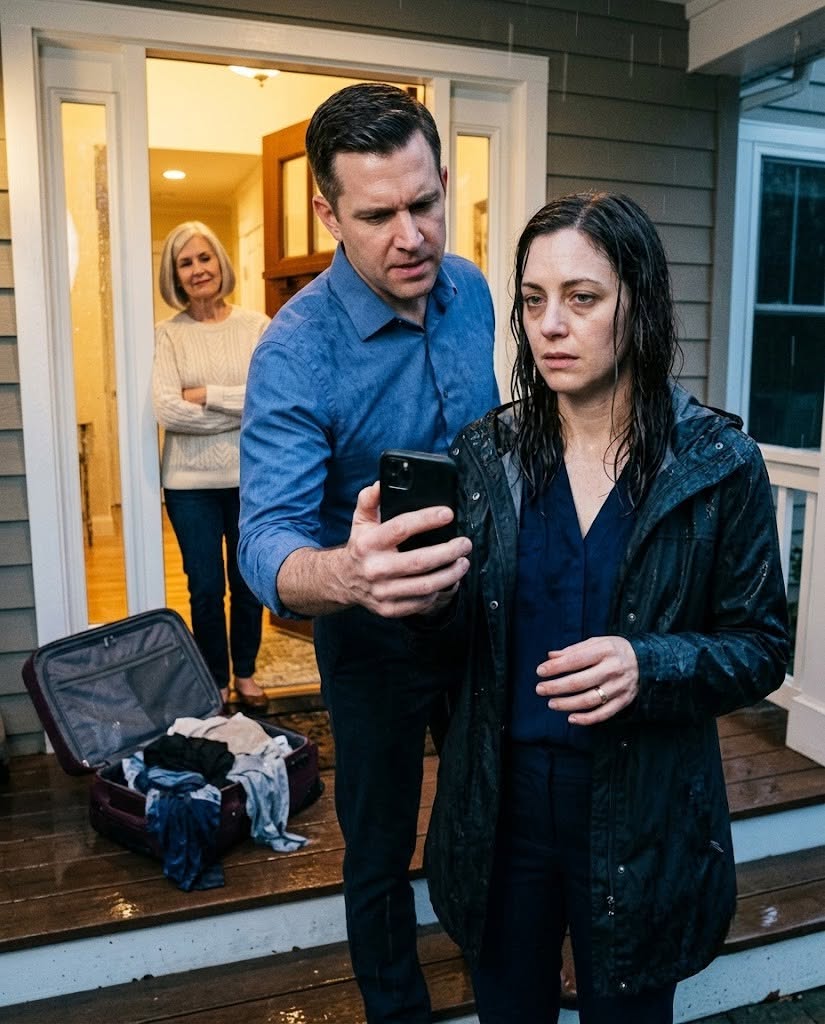
The rain had already found the collar of my blouse when the first suitcase hit the stairs. It bounced twice, split open, and dropped my shoes across the porch.
For a second, I only stared at them. They looked too ordinary for the moment. Black flats, a navy pump, one slipper I wore while making tea.
Then my sister-in-law appeared at the top of the staircase with my second suitcase. She dragged it by one wheel and let it tip over the edge.

‘Careful,’ I said.
She laughed.
My husband did not laugh at first. He stood in the hall with my phone in his hand. He had taken it so smoothly that I felt the loss after it happened.
‘Give it back,’ I said.
He turned the screen toward himself and pressed the side button until it went black.
‘No more calls.’
His mother stood behind him, dry and neat in a cream sweater. Her hair had not moved. Her face had the same pleasant look she used at church suppers.
‘You heard us,’ she said. ‘You no longer belong here.’
I looked past them into the entryway. The umbrella stand was where I had left it. The framed photo of my father-in-law still hung beside the stairs.
He had hated that picture. He said it made him look like a bank president. I had kept it there because visitors liked it.
That was the first thing that hurt. Not the luggage. Not the rain. The hurt came from seeing his face behind them while they erased me.
My husband stepped back and closed the door.
The deadbolt slid.
I heard it through the glass.
His sister lifted both hands like she had finished a chore.
Inside, they started laughing.
I stood under the porch light and looked at the mess. The rain flattened my hair. Water ran into one open suitcase and darkened my work blouse.
I had lived in that house long enough to know every sound inside it. I knew the hum of the refrigerator. I knew the pipe that knocked in winter.
I also knew the tiny red light above the porch camera.
It blinked once.
My father-in-law had installed it himself. He trusted cameras more than people who spoke loudly. He said loud people used volume to bury facts.
He had not been loud. In his last months, he had become almost weightless. I could lift his shoulder with one hand when changing his sheets.
My husband visited when he needed money. His mother visited when she wanted keys. His sister visited when there was food.
I stayed.
I learned how he liked his soup cooled. I learned which pills made him nauseous. I learned that he missed his first wife when it rained.
He told me stories when the pain medicine let him. Some were funny. Some were not.
One evening, he asked me to bring the small metal cash box from his closet. I thought he wanted old photographs.
Instead, he took out a lawyer’s card and a sealed envelope.
‘You may need this before they think you do,’ he said.
I told him not to talk that way.
He smiled at the ceiling.
‘People show you who owns their heart when a house is on the table.’
I put the card in my wallet because it made him calmer. I put the envelope back because he asked me to. He said the lawyer already had the signed copy.
After his funeral, the house changed before the flowers wilted. My mother-in-law started calling me temporary. My husband stopped touching my shoulder in front of her.
He became careful with pronouns.
My room became the guest room. My bills became favors. My grief became an inconvenience sitting in their chair.
I tried to keep peace because I thought peace was what my father-in-law wanted. I cooked, cleaned, and answered questions about bank drafts.
Then my mother-in-law brought a cardboard box to the hallway.
‘Pack what is yours.’
I asked for the estate papers.
She looked at my husband.
He looked away.
That night, he told me I would sign a statement saying I had left voluntarily. He said it would prevent ugly trouble.
‘What statement?’ I asked.
‘The one my mother wrote.’
I slept with my wallet under my pillow. Before sunrise, I used the bathroom, locked the door, and called the number on the old card.
The lawyer answered like he had expected me.
I whispered my name.
He said, ‘Stay visible if they try anything.’
I did not understand.
He repeated it.
‘Stay where the camera can see you.’
By noon, my husband had my phone. By twelve minutes after noon, my suitcase was on the steps. By then, I understood.
The lawyer arrived in a dark sedan with his wipers still moving. He parked behind the mail truck and stepped into the rain without hurrying.
He was older than I expected. He carried a black portfolio and wore no dramatic expression.
That scared them more than anger would have.
My husband opened the door before the lawyer knocked. He still had my phone in his hand.
‘Are you here for her?’ he asked.
‘I am here for the estate.’
My mother-in-law moved into the doorway.
‘This is private family business.’
The lawyer looked at my suitcase on the steps. Then he looked up at the camera.
‘It became recorded business when you threw her property outside.’
My sister-in-law muttered something from the stairs.
The lawyer did not look at her.
‘Please return her phone.’
My husband tightened his grip.
‘She has no right to call anyone from my father’s house.’
The lawyer opened the portfolio.
He removed one cream envelope with my father-in-law’s signature across the seal. My mother-in-law’s eyes changed before he broke it open.
‘That is not the final will,’ she said.
‘It is the only final will.’
‘He was confused.’
‘He was examined that morning.’
The lawyer said it calmly. My husband looked at his mother. She gave him a tiny shake of the head.
That tiny shake told me she had known about the envelope.
The lawyer unfolded the first page. He held it so rain would not touch it.
Then he read.
‘This house belongs to my daughter-in-law.’
Nobody moved.
A house remembers who was kind inside it.
My mother-in-law’s smile vanished so completely that her face seemed unfinished. She reached for the page, but the lawyer stepped back.
‘No,’ he said.
My husband finally looked at me. Not like a wife. Not even like an enemy. He looked at me like a locked door had opened behind him.
‘That cannot be legal.’
‘It is legal.’
‘She is not blood.’
The lawyer turned one page.
‘Your father addressed that.’
My mother-in-law’s voice dropped.
‘Do not read more outside.’
‘You placed her outside.’
The words landed quietly. My sister-in-law stopped smiling. My husband lowered my phone by two inches.
The lawyer pulled a second sheet from the portfolio. It was not part of the will. It was a still image from the doorbell camera.
My suitcase was frozen in mid-fall.
The time stamp was blurred by rain, but the picture was clear. My husband stood inside, holding my phone.
‘Your father also signed an instruction letter,’ the lawyer said.
My mother-in-law backed away from the threshold.
‘Instruction letters do not matter.’
‘This one explains the clause.’
He read the second clause slower than the first. Every word seemed to make the hallway smaller.
If any beneficiary removed me by force, intimidation, lockout, or seizure of communication, that beneficiary lost every remaining claim tied to the house.
My husband blinked.
The lawyer kept reading.
If the lockout occurred, the attorney was required to notify law enforcement. The person responsible could also report it at once and cooperate.
That was when my husband looked down at my phone.
His mother understood one second later.
‘Do not you dare.’
The lawyer closed the will with one finger marking the page.
‘You can call, or I can.’
My husband whispered, ‘What happens if I do not?’
‘Then I send the video, the will, and the letter without your cooperation noted.’
My mother-in-law grabbed his sleeve.
‘He is bluffing.’
The lawyer looked at her hand.
‘Madam, your husband hired me because he believed none of you would stop at shame.’
That sentence broke something in the room. Not loudly. It broke like glass under a rug.
My husband stepped away from his mother.
She slapped his arm, but he did not move back. He unlocked my phone with the code he had watched me use for years.
Then he dialed 911.
His face had gone gray.
The dispatcher answered. I could hear only his side, but every word reached the porch.
‘I need to report an unlawful lockout.’
His mother hissed his name.
He swallowed.
‘I locked my wife out. I took her phone.’
The lawyer’s eyes stayed on him.
‘Her belongings were thrown outside. She is on the porch in the rain.’
My knees weakened, but I stayed standing. I wanted to sit on the wet step. Pride kept me upright.
The dispatcher must have asked if I was safe.
My husband looked at me.
‘She is cold, but she is standing.’
That was the first honest thing he had said all day.
The police arrived before the rain stopped. The lawyer showed them the footage first. He did not argue, dramatize, or point.
He simply let the house speak.
On the recording, my sister-in-law laughed as the suitcase fell. My mother-in-law said I would learn my place. My husband took my phone and closed the door.
One officer asked me if I wanted to come inside.
I looked at the doorway.
The house was mine. Still, stepping back through that door felt harder than leaving it.
The lawyer held out my phone.
‘You do not have to decide fast.’
I took it. My hand shook when it touched mine again.
My mother-in-law stood in the hall with her arms folded. She looked smaller without certainty.
‘This is still my home,’ she said.
The lawyer shook his head.
‘It was your husband’s home. Then it became hers.’
‘Because he was sick.’
‘Because he was grateful.’
That word silenced her longer than any threat.
The officers asked my husband to step outside. He did. Rain touched his perfect shirt for the first time.
My mother-in-law tried to follow, but the lawyer stopped her.
‘One more thing.’
He removed a smaller envelope. My name was written across it in my father-in-law’s uneven hand.
I opened it inside the foyer, with rainwater dripping from my sleeves onto the tile.
There was one page.
His message was short.
My dear girl, if you are reading this at the door, then they became exactly who I feared they were.
I covered my mouth.
The note continued.
I did not give you this house because you married my son. I gave it to you because you made it a home when the rest of us treated it like property.
My husband stood outside between two officers. He could see me through the glass.
For the first time, he looked like the person locked out.
The lawyer waited until I finished reading.
‘There is a final paragraph.’
I looked down.
Your husband will call for help only when help is his last shelter. Let him make that call. Then choose peace without asking his permission.
I folded the letter against my chest.
My mother-in-law said my name, soft now.
I had waited years for softness from her. It came too late to be useful.
‘Please,’ she said. ‘We can discuss this.’
I looked at the suitcase on the porch. My cardigan still hung from the railing. Rain had soaked one sleeve until it stretched low.
‘No.’
The word surprised me. It was not loud. It did not need to be.
The lawyer nodded once.
The officers documented the lockout. My husband kept repeating that he had only followed family instructions. His mother stopped correcting him when she realized he was naming her.
By evening, the locksmith arrived. Not to keep me out.
To change the locks for me.
My husband asked if he could collect his clothes. I told him the lawyer would arrange a time.
He looked wounded by procedure.
That almost made me laugh.
My mother-in-law left last. She paused beside the umbrella stand, touching it like a relic.
‘He never told me,’ she said.
I held my father-in-law’s letter in one hand.
‘Maybe he did.’
She looked at me.
‘Maybe you just did not listen.’
She had no answer for that.
When the door closed, the house did not feel victorious. It felt tired. It felt like a patient finally sleeping after pain.
I carried my wet clothes inside. I placed my shoes near the heater. I hung the cardigan over a chair.
Then I went upstairs to my father-in-law’s room.
His old blanket was folded at the foot of the bed. The room smelled faintly of cedar and medicine.
I sat in his chair and let myself cry there. Not because I had won. Winning was too small a word.
I cried because someone had seen the day coming and believed I deserved shelter after it.
The next morning, the lawyer returned with copies of every paper. He also brought the original camera files.
My husband had called twice. His mother had called nine times. I answered none of them.
The second clause had done more than transfer claims. It had forced truth into an official record before they could rewrite it.
That was the real trap.
Not revenge.
Record.
My father-in-law knew his family could survive shame. They had survived years of it by assigning it to me. What they could not survive was a clean record.
A month later, I stood on the porch during another rainstorm. The new locks clicked behind me. My phone was in my own pocket.
The red camera light blinked above the door.
I smiled at it this time.
Then I carried my father-in-law’s letter to the small desk by the window. I placed it beside the will, the footage drive, and my house keys.
I did not frame the papers. I did not need a shrine.
I needed a home.
And at last, when the rain came down, nobody inside laughed.
