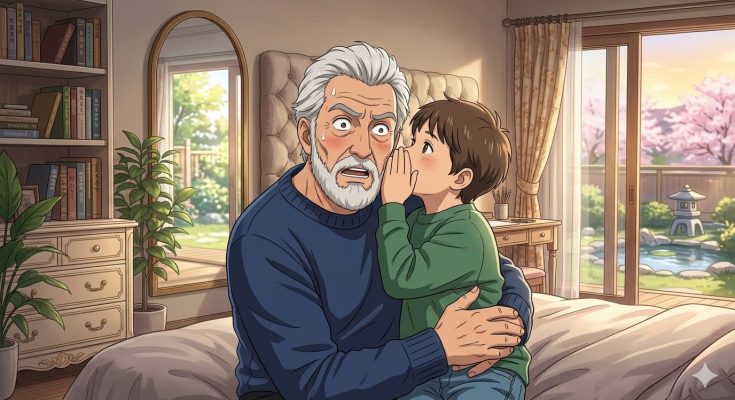
Part 1

“Grandpa, don’t give any more money to my dad. Just follow him one day… and you’ll understand why.”
Arthur Miller felt the soft-serve ice cream melt right onto his fingers. Across from him on a wooden bench in Madison Park, his six-year-old grandson, Leo, no longer looked like the happy kid who had been showing off a dinosaur sticker just a minute earlier. He was nervously scanning the walking paths.
“Who told you to say that to me, buddy?” Arthur asked.
“Nobody,” Leo whispered, staring at his shoes. “I heard him talking to a lady. They were laughing because you said you’d send him another transfer.”
For six years, Arthur had been wiring $1,500 every single month to his son-in-law, Marcus Vance. He had done it ever since his daughter, Claire, died in a horrific car crash on an icy stretch of highway upstate. Her sedan had veered off the embankment, crashed into a ravine, and burst into flames. The body recovered from the wreckage was burned beyond recognition. Arthur still clearly remembered the state troopers knocking on his door at two in the morning, and his wife, Evelyn, repeating over and over that there had to be some terrible mistake.
There wasn’t one—or so the authorities said at the time.
Six months later, Evelyn suffered a massive heart attack and passed away. Arthur always believed that grief had simply broken her heart.
Marcus was left alone with a six-month-old baby. At first, he pretended to refuse Arthur’s financial help, but Arthur insisted. He owned a modest hardware store, rented out a inherited duplex, and had a decent nest egg saved up. What good was money if his grandson was the only piece of Claire left in this world?
So the wire transfers began. Mortgage payments. Daycare tuition. Pediatricians. Clothes. Home repairs. Every year, Marcus brought up a new emergency. And with every passing year, he seemed less grateful.
Still, Arthur never asked too many questions. Twice a month, he picked up Leo for ice cream and walks through the park. Marcus never invited him past the front porch.
That afternoon, when Arthur dropped the boy off, Marcus was waiting by the driveway.
“Arthur, I’m going to need double next month,” Marcus said casually, leaning against his SUV. “Some unexpected medical and household bills hit all at once.”
“Three thousand dollars?”
Marcus smiled, looking entirely confident. “Yeah, roughly.”
For the first time in six years, Arthur hesitated. “I’ll have to think about it.”
The smile vanished instantly from Marcus’s face.
That night, Arthur couldn’t sleep. He kept replaying Leo’s voice, the way the boy had left his ice cream completely untouched, and how he had begged Arthur not to ask Marcus about it because “Dad will get mad.”
Two days later, a blonde woman in her mid-thirties walked into Arthur’s hardware store. She bought a box of brass screws, paid in cash without making eye contact, and hurried out.
Arthur watched her through the front window.
Across the street, parked near the curb, was Marcus’s black truck. The woman walked straight up to his driver’s side window, leaned in, and kissed him.
Rage flared in Arthur’s chest, but behind it came a far more disturbing sensation: her face looked strangely familiar.
He closed the store early and called Frank Miller, a retired precinct detective and a trusted friend. “Frank, I need your help tailing my son-in-law.”
Frank paused on the line. “You think he’s cheating on your late daughter’s memory?”
“No,” Arthur said quietly. “I think he’s doing something worse.”
That same evening, while digging through old family boxes in the attic, Arthur pulled down the brass urn sitting on a high shelf—the urn that supposedly contained Claire’s cremated remains.
The threaded lid gave way far too easily.
He tipped the urn over onto a section of newspaper laid out on his desk.
There were no human ashes inside.
Out poured coarse gray sand, crushed drywall, and fine cement dust.
Arthur called Frank back with a cracking voice. “My daughter isn’t in this urn.”
And he had no idea that the fake ashes were only the first layer of a terrifying fraud.
Part 2
Frank arrived at Arthur’s house before sunrise. He inspected the gray powder, took several high-resolution photos, and forced Arthur to sit down with a cup of black coffee.
“Six years of wiring him cash, and you never asked for a single receipt or invoice?” Frank asked softly.
“I thought I was taking care of Leo.”
“You wanted to believe that, Arthur. There’s a difference.”
The words cut deep, but Arthur knew he deserved them.
For four days, Frank and Arthur tailed Marcus with utmost discretion. The first two days were entirely ordinary: hardware store runs, his office, the grocery store. On the third day, the woman from the store reappeared. She drove straight to Marcus’s house, pulled a set of keys from her purse, and unlocked the front door like she lived there.
“That’s no guest,” Frank muttered through his binoculars. “She’s got her own key.”
On the fourth day, Marcus drove out toward the county line, turning onto a dirt road leading into a abandoned industrial park. He pulled up behind a rusted chain-link fence, parked, and spent nearly an hour inside a small wooden structure that had once served as a security gatehouse.
Meanwhile, Frank ran the woman’s license plate. Her name was Chloe Vance.
Arthur felt the air leave his lungs. “That’s impossible.”
Chloe had been Claire’s closest friend in college. According to Marcus’s statement to the police six years ago, Claire had spent her final hours at Chloe’s apartment before the fatal crash.
“That’s why she looked familiar,” Arthur whispered. “She was at our house dozens of times for dinner.”
Frank didn’t answer immediately. He opened a laptop sitting on the passenger seat and brought up a surveillance photo taken by a private investigator firm he had hired: Marcus and Chloe holding hands outside a steakhouse two towns over, smiling brightly.
Then Frank swiped to a second photo, taken near the gatehouse an hour earlier.
A frail, thin woman wearing oversized, faded clothes had stepped out onto the porch for a brief second to pick up a grocery bag Marcus had left on the ground. Her dark hair was dyed black, her posture was hunched, and her face was turned downward.
Arthur stared at the screen for a long, silent minute.
Then he noticed the subtle physical habit.
Her head was tilted slightly to the right—a nervous habit Claire had done ever since she was a little girl whenever she felt overwhelmed.
“Zoom in on her hands,” Arthur choked out.
Frank expanded the image.
Arthur stopped breathing. On her right index finger was a small, heart-shaped scar from a childhood baking accident.
“It’s her,” Arthur gasped, tears blurring his vision. “My daughter didn’t die six years ago.”
“Someone went through extraordinary lengths to make the world think she did,” Frank said darkly.
They didn’t wait for backup. That very night, under the cover of a moonless sky, they returned to the industrial site. The gatehouse had a single dim light burning inside, a padlocked exterior latch, and a small bar window. Frank used a heavy crowbar to pop the lock open.
Inside, the smell of damp air and old paper was thick. A thin mattress lay on the floor alongside a small electric hotplate, water jugs, and dozens of photographs taped to the wooden walls.
Photos of Leo.
At the park.
In his school uniform.
Eating ice cream on the bench with Arthur.
They were the exact photos Arthur had texted to Marcus every month so he could “keep memories for the boy.”
In the far corner of the room, a terrified figure scrambled backward against the wall, clutching a thin blanket to her chest. Her cheeks were hollow, her skin pale, and her arms bore faint marks from years of isolation.
Arthur recognized her eyes instantly.
“Claire…”
She slapped both hands over her mouth, gasping for air. “Dad?”
Arthur stepped forward, but Claire shrank back, trembling violently as if even an embrace posed a physical threat. “You can’t be here! If Marcus finds out you found me, everything is over!”
“What did he do to you, sweetheart?” Arthur cried out, dropping to his knees.
Claire began to weep silently. “I… I agreed to stay hidden.”
Arthur froze. “Why? Why would you ever agree to this nightmare?”
Claire looked up, her dark eyes filled with unbearable sorrow. “Because they made me believe I killed Chloe.”
Before Arthur could process her words, Frank unlocked his smartphone screen and extended it toward her. Claire had spent six years believing her best friend was dead—and she had no idea that Chloe was very much alive, sleeping in her former home every night alongside her husband.
Part 3
Claire stared at the phone screen for what felt like an eternity, her breath coming in ragged hitches.
The display showed Chloe—vibrant, smiling, and visibly healthy—walking out of a high-end bistro alongside Marcus just three weeks ago. In the next photo, Marcus had his arm wrapped tightly around Chloe’s waist as they loaded shopping bags into the back of his truck.
Claire collapsed forward onto the worn mattress, buried her face in her hands, and shook hysterically. “No… no, that’s impossible. I saw her die on the floor. I saw the blood.”
“You saw what they staged for you to see, Claire,” Frank said firmly, his voice filled with professional authority. “Tell us what happened that night.”
Bit by bit, the horrific story emerged.
Six years ago, Claire had gone over to Chloe’s apartment to confront her about a $10,000 personal loan that Chloe had refused to repay. Marcus had encouraged the confrontation, insisting they “work things out over a bottle of wine” while he stayed home with baby Leo.
Claire remembered feeling unnaturally lightheaded after just one glass of wine. Her memory of the evening was a blur of spinning room angles, Chloe taunting her viciously, and a heated argument near the dining table. In a sudden panic, Claire had shoved Chloe away. Chloe tripped backward, striking her head against the sharp edge of a heavy marble coffee table.
A sickening thud echoed through the room, followed by pool after pool of dark blood spreading across the rug.
“I knelt beside her,” Claire sobbed, her body shaking as the trauma resurfaced. “She wasn’t breathing. She had no pulse. I was intoxicated, terrified, and completely out of my mind. I called Marcus.”
Marcus arrived within twenty minutes. He checked Chloe’s wrist, looked at Claire with horrified eyes, and declared that Chloe was dead.
“He told me the police would charge me with aggravated manslaughter,” Claire whispered. “He said I’d go to prison for twenty years, that I’d lose Leo forever, and that you and Mom would never survive the public disgrace. I was twenty-five years old, my baby was six months old, and I thought my life was over.”
Marcus offered her a horrifying “solution.”
He claimed his cousin worked at a county mortuary and could arrange for an unidentified Jane Doe from a fatal car crash to be registered under Claire’s name. They would stage the accident, burn the vehicle, and hide Claire away in a remote spot for six months until the investigation cooled down. Then, Marcus promised, he would pack up Leo, collect his life savings, and they would all relocate under assumed identities to South America.
“He swore it would only be a few months,” Claire said, wiping tears from her hollow cheeks. “But months became years.”
Once she was safely hidden, Marcus systematically stripped away her autonomy. He confiscated her cell phone “so the signal couldn’t be traced,” took her driver’s license, and kept her locked inside the gatehouse. Every time Claire begged to leave or demanded to see her son, Marcus showed her forged screenshots of state police warrant notices and news articles claiming federal authorities were still actively hunting for her.
“He told me Chloe’s family had hired private investigators,” Claire said. “He said if I stepped outside, I’d be arrested on the spot and Leo would grow up knowing his mother was a murderer.”
The tiny gatehouse became her living tomb. Marcus dropped off cheap groceries twice a week and padlocked the door from the outside when he left. His only mercy was leaving photos of Leo—photos Arthur had taken at the park.
“I survived on those pictures,” Claire whispered. “I stayed in the dark because I thought it was the only way to protect my son from my crime.”
Arthur looked at the wall covered in the very photographs he had snapped with his phone over the years. A wave of physical nausea hit him so hard he had to grip the edge of the wooden table.
“Your mother died crying for you, Claire,” Arthur said, his voice breaking completely.
Claire closed her eyes tightly. “I know.”
“No, you don’t know!” Arthur shouted, the anger and grief of six long years boiling over. “She sat in front of that fake brass urn every single night! She stopped eating! She lost her will to live and her heart gave out because she believed her daughter was burned to ashes!”
Claire’s face crumpled in total agony. “Dad, please…”
Arthur was about to say more, blinded by the resurfacing agony of losing his wife, but Frank placed a heavy, grounding hand on his shoulder.
“Look at her, Arthur,” Frank said quietly. “She didn’t abandon you. She was buried alive by two sociopaths.”
Arthur stopped. He looked past his own lingering grief and truly saw his daughter—pale, malnourished, terrified, and utterly broken by psychological torture.
He knelt down, wrapped his arms around her frail shoulders, and pulled her close. “I’m so sorry, sweetie. I’m so sorry.”
They held each other and wept in the dim light of the guardhouse.
Frank let them grieve for a moment before stepping in. “We have enough to put them away, but if we want to ensure airtight convictions for kidnapping, extortion, and fraud, we need them on tape confessing to the entire scheme.”
The following morning, Frank contacted high-ranking allies in the State Attorney’s Office. Claire was brought to a secure medical facility, examined by forensic specialists, and given formal police protection. Investigators quickly verified that no arrest warrant had ever existed for Claire Miller, and Chloe Vance had never been reported missing or dead.
The “blood” on the carpet six years ago had been a combination of theatrical props and sedatives mixed into Claire’s wine. Marcus and Chloe had engineered the entire plot to eliminate Claire without a messy divorce, secure absolute control over Leo, and systematically bleed Arthur dry through emotional manipulation.
Over six years, Marcus had extracted over $100,000 in cash from Arthur. He used the funds to pay off his mortgage, finance lavish vacations with Chloe, and maintain a hidden lifestyle. Recently, he had begun liquidating assets and listing his house for sale.
They were preparing to flee the country with Chloe and Leo, leaving Claire to starve in the padlocked shed once the money ran out. That was why Leo had overheard them laughing about “Grandpa’s final wire transfer.”
The District Attorney authorized a sting operation. Claire was returned to the gatehouse equipped with a body wire hidden beneath her sweater. Tactical officers and detectives set up surveillance in an unmarked van parked two hundred yards away.
At 7:10 PM, Marcus’s truck pulled up the gravel driveway.
He unlocked the padlock, pushed the door open, and tossed a bag of fast food onto the table. “What’s with the face, Claire?”
Claire took a slow, deliberate breath, steadying her hands. “I know Chloe is alive.”
Marcus went entirely still. “What did you just say?”
“I saw her,” Claire lied smoothly. “Through the window yesterday. She was driving your truck.”
The silence in the small room grew thick and dangerous. Marcus closed the door behind him, locking the deadbolt from the inside. “You’re losing your mind in here. You’re hallucinating.”
“I also know the police were never looking for me,” Claire pushed, her voice gaining strength. “There was no warrant. There was no murder.”
Marcus stared at her for several seconds before a cold, arrogant smirk spread across his face. He let out a dry, dismissive laugh. “And what are you going to do about it, Claire? Run to the cops? Tell them you’ve been hiding in a shed for six years because you were too stupid to check the news? Who’s going to believe a word you say?”
Claire kept her eyes locked on his. “Does Chloe think this is funny too?”
Marcus pulled out his phone and made a quick call. Twenty minutes later, Chloe walked into the guardhouse, looking furious.
“What’s the problem, Marcus? Why did you call me out here?” Chloe snapped.
“Our resident ghost thinks she’s figured everything out,” Marcus chuckled, leaning against the wall with his arms crossed.
Because they genuinely believed Claire was entirely powerless and broken, they stopped hiding the truth.
Chloe admitted with icy arrogance that she had never lost consciousness that night, laughing about how easy it had been to fake the fall with theatrical blood and drugged wine. Marcus openly bragged about using forged police documents to keep her paralyzed by fear.
“Your old man was the best part of the deal,” Marcus sneered, wiping a speck of dust off his jacket. “He wired money like clockwork every month. Easiest cash I ever made.”
Claire clenched her fists beneath her blanket. “What about my mother? She died from grief because of your lie!”
Chloe shrugged indifferently. “That wasn’t part of the original plan, but honestly? It made things ten times easier. Once your mother was out of the picture, your dad didn’t have anyone questioning where the money was going.”
In the surveillance van parked down the road, Arthur wore headphones connected to the feed. He slammed his fist against the console, tears of rage pouring down his face, but the detective beside him kept a firm hand on his shoulder, keeping him grounded.
Inside the gatehouse, Claire asked the final, crucial question.
“What were you planning to do with Leo once you fled the country?”
Marcus answered without an ounce of hesitation. “Leave him with your father. The old man loves playing the hero anyway.”
Something broke inside Claire—not fear this time, but a fierce, maternal rage that restored every bit of her spirit.
“Then take me with you,” Claire said softly, feigning surrender. “I won’t say a word to the police. I just want to be near my son.”
Chloe scoffed loudly. “Not a chance. You’re a liability.”
Marcus took a step toward Claire, his eyes darkening. “Don’t worry, Claire. I’ll make sure you’re taken care of permanently before we leave.”
That was the explicit threat of violence the tactical team was waiting for.
“State Police! Door down! Door down!”
The wooden front door shattered inward as tactical officers flooded the small gatehouse with flashlights and drawn sidearms. Marcus tried to scramble toward a rear escape hatch, but officers tackled him to the floor before he even reached the back wall. Chloe shrieked as female officers pinned her arms behind her back and snapped handcuffs onto her wrists.
Arthur rushed in right behind the entry team.
Claire was sitting up on the mattress—unharmed, free, and looking at her father with clear, conscious eyes. For the first time in six terrifying years, nobody was going to lock the door behind her.
Final
The legal proceedings dragged on for several months, building an unassailable case against Marcus Vance, Chloe Ruiz, and two accomplices who helped procure the unidentified body and falsify the accident report six years prior.
The fake brass urn Arthur had kept on his mantelpiece was entered into state court as Exhibit A.
During the sentencing hearing, Claire stood at the witness lectern for over an hour. She did not shed a single tear while detailing the endless hours she had spent staring at the wooden walls of the guardhouse, nor when describing the birthday milestones she had missed in isolation.
But her voice broke when she addressed her mother’s memory.
“My mother died holding a lie that they manufactured and put inside a brass jar,” Claire told the packed courtroom. “They didn’t just steal six years of my life—they stole her entire future.”
The audio wire recordings were played for the jury. The courtroom listened in stunned silence as Marcus’s voice echoed through the speakers, mocking Arthur’s grief and callously discussing how Evelyn’s death had made their financial extortion easier.
The verdicts were swift and severe. Marcus received thirty-five years in federal prison for kidnapping, extortion, bank fraud, and child endangerment. Chloe was sentenced to twenty-eight years for her central role in the conspiracy and fraudulent schemes. Their assets were seized by court order, and full legal restitution was awarded to Arthur and Claire.
Yet no judicial ruling could restore the six years that had been stolen.
Claire had to undergo a lengthy legal process to restore her identity, re-issue her Social Security card, and prove to the state that she was alive.
Marcus lost all parental rights immediately, and temporary custody of Leo was granted to Arthur while Claire completed her trauma rehabilitation.
The initial reunion between mother and son was slow and carefully guided by child psychologists. The first afternoon Claire visited Arthur’s house, six-year-old Leo stood near the living room doorway, staring at her with deep hesitation. He had been told this woman was his mother, but he only recognized her from a few faded photographs in a family photo album.
Claire did not force a sudden hug. She simply sat on the floor near his building blocks and smiled gently.
“Hi, Leo,” she said softly.
“Hi,” the boy replied, clutching a plastic race car. “They said you were my mommy.”
“I am,” Claire whispered, keeping her voice calm and steady. “And I know this feels really strange right now. You don’t have to rush into anything.”
Leo nodded slowly. “Did you know my Grandma Evelyn?”
Claire touched her hand to her heart. “She was my mom, too. And she loved you more than all the stars in the sky.”
That simple shared memory opened the door.
There were no instant, cinematic miracles. There were quiet weeks, lingering questions, therapy sessions, and afternoons when Leo felt confused or angry about the sudden changes in his life. But slowly, trust began to bloom in the everyday routine of family life.
Two months later, after Claire had fully recovered her health and legally secured her parental rights, she moved into the duplex apartment Arthur owned down the street.
One morning, Claire prepared Leo’s lunchbox for school. Out of practice, she accidentally cut the sandwich crusts crooked, used a bit too much peanut butter, and struggled to latch the plastic container properly.
Leo inspected the box on the kitchen counter. “Mom, this sandwich is entirely squished.”
“I’m a little rusty at this, buddy,” Claire laughed self-consciously.
“Yeah, I can tell,” Leo grinned, taking the juice box.
The following afternoon, Claire stood near the elementary school gates waiting for the dismissal bell. She overheard Leo talking to one of his classmates near the playground line.
“My mom packed my lunch today,” Leo said proudly, holding up his lunchbox. “She made it herself.”
Claire had to step back toward her car to hide the tears of joy streaming down her face.
On Sundays, Arthur, Claire, and Leo began visiting Evelyn’s grave at the memorial park, bringing fresh white lilies. Leo would sit on the grass and tell his grandmother about his report cards, his little league games, and the burnt dinners Claire occasionally made.
In Arthur’s living room, the shelf where the fake brass urn had once sat was kept empty for a long time. Eventually, Leo placed a framed photograph of Evelyn in that very spot, flanked by a small glass jar filled with butterscotch candies.
Claire smiled warmly when she saw it. “Your grandmother used to hide those exact same candies in her purse.”
“Then it’s a family tradition,” Leo declared proudly.
One evening, the three of them cooked dinner together using an old handwritten recipe card Evelyn had left behind in her kitchen drawer. Claire read the instructions aloud, Leo set the table with mismatched napkins, and Arthur complained loudly that nobody was allowing him to add extra salt to the pot.
For a moment, all three of them went silent, looking around the bright kitchen.
There was a chair at the table that would never be filled again.
There were six lost years that no one could ever give back.
There were scars that would always remain beneath the surface.
But they were together, sitting in the light.
Claire was alive. Leo was safe. And Arthur was right there beside them.
Six years earlier, two ruthless people had built an elaborate cage out of fear, guilt, and greed, confident that silence would keep their crime hidden forever.
It had taken a single, quiet sentence from a six-year-old boy on a park bench to tear the whole structure down:
“Grandpa, just follow my dad.”
Sometimes the truth doesn’t come shouting. Sometimes it speaks in a whisper, takes you by the hand, and simply asks that an adult finally decides to listen.
