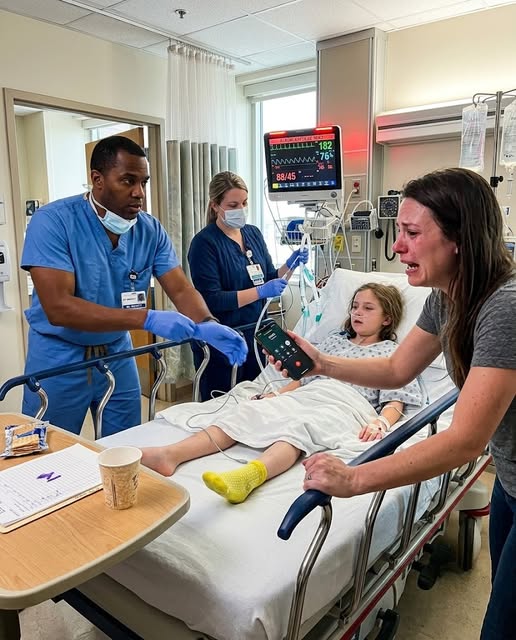
I said yes, and within forty seconds the written accusation was attached to Lily’s chart, Daniel’s blue badge was disabled, and the hospital’s medication safety supervisor had begun tracing every door he had opened that afternoon.
Her name was Marisol Grant.
She spoke quickly without sounding rushed, and while I filled in the electronic form, she read the access trail aloud so Dr. Bennett and the charge nurse could hear it.

Daniel had canceled Lily’s order at four eighteen.
At four twenty-three, he had opened a refrigerated dispensing cabinet on the pharmacy level and removed a three-dose package assigned to Lily Carter.
Two minutes later, he had used an employee override to transfer the package to Ambulatory Infusion Suite 3B under Vanessa Cole’s name.
There was no prescription for Vanessa.
There was no physician approval.
There was only Daniel’s badge number attached to every step.
Marisol activated the hospital’s patient-rescue protocol, ordered the infusion suite sealed, and sent a pharmacist to retrieve the package while Dr. Bennett requested a replacement dose from another hospital in the network.
Then Daniel called again.
“You need to withdraw whatever you just filed,” he said.
I kept the phone on speaker and pressed my thumb against the cold rail beside Lily’s bed because my hand had started shaking.
“I filed exactly what you did.”
“You don’t understand the consequences.”
Behind me, someone tore open a sterile wrapper, and the sharp smell of antiseptic spread through the room.
“I understand that Lily’s medication left this hospital under your credentials.”
Daniel lowered his voice.
“Emily, listen to me carefully. I can bring it back, but you have to stop this before compliance sees it.”
Marisol heard him.
So did Dr. Bennett.
I looked at Lily’s face beneath the oxygen tubing, checked the box confirming that I wanted the access logs preserved, and pressed Submit.
The first pharmacist reached Suite 3B eleven minutes later.
The cooler was there.
It was empty.
Inside it were two blue gel packs, a torn barcode label, and a folded paper towel with a coffee ring on one corner.
Daniel stopped answering his phone.
Marisol expanded the search to every cabinet, refrigerator, staff locker, and internal courier station his badge had accessed since noon.
While she worked, Dr. Bennett adjusted Lily’s medication and told me the network courier was nineteen minutes away if the roads stayed clear.
Lily’s pressure kept falling.
I rubbed the side of her thumb with one finger because it was the only part of her hand not covered by tape.
The yellow sock slipped again.
I pulled it back over her heel, although the movement did nothing for the alarms, the missing medication, or the number on the monitor that everyone kept watching.
At four fifty-one, Vanessa called me from the employee parking garage.
Her breathing sounded uneven, and a car horn blared somewhere behind her.
“Daniel said you reported me,” she said.
“I reported the person who canceled my daughter’s medication.”
“He told me Lily had been switched to something else.”
“You answered his office phone and told me not to call again.”
Vanessa went quiet.
A ventilation fan rattled above Lily’s doorway, stopped for a second, then started again.
“I didn’t know she was in the ICU,” Vanessa said.
I did not argue about what she knew.
I asked where the medication was.
She told me Daniel had brought the package to her shortly after lunch and had given her one injector in his office.
The other two, she said, were still inside a small refrigerator beneath his desk.
“Send that statement to medication safety,” I said.
“I can explain it to you.”
“Send it to them.”
Vanessa asked whether Daniel would lose his job.
Lily’s monitor sounded again before I answered.
“I am not managing his consequences for him.”
Marisol texted Vanessa a secure link while we were still connected, and I stayed silent until Vanessa confirmed that she had opened it.
Then I ended the call.
Daniel’s office was on the fifth floor of the education building, connected to the hospital by a glass walkway that required badge access after four.
His badge was already dead, but the access record showed that he had entered the building nine minutes before calling me.
He had never gone back through the walkway.
Marisol sent two hospital security officers and a pharmacy manager through the public entrance while the ICU team prepared Lily for another emergency procedure.
Dr. Bennett placed a consent form in front of me and explained that they could not keep waiting for the missing dose to solve everything.
The words blurred once.
I read them again.
Then I signed.
Before the team moved Lily, a unit clerk named Nina Walsh brought me a form to revoke Daniel’s family access to Lily’s patient portal.
Nina said the revocation would remove him from every part of the chart immediately.
She was wrong.
The form blocked his family login, but it did not touch the separate medical-management authorization I had signed three years earlier, when Lily first began treatment and Daniel offered to handle the insurance calls.
Daniel used that authorization at five twelve.
From a public computer in the education building, he submitted a request to transfer Lily to another hospital after stabilization and listed me as temporarily unable to make decisions.
The request did not move Lily.
It did, however, place a red dispute notice across her chart and force the ICU staff to pause every nonemergency order until the authorization conflict could be reviewed.
For seven minutes, Daniel regained control without entering the room.
I photographed the old authorization, signed the revocation in front of two hospital employees, and requested that every future medication change require confirmation from me and Lily’s attending physician.
Marisol attached Daniel’s transfer request to the safety case as possible retaliation.
The red notice disappeared.
At five twenty-six, security opened Daniel’s office.
The room was warmer than the ICU, and according to the pharmacy manager’s report, the refrigerator beneath his desk was humming beside a stack of training manuals and a plastic fork still coated with dried salad dressing.
Both unused injectors were inside.
One was sealed.
The other had been removed from its carton but still carried Lily’s pharmacy label.
A pharmacist carried the sealed dose directly to the ICU in a locked container while another verified its temperature history and packaging.
When the container reached Lily’s room, Dr. Bennett checked the label himself.
He said we should see her pressure begin to rise within twenty minutes.
It did not.
At six fourteen, Lily’s hand jerked once beneath mine, and the monitor numbers dropped again.
The staff moved fast.
I stepped back when they asked, answered every question they gave me, and forced myself to look away from the equipment long enough to unlock my phone.
Vanessa had submitted her statement.
She had also forwarded thirty-two messages from Daniel.
I did not open them yet.
Instead, I called medication safety and confirmed that the dose had reached Lily, then asked Marisol to preserve Vanessa’s messages without sending them to me until the doctors finished working.
Daniel arrived on the ICU floor at six thirty-seven through the public elevators.
His tie was loose, his shirt was damp beneath the collar, and he carried a white pharmacy bag as though arriving with something useful could erase the audit trail behind him.
A security officer stopped him outside the unit doors.
Daniel could see me through the glass.
He lifted his phone.
I let it ring.
On the fourth call, Dr. Bennett asked whether I wanted the device silenced because the vibration kept moving it across the metal counter.
I turned it face down.
Daniel began speaking to the security officer with both palms open, using the calm voice he used when insurance representatives denied Lily’s claims.
He said there had been a misunderstanding.
He said Vanessa was also a patient in need.
He said I had become emotionally unstable after forty-eight hours without sleep.
Then he asked to enter as Lily’s father.
I requested a temporary visitor restriction based on the active medication diversion investigation and his attempt to alter her transfer status.
The hospital approved it for the night.
Daniel remained behind the glass for another minute, staring at me as if I had taken something that belonged to him.
Then security escorted him to a conference room away from the ICU.
Just after seven, Lily’s pressure finally rose by two points.
Then four.
Her fingers warmed slightly beneath mine, and the nurse reduced one of the medications supporting her circulation.
Nobody celebrated.
Dr. Bennett only nodded and told me they needed another hour before calling the change stable.
I opened the cafeteria crackers.
One broke inside the wrapper and scattered crumbs across my lap.
I ate the smaller half and left the other beside the paper cup.
Then I read Vanessa’s messages.
Six days before Lily collapsed, Daniel had written that her refill was available but should be held because Vanessa’s insurance review might take another week.
Vanessa had asked whether Lily would miss a dose.
Daniel replied that children recovered quickly and that the hospital always kept reserves.
Three days later, he used his badge to cancel Lily’s scheduled delivery.
The audit showed another cancellation two weeks before that.
That earlier delay had been blamed on the manufacturer.
Daniel had approved the explanation himself.
I scrolled back to the photograph of the refrigerator schedule I had given Dr. Bennett.
Two dates were marked with Daniel’s handwriting beside the words insurance delay.
They were the same dates in the access report.
The missing ICU dose was not the beginning.
Daniel had been creating gaps in Lily’s treatment for weeks.
I set the phone on the chair and pushed it far enough away that I could not reach it without standing.
Across the room, Lily’s yellow sock had slipped to the middle of her foot again.
I fixed it.
At eight forty-three, Marisol came to the ICU with a printed preliminary report.
She did not tell me what Daniel had said in the conference room, but she showed me the parts that affected Lily.
He had claimed the first cancellation was an insurance adjustment, the second was a supply correction, and the ICU transfer was an emergency compassionate-use decision for Vanessa.
None of those explanations matched the system records.
The insurer had approved Lily’s medication.
The pharmacy had stock.
Vanessa had no active order.
Daniel had used Lily’s patient assignment because it allowed him to remove the medicine without generating a personal charge for Vanessa.
Marisol asked whether I recognized a phone number listed beside the transfer request.
It was Daniel’s private number.
He had entered it where the receiving physician’s number should have been.
The hospital suspended him that night, removed his access to every clinical system, and placed the remaining medication records under independent review.
Vanessa was put on administrative leave after admitting she had accepted a dose bearing Lily’s name, although she continued cooperating and turned over the injector packaging from Daniel’s office.
By one thirty-seven in the morning, Lily’s pressure had held steady for more than an hour.
Dr. Bennett reduced another support medication and told me the immediate crisis had passed.
Daniel was gone.
The missing dose had been found.
Lily was alive.
For twenty minutes, I believed that was the end of it.
Shortly before sunrise, the discharge pharmacy called the ICU to verify who controlled Lily’s future deliveries.
Their records still named Daniel as the sole pickup contact, insurance representative, and medication coordinator.
Even with his employee access disabled, he could still delay shipments through the family authorization system unless I replaced every instruction he had created.
I asked for the complete account history.
There were fourteen pages.
While Lily slept, I revoked Daniel’s authorization with the insurer, removed his phone number from the specialty pharmacy, changed every account password, and moved Lily’s future deliveries to a pharmacy outside his hospital network.
I also requested paper confirmation for each change.
The printer near the nurses’ station jammed twice and produced one warm page with a black streak through the margin.
I kept it anyway.
Over the next three days, Lily improved slowly.
She woke for several minutes at a time, complained that the oxygen tubing smelled strange, and asked why her left sock would not stay on.
I told her the truth in pieces small enough for an eight-year-old.
Her medication had been taken.
The hospital had found it.
Her father would not be managing her medicine anymore.
Lily stared at the blanket for a long time.
Then she asked whether she had done something wrong.
“No,” I said.
She asked whether Daniel knew the medicine was hers.
“Yes.”
She did not ask anything else that day.
The hospital’s formal review took twelve days.
I attended by video from a quiet family room near the ICU because Lily was still too weak to leave the floor.
Daniel appeared from another room with an attorney beside him, but the panel limited the hearing to hospital access, medication handling, and patient safety.
He called the transfer a judgment error.
He said he had believed Vanessa’s need was urgent.
He said Lily’s ICU team had resources Vanessa did not have.
Marisol displayed the access timeline without commentary.
Four eighteen: Lily’s order canceled.
Four twenty-three: medication removed.
Four twenty-five: Vanessa’s name entered without an order.
Five twelve: transfer request filed after Daniel learned he had been reported.
Then she added the two earlier cancellations.
Daniel leaned toward his screen and asked for a private break.
The panel continued.
Vanessa’s messages showed that he knew Lily would miss treatment, knew the hospital reserves were not guaranteed, and planned to describe any delay as an insurance problem.
The temperature logs showed he had stored patient medication in an unauthorized office refrigerator.
The chart history showed he had used a family authorization to interfere with Lily’s care after his clinical access was frozen.
When the panel chair asked why he had canceled Lily’s medication before Vanessa had any approved prescription, Daniel did not answer the question.
He talked about pressure.
He talked about compassion.
He talked about protecting two people.
The panel ended the hearing after twenty-eight minutes.
That afternoon, the hospital terminated Daniel’s employment for deliberate medication diversion, falsification of internal records, misuse of patient information, and retaliation during an active safety event.
His conduct was also submitted through the hospital’s mandatory professional-reporting process, leaving his pharmacy license subject to a separate review that had not yet concluded.
No one promised me an arrest, a lawsuit victory, or a punishment large enough to match the sight of Lily fighting for breath.
What the hospital could prove, it documented.
What it controlled, it removed from him.
Nine days later, Lily left the ICU.
She still needed treatment, physical therapy, and close monitoring, but she walked twelve steps to the pediatric floor with a nurse holding one elbow and me carrying the portable monitor behind her.
At home, I removed Daniel’s schedule from the refrigerator and replaced it with one Lily and I made together.
She wrote the dates in purple marker.
I handled every refill myself, checked every confirmation, and kept the printed records in a plain kitchen folder beside the cereal boxes.
Daniel sent one final message asking me to describe the diversion as a family misunderstanding so the licensing review would be easier.
I forwarded it to the hospital and did not reply.
When Lily eventually asked whether he would come home, I told her he would not be living with us and that adults could love someone while still making choices that were unsafe.
She pressed her lips together, climbed onto the couch, and rested her recovering leg across my lap.
Months later, during the last internal evidence review I attended, Daniel’s employee card was placed on the table beside the printed access logs and Lily’s canceled orders.
The photograph still showed him smiling in his white coat, with the hospital logo above his name and the blue plastic polished around the edges from years of use.
The blue badge remained sealed inside the evidence sleeve.
