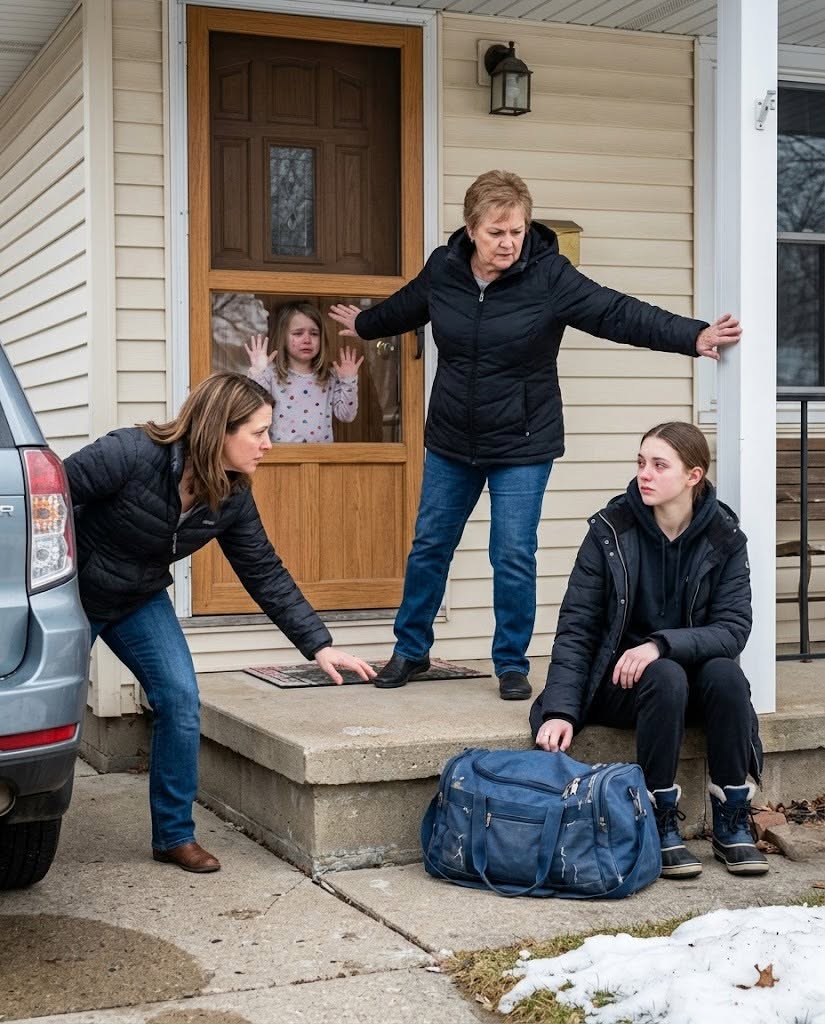
I opened the other rear door too.
“Sadie is coming home with us,” I said.
My mother’s arms dropped from their tight fold across her chest. “That is not what we agreed to.”

“We never agreed to separate them.”
“She needs one peaceful night,” Mom insisted, glancing toward the screen door. “Nora has done enough damage.”
Inside the house, Sadie struck the doorframe four times with her palm.
Nora answered against the side of her blue duffel bag.
I walked past my mother, opened the screen door, and held out my hand to Sadie.
She ran around me instead.
Sadie hit Nora with enough force to push them both against the porch railing, then wrapped her arms around her sister’s waist and refused to let go.
Nora’s face stayed blank for several seconds.
Then she lowered her chin onto Sadie’s hair.
My mother reached for the younger girl. “Sweetheart, you can stay here. You don’t have to leave just because she—”
“Don’t touch her,” Nora said.
Her voice was quiet, but her entire body had shifted between Sadie and my mother.
Mom looked at me as though Nora had just proven every accusation she had made.
“See?” she said. “Threatening. Controlling. This is exactly what I reported.”
My father appeared behind the screen door with one hand resting against the frame.
He looked tired, not injured, and he would not meet my eyes.
“Dad,” I said, “did Nora hit you?”
Mom answered for him. “We are not doing this on the porch.”
“I asked him.”
My father looked at Nora, then at the damaged tripod lying beside a small table in the entryway.
One of its legs had folded inward.
Before he could speak, my mother stepped in front of him.
“He has already given his statement.”
That was when I understood that nothing honest was going to happen inside that house.
I loaded both girls into the car, placed Nora’s duffel behind the passenger seat, and shut the doors before my mother could reach for either handle.
She followed me down the driveway.
“You are risking Sadie’s future for a girl who does not even want you,” she said.
Nora heard every word through the closed window.
I saw it in the way her thumb returned to the frayed seam of the bag.
I stepped close enough that my mother had to lower her voice.
“You filed an emergency report asking for one of my daughters to be removed while demanding that the other stay with you,” I said. “You will not be alone with either of them again.”
My mother’s expression hardened.
“You will regret choosing this fight.”
“I didn’t choose it.”
I got behind the wheel and drove away.
For the first ten minutes, Sadie cried so hard she hiccupped between breaths.
Nora tapped four beats against the window, waited, and tapped them again.
Sadie eventually matched the rhythm with her fingers against the seat belt buckle.
When we reached home, Nora did not take her bag upstairs.
She placed it beside the front door.
I carried it to the bottom of the staircase.
“You can unpack whenever you’re ready,” I told her.
“I’m not staying.”
“Yes, you are.”
“You don’t know that.”
She looked toward Sadie, who was sitting on the living room rug with her knees pulled against her chest.
“If they make you choose, pick her,” Nora said. “She still has a chance to be normal.”
I wanted to tell her there was nothing wrong with her, but that would have been another adult denying what she knew about herself.
Nora knew she had nightmares.
She knew she checked every lock twice and hid granola bars in her dresser.
She knew sudden footsteps in a hallway could make her freeze before she remembered where she was.
Pretending those things did not exist would not make her feel loved.
So I gave her a truth I could keep.
“If anyone asks me to choose between you,” I said, “my answer is no.”
The caseworker arrived before dinner.
She carried a laptop bag and the careful expression of someone who knew that every word she heard might matter in a courtroom the next morning.
She spoke with Sadie first while Nora and I waited in the kitchen.
Nora sat at the table with her hands hidden inside her hoodie sleeves.
“What happens if she believes Grandma?” she asked.
“We tell the truth anyway.”
“That doesn’t always work.”
“No,” I admitted. “But this time you won’t be telling it alone.”
When the caseworker brought Nora into the living room, she did not ask whether Nora was a good kid or a bad kid.
She asked what happened in order.
Nora stared at the carpet for a long time before answering.
Dinner had started normally.
My sister had positioned the tripod near the dining room doorway because she wanted pictures of Sadie opening another gift.
Nora had been told to move her chair out of the frame.
When Sadie refused to pose without her sister, my mother became irritated.
“She said I was making everything difficult,” Nora explained. “Then she told Laura’s sister that Sadie would settle down once I stopped hovering.”
The caseworker asked what happened next.
Nora pulled her hands farther into her sleeves.
“Grandma said, ‘Keep the sweet one. Send the older girl back.’”
She had not said it as a joke.
She had said it across the dinner table while Sadie was still sitting there.
Sadie started crying and asked where Nora would go.
My mother told her that grown-ups sometimes had to make hard choices for children’s own good.
Nora went upstairs, packed the blue duffel, and decided to leave before anyone could use her as a reason to send Sadie away too.
My father blocked the front doorway.
He told Nora she could not walk outside alone after dark.
When he reached for the duffel, Nora pulled it back.
He stepped sideways, bumped the tripod, and caught himself against the wall while the tripod fell.
Nora had not struck him.
She had not shattered the tripod either.
One leg had bent when it hit the hardwood floor.
“What did your grandmother do?” the caseworker asked.
“She told Grandpa not to move anything,” Nora said. “Then she said this was finally enough.”
The phrase made the caseworker stop typing.
“Finally enough for what?”
Nora shrugged, but Sadie answered from the hallway.
“For Grandma to keep me.”
The caseworker closed her laptop halfway and asked Sadie to sit beside me.
Sadie said my mother had already shown her the guest room before dinner.
New pajamas were folded on the bed.
Her name had been placed on a little sign beside the lamp.
There was nothing for Nora in the room they had been told to share.
The caseworker looked at the blue duffel by the stairs.
Then she told me something she had not been permitted to discuss during the phone call.
The week before the overnight visit, my mother had asked whether siblings could ever be placed separately if one child was “preventing the other from bonding.”
The caseworker had told her that the girls’ relationship was considered protective and that any attempt to separate them would require serious cause.
My mother had asked what qualified as serious cause.
The caseworker had documented the conversation.
“This was not a reaction to the tripod,” I said.
The caseworker did not answer directly.
Instead, she reopened her laptop and said, “The court will have the timeline in the morning.”
After she left, Nora stood near the stairs and stared at the duffel.
“You can still tell them you didn’t know,” she said to me.
“Didn’t know what?”
“How bad I was.”
Sadie walked over and pressed her cheek against Nora’s arm.
I picked up the bag and carried it upstairs.
“I knew you were hurt,” I said. “That is not the same thing as being bad.”
The next morning, Nora wore the same hoodie.
Sadie insisted on wearing the coat Nora had zipped for her because she said it felt lucky.
My parents sat on the opposite side of the hearing room with my sister beside them.
My mother wore the small, satisfied smile she used whenever she believed everyone else was about to confirm that she had been right all along.
My sister leaned close and whispered something that made the smile widen.
My father sat at the end of the row with his hands clasped between his knees.
He looked at the floor.
The judge entered carrying a stack of documents secured with a black binder clip.
My mother straightened in her chair.
The judge sat down, opened the top document, and read the first line aloud.
“The request to remove Nora from the home was opened and partially completed before the event described as the emergency.”
My mother’s smile stopped.
So did my sister’s.
The judge continued.
The report had not merely been submitted after the tripod fell.
My mother had begun entering information earlier that day, identifying Nora as the child she wanted removed and Sadie as the child she was willing to keep.
The unfinished draft had remained in the system until she completed it after dinner.
The caseworker’s notes from the earlier phone conversation were attached behind it.
So was the placement plan explaining why separating the sisters could cause serious harm to both girls.
My mother’s attorney tried to argue that preparing for a possible emergency did not mean she had manufactured one.
The judge agreed that a draft alone did not settle what happened.
Then she turned to my father.
“Were you struck by Nora?”
My father looked at my mother.
She gave him the smallest shake of her head.
It was the kind of signal most people in the room might have missed.
I did not miss it because I had spent my childhood watching for it.
Neither did Nora.
My father’s shoulders dropped.
“No,” he said.
My mother whispered his name.
He kept looking at the judge.
“I blocked the doorway because she was trying to leave,” he continued. “I grabbed for the bag. She pulled it away. I backed into the tripod.”
The judge asked why he had allowed the report to say otherwise.
My father swallowed.
“Judith told me the agency would never let us protect Sadie unless there was an incident.”
My mother stood so quickly that her chair scraped backward.
“She is destroying that little girl,” she said, pointing at Nora. “Everyone is too afraid to say it because she has had a difficult life. Sadie could be happy if Nora would let her.”
Nora’s face went still.
I had seen that stillness before.
It was not calm.
It was the moment she began removing herself from the room before anyone else could do it for her.
She rose from her chair.
“You can send me somewhere else,” she told the judge. “Sadie can stay with Laura.”
Sadie grabbed the back of Nora’s hoodie.
“No.”
Nora did not turn around.
“She’ll be okay if she stays here,” she said. “I can go by myself.”
The judge looked at me.
“Laura, do you believe you can continue caring for both children while this matter is reviewed?”
Every person in the room understood what the question could cost.
Saying yes meant accepting more visits, more scrutiny, and more chances for my mother to argue that I had ignored a warning.
It meant losing the relatives who had promised to provide respite.
It meant telling the court that I would rather have my own judgment examined than make Nora prove she deserved to stay.
“Yes,” I said. “And I will not agree to a plan that keeps Sadie by treating Nora as disposable.”
My mother gave a bitter laugh.
“You barely know her.”
“I know what she packed when she thought her sister was in danger.”
I looked at the blue duffel beside Nora’s chair.
“She packed her own things and left every gift you gave Sadie behind.”
The judge asked Nora to sit down.
Then she addressed my mother.
The emergency request to remove Nora was denied.
Both girls would return home with me.
My parents would have no unsupervised contact while the caseworker completed the review, and any future visits would require my agreement as well as the girls’ willingness to participate.
The judge did not declare my mother evil.
She did not make a speech about what a family should be.
She simply stated that a child’s trauma could not be used as a convenient explanation for an adult’s preplanned decision.
My mother tried one final time.
“What about Sadie’s right to have a normal childhood?”
The judge looked toward the sisters.
Sadie had moved her chair against Nora’s and was holding the cuff of her sleeve.
“Her relationship with her sister is part of her childhood,” the judge said. “You do not improve her life by teaching her that love depends on abandoning someone who is harder to photograph.”
My sister looked down at her phone.
For the first time since the hearing began, she had nothing to post.
Outside the courtroom, my father caught up with us near the elevator.
“Nora,” he said.
She stopped, but she did not face him.
“I should have told the truth yesterday.”
“Yes,” Nora replied.
He waited for forgiveness she was not ready to give.
When it did not come, he nodded once.
“I’m sorry.”
Nora pressed the elevator button.
The doors opened, and she walked inside with Sadie.
My father remained in the hallway.
My mother did not come after us.
In the parking lot, Nora placed the duffel in the trunk instead of keeping it on her lap.
That was the first sign that she believed we might be driving home rather than toward another goodbye.
The review lasted several weeks.
The caseworker visited our house, spoke with the girls separately, checked their rooms, and asked what happened when we disagreed.
Nora told her the truth.
Sometimes she slammed doors.
Sometimes she refused dinner and later ate cereal at midnight.
Sometimes she accused me of planning to leave because I came home twenty minutes late.
She also helped Sadie with spelling words, remembered every appointment, and stood in the kitchen each morning until she heard me say exactly when I would be back.
The caseworker did not need Nora to be easy.
She needed our home to be safe, predictable, and honest.
My mother sent messages insisting she had acted out of concern.
She said she had only wanted to give Sadie a chance to thrive.
I responded once.
I told her concern did not begin with deciding which child was worth keeping.
After that, I stopped answering.
My sister removed the photographs of Sadie from her page when I told her she no longer had permission to post them.
She complained that I was punishing the entire family over one misunderstanding.
Nora heard me say, “It was not a misunderstanding. You moved her chair out of the picture.”
My sister did not call again.
My father requested a supervised visit.
I asked both girls before agreeing.
Sadie wanted to see him.
Nora said she would go if she could leave whenever she chose.
At the visit, my father brought no gift bags and asked for no photographs.
He sat across from Nora at a plain table and admitted that he had noticed the unequal treatment from the beginning.
He had looked away because confronting my mother would have made his own life harder.
“I told myself I was keeping the peace,” he said.
Nora rubbed the seam of her sleeve.
“You were keeping your peace.”
He nodded.
It was not forgiveness, but it was the first conversation between them that did not require Nora to pretend she had imagined what happened.
My mother refused supervised visits because she said the rules were insulting.
Sadie cried when I told her.
Nora tapped four beats against the kitchen table until Sadie could breathe evenly again.
Then Sadie asked, “Is Grandma mad at me?”
“No,” I said. “She is angry that she cannot make the rules.”
“Will she come back?”
“I don’t know.”
Nora looked at me carefully.
“You’re allowed to say that?”
“I’m allowed to tell you the truth.”
The emergency matter was eventually closed without either girl being removed from my home.
The report remained part of the record, but so did the corrected timeline, my father’s statement, the caseworker’s observations, and the judge’s decision to keep the sisters together.
Nothing about the process felt like a victory parade.
There were still nightmares, missed sleep, paperwork, and mornings when Nora stood at the front door asking whether I was sure she was coming back after school.
Trust did not arrive because a judge ordered it.
It grew through ordinary repetitions.
I came home when I said I would.
I knocked before entering her room.
When I was late, I called.
When I made a promise, I wrote it on the refrigerator calendar where she could see it.
One evening, several months after the hearing, I found the blue duffel in the upstairs hallway.
My stomach tightened before I could stop it.
The zipper was open.
Inside were two library books, a sweatshirt, a bag of pretzels, and Sadie’s stuffed rabbit.
Nora came out of her room and saw me looking at it.
“Sadie wants to sleep in my room,” she explained. “She says it counts as a trip if she packs.”
Sadie appeared behind her carrying a pillow almost as wide as her body.
“Are we allowed?” she asked.
Nora waited for my answer with one hand resting on the bag that had once held everything she owned when she thought she had to disappear.
“Yes,” I said. “But both of you still have school tomorrow.”
Sadie cheered and dragged the duffel into Nora’s room.
Nora started to follow, then paused beside me.
“You really meant it?” she asked.
“What?”
“Both of us.”
I looked through the doorway at Sadie unpacking the rabbit as though she had crossed the country instead of the hallway.
“Both of you,” I said.
Nora nodded and went into her room.
A moment later, four steady taps sounded against the wall.
Sadie answered from the other side of the blanket fort, and the blue duffel stayed open on the floor—packed for one night, in a home neither sister had to earn.
